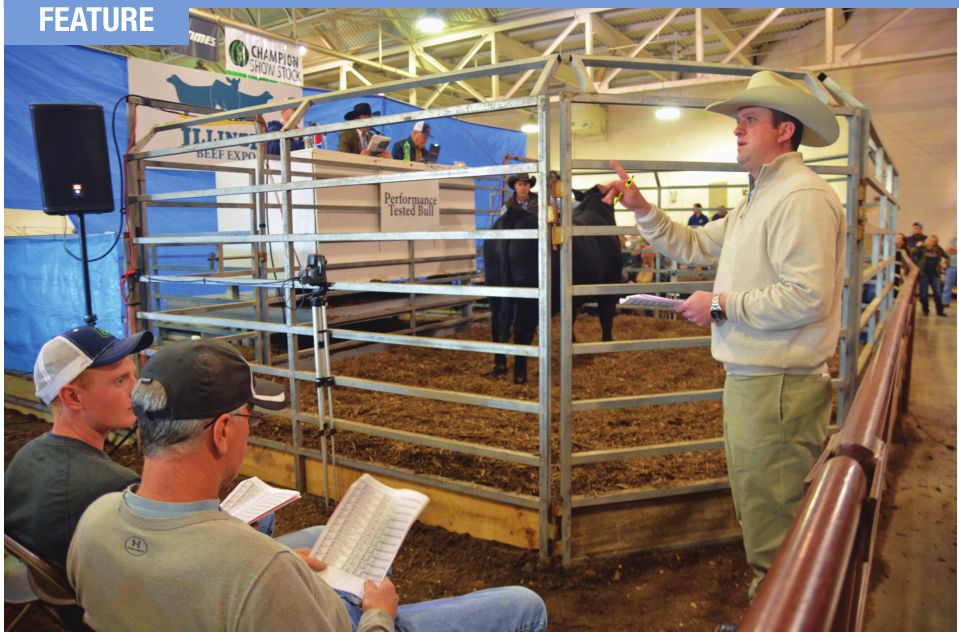
At Illinois Beef Expo, DNA testing lets bull buyers ‘look under the hood’
The Annual Illinois Performance Tested Bull Sale on Feb. 23 during the 29 th Illinois Beef Expo was pretty predictable. And the genetic testing that made that predictability possible was good news for those buying or selling animals during the event. The Illinois Beef Expo took place Feb. 24-28 at the Illinois State Fairgrounds.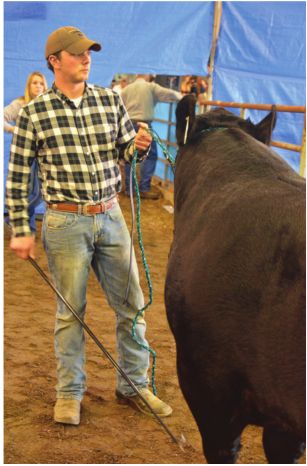
“This absolutely helps the buyer,” said prospective buyer Bill Bree of Lincoln. “A lot of these guys are real good studyers of this data, so this is what makes the difference in these topend bulls we are seeing.”
The DNA testing performed on the bulls that were being sold can predict with a high degree of accuracy the weaning weight of calves sired by each bull, the calves’ growth rate, the marbling of their meat, their temperament and, if they are female, what kind of mothers they will eventually be. The tests create what is called an expected progeny difference, or EPD, that is crucial to determining how much money a bull can fetch in the auction ring.
These test-determined characteristics were promoted by the bull sale auctioneers along with matter-of-fact commentary on each bull’s visible attributes, including the dimensions of his progeny producing equipment.
“If they do a little better with the EPDs, they are going to sell better,” Bree said. “Right now with about $3,000 being average, I would say that they are having a pretty good sale for the bulls that were brought.”
Barney Gehl is with Zoetis, a worldwide animal health company that performed much of the genetic testing on the bulls in the Feb. 23 sale.
“Based on the DNA that we sample, we can find out what genetics that bull got when he was conceived to give us a lot better handle on what’s under the hood, so to speak,” Gehl said. “So instead of waiting for a couple of years of data to figure out exactly what genetics that bull received from his parents, we have a better handle on what he is actually made up of and what he can transfer on to his progeny.”
“For future calves sired by each bull, we can determine anywhere from growth traits to carcass traits to docility,” Gehl said. “In some of the purebred cattle that we test we can look at 15 to 19 different traits. So we are actually adding more accuracy to that bull’s pedigree numbers.”
“I would say it’s our version of precision beef,” Gehl said. “We talk about precision planting, precision nutrient application, this is an area where we can really get more precise and gain more information on cattle sooner.”
Illinois Agriculture Director Raymond Poe, who attended the Beef Expo, continues to be amazed at the advances the industry is making.
“I can’t believe the changes that I’ve seen in my lifetime, everything has so much more precision,” Poe said. “They are always developing new ways to make those cows grow a little faster.”
Bull sellers like Andrea Hosto of Alhambra, Illinois, appreciate what the genetic testing has done for the industry.
“The
cattle prices where they are, people need something that can perform
efficiently on feed so they can get a better bang for their buck,” Hosto
said. “You get more efficient calves so you don’t have to put quite as
much feed into them. You can do better at the top end of the sale.”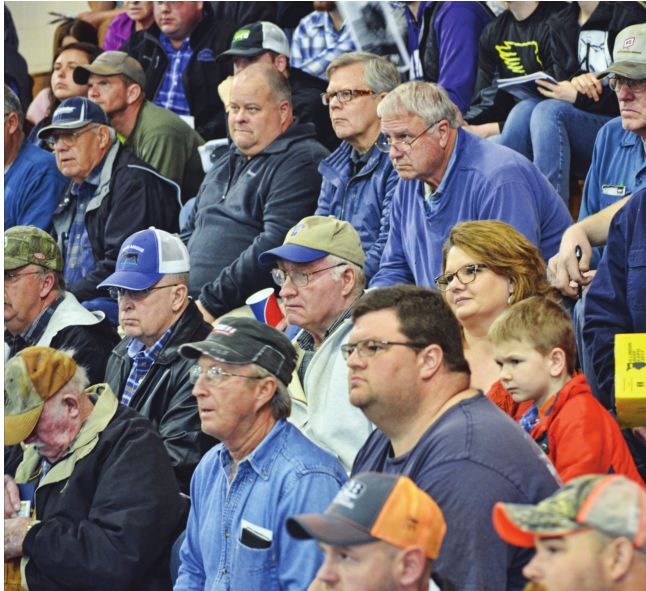
Fourth-generation
Altamont, Illinois, farmer Tyler Alwardt, another bull seller at the
Beef Expo, agreed the genetic data makes a difference.
“I
think the genomic tests make the EPDs more accurate to help you pick
out a bull,” Alwardt said. “The last few years we’ve had a lot of
success in the industry.”
“Whether
the price has been low or high there’s a lot of optimism on building a
cow herd in the state of Illinois,” Alwardt said.
That
optimism is music to the ears of the Springfield-based Illinois Beef
Association, the hosts of the Beef Expo, and their executive vice
president, Reid Blossom.
“Illinois’
livestock industry is growing,” Blossom said. “Some of the price
pressure that we faced on the farm has been caused by increasing
supplies of cattle and beef, but what has not changed has been strong
consumer demand for our product. That has held true here in the states
and internationally as well.”
Blossom
said recent USDA statistics show a three percent growth in the
population of the state’s cattle herd, led by an eight percent increase
in cattle feedlot numbers.
“That’s
amazing because 2016 from a price standpoint was one of the most
volatile ever in the history of the beef cattle business,” Blossom said.
“I think it’s a big indicator of the strength of our industry and the
interest and optimism of cattle producers in Illinois.”
Blossom
said a major challenge facing the industry will be convincing the Trump
administration to expand overseas markets for U.S. livestock, something
that was a priority of the Obama administration.
Meanwhile, back in Springfield, Blossom is proud to showcase the state’s cattle industry each year at the Illinois Beef Expo.
“The
last two North American champion Angus bulls not only were from
Illinois, but they sold here at the Illinois Beef Expo,” Blossom said.
“It’s a really high quality offering all weekend and we’re really proud
of it.”
David
Blanchette is a freelance writer and photographer from Jacksonville. He
was part of the group that planned and opened the Abraham Lincoln
Presidential Library and Museum and served as a media spokesman for the
Illinois Historic Preservation Agency, Capital Development Board and the
governor’s office. Prior to his state service, David had a career as an
award-winning broadcaster. He is also the coowner of Studio 131
Photography in Springfield.


