Students feared him, reports say
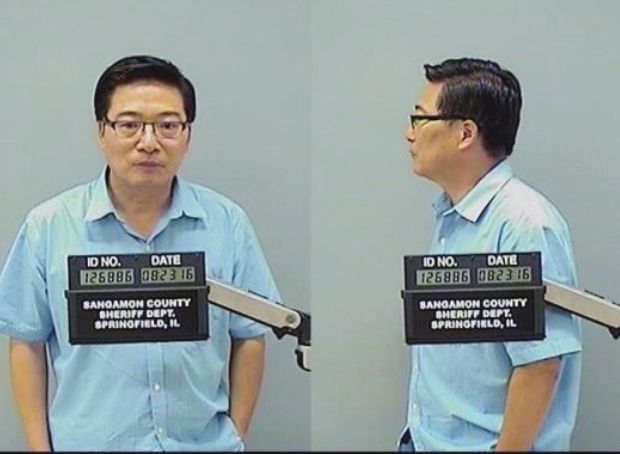
Accused rapist Xuesong “Gary” Yang reportedly had extraordinary power over Chinese students who came to University of Illinois Springfield to learn English.
Students feared Yang, according to a Springfield police report written after a 17-yearold student accused him of rape. Yang, who has been charged with two counts of sexual assault (“Springfield businessman charged with raping UIS student,” Jan. 20, illinoistime.com), threatened students, saying that he had the power to change grades and send them back to China, according to police reports.
The alleged victim and at least two other students from China told Springfield police that Yang, a UIS employee paid to recruit students from China, threatened students during meetings and other occasions. Consider a game of pickup basketball last summer on campus.
When Yang, 54, spotted the alleged rape victim shooting hoops on campus with another Chinese student who wore no shirt, he told the two that they should not play basketball. The two returned to their dorms, and the shirtless student got a phone call from his mother, who yelled at him for playing basketball with no shirt on, the alleged victim told police. She told an officer she thought Yang was sending her a veiled warning by stopping the game.
Yang, the alleged victim said, was arrogant.
When she told him not to contact the mother of the shirtless basketball player and offered to take him to dinner, he became angry, according to a police report.
“(H)e told her that no Chinese in the United States is worthy of taking him to dinner,” an officer reported.
The alleged victim said that Yang subsequently told her that a classmate would be sent back to China because he had “made some mistakes,” according to a police report. The alleged victim told an officer that she asked another classmate if he’d told Yang anything about the classmate who was being sent home. The classmate reported the conversation to Yang, who became angry and summoned all students from the alleged victim’s hometown into his campus office, the alleged victim told police.
“(He) told them he had the power to send all of them back to China,” a Springfield police officer wrote in his report. “He said he had the power to change their grades and would have them expelled from school.”
Yang, the alleged victim told police, once sent her a text at 3 a.m. that she believed was intended for another student. The report doesn’t state the contents of the message.
On another occasion, after Yang had raped her the day after her arrival in the United States, he asked the alleged victim if she wanted to go to his office for some snacks, according to a police report. She declined. Later that day, he sent her a text asking her to go to dinner with him. She told an officer that she accompanied Yang to Tai Pan, a Chinese restaurant on Adlai Stevenson Drive. He wanted the food to go. She said she wanted to eat in the restaurant, but he refused, according to a police report.
“She said he took this as a rejection and he was very upset,” an officer wrote in his police report. “Yang picked up the food and sent it with her but took her back to the dorm. She said Yang was very angry.”
The alleged victim told police that after Yang first attacked her, he again raped her a week later. The day after the second rape, she told police that Yang sent her a text message, asking if she wanted to go to the Abraham Lincoln Presidential Library and Museum. She told police that she didn’t reply. Later that day, she told a friend what had happened. Police were informed, and the criminal investigation began.
The alleged victim and two other foreign students told police that Yang has sexually assaulted other students. Under the university’s sexual misconduct policy, UIS can conduct its own investigation separately from a criminal probe. Asked whether UIS conducted its own investigation, UIS spokesman Derek Schnapp responded via email.
“An informational meeting was held for international students following the alleged incident,” Schnapp wrote. “They were given the opportunity to ask questions or follow up privately with university professionals about any related concerns they may have had. They were also reminded of the resources and offices that could provide assistance.”
The UIS sexual misconduct policy also says that students should undergo annual training on sexual discrimination and sexual violence. The training is supposed to include procedures for reporting sexual misconduct, either to university administrators or the police.
Schnapp in his email wrote that the university provides all students, including those enrolled to learn English, with the address of the website that includes information on sexual misconduct and how to report it. While the website is in English, Schnapp said that there are ways for students who don’t speak English to understand it.
“Language translation tools are readily available and widely used by our international students,” Schnapp wrote. “The IEP (Intensive English Program that teaches English to foreign students) office serves as a resource for those students with any language related questions.”
This is not the first time that a UIS employee has been accused of sexual improprieties involving students. In 2009, Roy Gilmore, a women’s softball coach, resigned after being accused of sexual impropriety involving a student athlete who received a $200,000 settlement after her lawyer wrote a letter to university administrators accusing Gilmore of assaulting his client. Police were not called.
Colby Bruno, senior legal counsel for the Victim Rights Law Center in Boston, an advocacy group for sexual assault victims, said that universities under Title IX, a federal anti-discrimination statute, must conduct investigations into allegations of sexual assault even if there is also a police investigation. That includes determining how many victims there might be.
“That’s just the starting point,” Bruno said.
“If you don’t (conduct an investigation), you are violating Title IX. … Just because someone has reported something through a criminal investigation doesn’t mean the school’s Title IX obligations have been fulfilled.”
Schnapp via email said that UIS “followed the Title IX process.”
Yang is no longer employed by UIS, and, under terms of his bond, cannot contact anyone affiliated with the university. That doesn’t matter, Bruno said, in terms of the university’s obligation to conduct an investigation to determine whether other students have been assaulted and what can be done to ensure assaults don’t happen in the future. Otherwise, Bruno said, there can be no assurance that a hostile environment that allowed sexual assaults to occur doesn’t still exist.
“The school must investigate, because what Title IX says is, even one rape constitutes a hostile environment,” Bruno said. “What the school might say, and it’s really not a defensible position, ‘This guy’s gone, he’s off campus, we don’t have to worry about him anymore, this is moot.’ But it’s not. The question remains: What have they done for the victims? … It’s a moral and ethical obligation to ensure that students are safe. There’s still a culture, probably, of frightened students, students who think they have to do these things in order to come here.”
Yang recruited students to come from China to UIS, and significant money was at stake. After becoming proficient in English in classes at the university’s Intensive English Program, foreign students can enroll as regular undergraduates. As out-of-state students, they are charged $18,930 per year for tuition, as opposed to $9,405 for Illinois residents, according to the university’s website.
In 2014, the State Journal-Register reported that foreign students comprised 15 percent of the UIS student body. In the 2014 story, UIS Chancellor Susan Koch told the paper that the university has been trying to boost enrollment of foreign students, which helps the school’s budget because they pay out-of-state tuition. She also said the students help the overall economy.
“They spend money in the local economy and don’t go home on breaks,” Koch told the paper. “Some even buy cars.”
Contact Bruce Rushton at [email protected].