Illinois Education Association president brings back ideas to improve education here
When I was offered the
opportunity to participate in an education study tour of the Finland
school system, sponsored by the National Education Association
Foundation, I welcomed the opportunity to see what is known as the No. 1
education system in the world. I had never put Finland on my bucket
list, but now, I suggest everyone should.
I
discovered a beautiful country and a school system that offers some
ingredients we should consider. I came home, though, proud of our public
schools and what happens every day to support students.
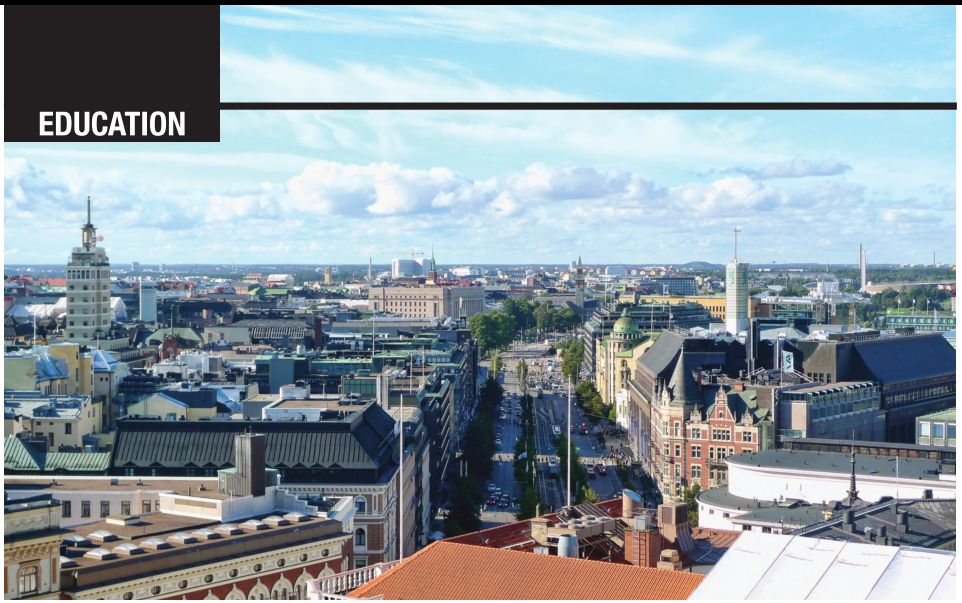
Helsinki,
the capital, sits at the southern tip of Finland, surrounded by the
sparkling blue Baltic Sea. Near one of its many harbors, vendors set up
under orange or white tents to sell their goods: Baltic-amber jewelry,
silver jewelry, woolen goods, leather items, etc. Food vendors offer up
such items as grilled salmon, reindeer hotdogs, sugary pastries and
lingonberry or cloudberry jam.
The
city is very easy to walk – from the city center with its series of
indoor shopping centers and Eero Saarinen-designed train station to the
esplanade – a parklike setting bordered by two large streets and lined
with shops and restaurants. It’s called the Champs Elysees of Helsinki.
Culture
To understand the schools, it is helpful to understand the culture. One
is struck by how quiet the Finnish are – restaurants and stores just
aren’t as noisy as ours. Even the airport was eerily quiet in the middle
of a Saturday afternoon when we landed.
Trust is embedded in the Finnish culture.
As one speaker at the
Ministry of Education explained, “We trust – we trust our police, we
trust our teachers, we trust our politicians. That’s just part of what
we believe.”
Equity
drives their belief system, too – equity of resources and funding to
schools, equally staffed schools and language immersion for all
immigrants needing to learn Finnish, one of the most difficult languages
in the world. No matter one’s socioeconomic status, resources are
equitable, including free health care and free public schools. There is
no tuition for higher education – even for college students from foreign
countries.
Even
though health care and education are free, Finland is not a socialist
country, but rather a democracy run by a president, prime minister and a
parliament. There are as many as nine political parties.
School system
Today, Finland’s school system has earned
the
distinction of being #1 in the world, determined by the PISA test
(Programme for International Student Assessment), a test given randomly
every three years to 15-yearolds. But Finland was not always first, and
in the 1970s leaders recognized that their school system needed to be
much better. Stakeholders – including politicians, union leaders,
teachers, university faculty and others – began deep conversation. This
is the first lesson we should learn from Finland – bring experts and
practitioners and representatives of all stakeholders together, and then
engage in meaningful conversation about education. Finland’s group dug
deeply into several key questions: What is the value of education?
Why is education important for our future as a nation? What is the main objective of our schools? What should be taught?
They even say that they looked at the research that we in the U.S. have done and then put those recommendations in place.
They
designed a comprehensive system with each component working in tandem
to create the overall system. The second lesson they teach us: don’t
focus on just one item and expect that to make the difference; it is the
combination of many items working together that creates an excellent
system. That means focusing on what is needed in early childhood through
higher education, teacher training and recruitment, salary and
benefits, curriculum, school experiences, time in school for both the
student and teacher, and resources to accomplish all the areas needed.
In Finland,
• Public education is valued. The Finns would not entertain any serious
conversation about private schools, vouchers or charter schools.
• Funding is equal for all schools so there is no talk of good or bad schools.
• Students attend their neighborhood school.
• Education is promoted, honored and seen as a lifelong endeavor.
• Teachers are given full autonomy as experts to make decisions about what is best for students.
•
Becoming a teacher is highly competitive; teaching is considered the
most prestigious profession and teachers are given ultimate respect.
• A national core curriculum outlines the skills and goals for educators to use in developing the lessons for students.
• There are no standardized tests that students must take except for a matriculation exam at the end of their schooling.
• Teachers are not evaluated, and the Department of Ministry does not grade, monitor or oversee schools.
• Trust is given to the highly educated teachers and to the schools to do what is needed.
Schools
Let’s
take a look at their school structure. School is in session 190 days,
five days a week, but the day is shorter. Most students finish by 1 p.m.
or 2 p.m. each day.
Kindergarten
(what we know as preschool) is run by the municipalities and is paid
for by parents. Compulsory preschool (what we call kindergarten) starts
at age 6.
Throughout their schooling, students take tests within their classes, but there are no standardized
tests, except for a matriculation exam upon completion of school. The
matriculation exam might be used for entrance into college but it is
only one indicator, not the determinant, for acceptance, unlike our
overemphasis on an ACT or SAT score.
Students
begin first grade at age 7, and grades 1-6 look somewhat like ours.
Teachers teach most of the subjects, and students interact in groups or
work on individual lessons. There are some differences, though, compared
to our system. In the schools we visited, students walked around in
their socks, shoes stowed away. The principal said it was a way to keep
the school clean. Children in early grades learn vocational skills – in
one school the woodworking room was set up with saws stacked on a table
for the next class coming in – a group of second-graders. Another class
was learning about textiles and making woolen items. Looking at skills
and possible career interests start at an early age so that students
begin thinking about their futures.
Finnish and Swedish are the two main languages and are taught along with English; almost everyone in Finland speaks English.
Grades
7-9, as in the U.S, are arranged by subjects. Again, vocational
subjects such as woodworking, welding, textiles, etc. are incorporated
into studies much more widely than in the U.S.
The
end of ninth grade is a key turning point for students. It is then that
they choose their next step: stay for the 10 th grade (rare), go to
upper secondary for general studies (leading to the university) or for
vocational studies (leading to an apprenticeship, job and possible
university studies). There is no stigma in taking the vocational route.
Whatever choice is made does not close off future studies since adult
education is promoted.
Upper secondary schools do not divide students into grades; rather, students choose subjects that fit with
their interests, skills and career interests. It is similar to our
community college arrangement. Students complete their courses within
two to four years; at the end of this time they take a matriculation
exam, the only required test.
Teacher prep
Becoming a teacher is more rigorous than becoming a doctor. Teachers
are not chosen by a high standardized test score (they don’t believe in
standardized tests), but rather by a series of requirements: interviews,
team work that is observed by professors analyzing a person’s
collaboration and interaction skills, and finally a four-hour writing
assignment, formulating an essay based on a required 250 pages of
reading that applicants are given a month to read. The competition is
high and very selective in the nine university teacher prep programs.
For example, the University of Helsinki teacher prep program had 1,800
applicants and only 120 were chosen last year.
A
short training program like Teach for America, which trains teachers in
six weeks and then assigns them to schools, would not be accepted by
the Finns. Their teachers must complete a very intense program that
lasts 5 years, culminating with a master’s degree. The last year of the
program includes student teaching at a teacher training school where
student teachers are mentored by trained teachers.
The
teachers in the vocational programs are highly skilled and are required
to have a degree plus three years of work in their field.
Beginning
teachers earn around $32,000 in U.S. dollars, but, as one teacher said,
“We don’t make a lot of money, but we are given autonomy, are
considered experts and are highly respected. Those make all the
difference.”
Union
Finland
is highly unionized, and the teacher trade union OAJ keeps a steady
membership of around 95 percent. The union is included in all
committees, task forces
and discussions with the Ministry of Education and bargains a basic
contract that is followed by the municipalities. Collaboration in
schools is a basic tenet and also embraced at the OAJ union/Ministry
leadership level.
Other
unions exist for other trades and unionism is an accepted part of the
Finnish culture. Bashing of unions would equate to bashing of the
professionals within each union and so doesn’t happen.
Trust and equity
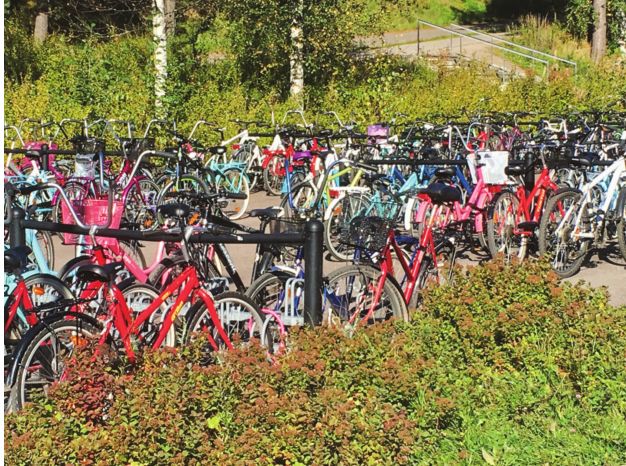
Everything comes back to these two fundamental premises. Trust is
obvious when observing the schools and students. At one school, kids’
bicycles lined one side of the building – all unlocked. Students, coming
out for recess, roamed into the adjoining woods, or got out their
cellphones to text or play a game. No teachers were on playground duty
supervising. Students aren’t in school a full day, and when the
principal was asked if parents objected that their children were home by
1 p.m. or 2 p.m., the principal said, “The young children go to day
care, but otherwise, kids go home. The parents don’t object; that’s how
it has always been – when I was a kid it was the same.”
Equity
drives the decisions about each student, and each student is looked at
as an individual with varying needs. If a child needs special help, then
it is to be determined early and resources are to be provided. If an
immigrant student doesn’t speak Finnish, then a language immersion
program is offered by the municipality. Students are not put into
ability groups, and there aren’t separate special ed or gifted classes.
Instead, each student is looked at as an individual and the teacher
designs each student’s lesson to help hone skills and build knowledge.
This is a major difference from our system. In our schools, students
take subjects and all study basically the same unit, with the same
homework assignments. In Finland, students in upper secondary study a subject and their lessons
and homework might all be different, based on each student’s needs,
interests and ability. It is up to the teacher to then find the ways for
all students to work in teams and collaborate on projects.
What Finland faces going forward
The
Finnish economy has fallen, and many comment on how bad it is. This has
raised questions for the Finns on how to maintain equity for all and
continue the practice of free higher education. There is now a movement
to start charging tuition for foreign students in the universities.
Finland
was surprised when they reached the status of being No. 1 in the world
in their education system, and they immediately reviewed and analyzed
why, instead of just resting on their laurels. They are continuing to
monitor what needs to occur in order to stay on top. This was made a
goal when in 2012 their PISA scores fell somewhat. Although they still
maintained the No. 1 spot in all of Europe, they understand that
constant collaboration among the stakeholders and the education experts
must be continued to fine tune the work.
This
year that has led to a new approach called phenomenon-based education –
looking at skill goals first and then subject goals, designing
multidisciplinary activities and having students participate in
determining their own learning and ways to be assessed. As a teacher
said, “It is not just going through a textbook and mastering a lesson.”
They are faced with a growing diversity.
In
the fall of 2015, 30,000 immigrants came into Finland from areas such
as Syria, Bosnia, Ethiopia and Russia. This has put a strain on the
municipalities in ensuring language immersion continues for all.
Be proud of our schools
Our U.S. public schools do exceptional work for students without the funding and equity that Finland provides. Some
of the same things are happening here as in Finland: students arranged
in classes, studying many of the same subjects. But, unlike Finland, we
offer students extracurricular activities, sports and clubs.
Final lessons
The question often asked is whether we in
the
U.S. could create the system that Finland has. Probably not on such a
large scale, since our population is so much larger. But, as one
prominent Finnish educator Pasi Sahlburg recommends in his book Finnish Lessons 2.0, start with a state.
We know the ingredients needed: Finland took our ideas and implemented them in a comprehensive way.
The
question remains, though, if we truly have the motivation and interest
to create an equitable education system. Unfortunately, we know there
are the “have” and the “have not” schools here in Illinois. Funding is
based on one’s ZIP code and is not equitable throughout the state. That
means staffing, resources and programs are unequal for students,
teachers and communities, something that would not be tolerated in
Finland.
Instead of
designing a system using the expertise of the stakeholders, deep
conversation, looking at what students need and then determining the
right funding, we spend countless hours talking about tweaking a funding
formula that hasn’t worked for decades and does not address student
needs.
Too many
reformers propose half-baked ideas as a panacea for our schools,
ignoring what the Finns know: it takes many pieces, properly designed
and working together, to create a school system. That is the biggest
lesson we could learn from Finland.
Cinda
Klickna is a former District 186 English teacher and now serves as
president of the Illinois Education Association. She has been a
freelance contributor to IT for many years.