I remember my grandmother had an Ouija board and it was something we kids pulled out at every family and holiday gathering, handling the tattered brown cardboard box with a sense of awe and respect that it ultimately didn’t deserve. Hoping to get in touch with the spirit world, my cousins and I would gently remove the board, daintily place the planchette on it, and timidly put our fingers on that heartshaped talisman, waiting for the magic to start.
It never did, disappointing us all and leaving me to reason that the spirits had their own holidays to tend to or that they didn’t like my grandmother’s cooking.
If the evidence on display in Ouija: Origin of Evil is any indication, instead of feeling disappointed, I should have considered myself damn lucky no spirits decided to drop by 665 S. Cannon St. They’d have wrecked havoc on the entire affair, and it would appear that my grandparents’ staunch Catholic beliefs would have done them no good in defense of malevolent ghosts. What with the surprise performance of 2014’s Ouija at the box office (a worldwide gross of $100 million on a $5 million budget), it comes as no surprise that a follow-up of some sort would come in its wake. What is a surprise is that it proves to be much better than its predecessor and a great deal of fun.
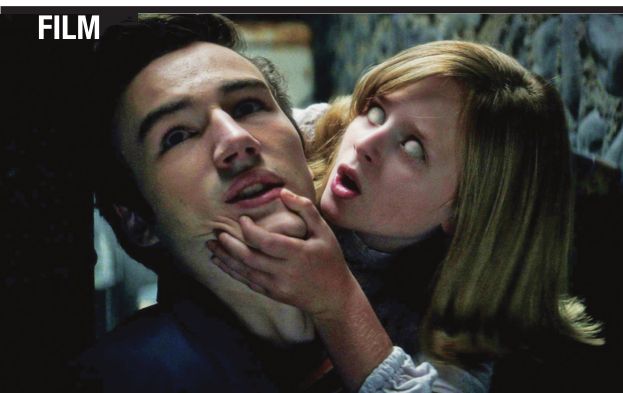
Taking place in Los Angeles of 1967, this prequel finds widowed mom Alice Zander (Elizabeth Reaser) trying to make ends meet by holding crooked séances, assisted by her two daughters Paulina (Annalise Basso) and Doris (Lulu Wilson). However, interest is waning, and in an effort to add a new dimension to her readings, she decides to incorporate an Ouija board into her act. All goes well until an angry spirit is unwittingly released, possessing young Lulu, who, before you know it, is writing long missives in Polish, claims to be talking to her deceased father and dispatches bullies with efficient cruelty.
As constructed by director Mike Flanagan and his co-writer on the screenplay Jeff Howard, the film is very deliberate in the way it dispenses one key piece of information after another. While this approach may prove too slow for some viewers, it is effective as it gradually builds a sense of suspense that pays off in some genuinely shocking moments during the movie’s third act, as well as creating sympathy for Alice and her brood. Whether we see the possessed Doris whispering evil thoughts in her sleeping sister’s ear or see the young girl’s eyes become smoky and her mouth open to a horrific size so that the spirits might enter her, Flanagan keeps our attention.
The film’s Hollywood look works against it, as a low-budget aesthetic (ramshackle sets, grainy visuals, etc.) would have lent a degree of realism to it that works so well in the similarly themed The Last Exorcism. However, all the stops are pulled out during the climax in which we have an unexpected hanging, a reanimated corpse, and children crawling on the walls in a non-stop frenzy that’s startling and will have viewers continually rocking in their seats.
Ouija: Origin of Evil should not be taken as a serious entry in the horror genre – its sole purpose is to generate a profit and open up the possibility of a sequel, thus cementing a reliable franchise for Universal Pictures. Be that as it may, there’s no question that this is an entertaining time-killer that effortlessly segues from scary to silly throughout and it’s never less than fun, certainly more than the stagnant board that continually let me down as a child.
Contact Chuck Koplinski at [email protected].