I become an historian
Next summer, if things go well, I will become an historian, to the extent that the published author of a book-length history of mid-Illinois can be called an historian. In truth, I am untrained in the arts of the rigors of scholarship and don’t write history so much as I write about history. But I like the sound of it enough to claim the title.
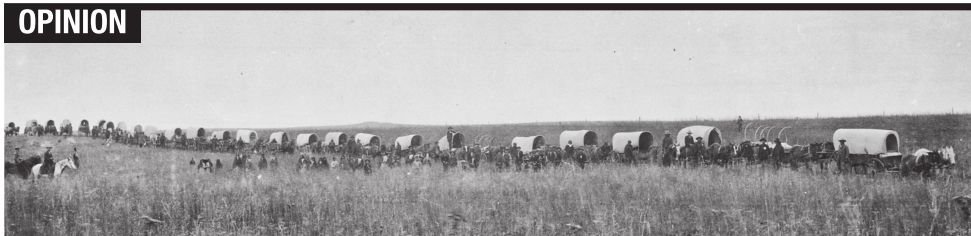
How does one find oneself turned around, looking backwards rather than forwards the way a real American should? I can say honestly that it was not my fault. My ancestors lured me into it. I am a mid-Illinois boy from mid- Illinois parents whose families’ roots in the region date to the 1820s and early 1830s. That’s when separate families, mostly unknown to each other, converged on Morgan, Pike, Adams and the future Cass counties. They came by steamboat and wagon from North Carolina by way of Tennessee, from Kentucky by way of Indiana, from Württemburg and Upper Saxony by way of New Orleans, and Ireland by way of Pennsylvania. The only history most of them knew was the history they were trying to escape. Had they been alert to it when they arrived in mid-Illinois, my progenitors might have heard, mingled with the rustle of prairie grasses and the clatter of their wagons on rutted roads, the sound of slates being wiped clean.
My own parents had made a new start too.
Opportunity for my father in the 1940s was not government land but a government job, and we ended up in Springfield, an hour’s drive and a world away. As we motored around town, there was no point asking my parents “What is that?” or “Who lives there?” because they usually didn’t know, having lived here no longer than I had.
There were answers to all those questions, of course, if I had known where to look. Springfield history was laid out in the commercial buildings that bore the names of the entrepreneurs who built them, the public schools bearing the names of the town’s civic worthies, and the houses of the succession of local elites who lived in them. As a strapling I wielded a shovel on summer archaeological excavations of both frontier- and Mississippianera sites in the Sangamon and Illinois river valleys. I delivered a scripted spiel to tourists at the newly refurbished law offices of Lincoln and Herndon which later research would expose as under-informed – a valuable lesson that history, while not quite scientific in its method, is at least amenable to correction by new facts. Cullom Davis, then a professor of history at Sangamon State University and my mentor, colleague and coauthor in the 1970s, had set up an Oral History Office at SSU and began to build what he has called “people’s history for a people’s university.” I was one of the students whose tape recorders sought the testimony of ethnic group members, minorities and women, coal miners, farmers, labor unionists – what Davis has called “‘the others’ in American and rural life.”
What I was learning was that the emigrants who arrived in wagons had been extolled by conventional town histories but those who arrived on trains were ignored by writers who believed the stuff of history to be factories and the men who owned them, not the workers who worked in them. The Old Settlers of every locale were celebrated for their hardiness and their foresight but never for their luck or their guile; one didn’t have to be more than ordinarily virtuous to succeed back then; in fact it rather helped not to be. As for Mr. Lincoln, he needed to be put in his place, so to speak, as a man informed if not ennobled by his experience of the region.
About Springfield in particular I learned that it was not a garden whose rich soil has nurtured a Lincoln. Rather, Springfield was complacent, casually corrupt and irremediably racist. Unexpectedly, I found this realization elating. My hometown was less admirable, certainly, but it also became much more interesting. This mattered at two levels. I was a budding journalist, and history, which had been something I lived with, had become something I talked about and wrote about and argued about publicly. Privately I nurtured a hope that becoming known as a product of a place that had once been interesting might make me interesting too.
It didn’t. Happily, in the 1970s a new generation of scholars were beginning to paint the warts back into the portraits of the region. Scholars such as Elazar, Faragher, Doyle, David, Meyer, Gittens, Franke, Mazrim, Seneschal, Thompson, Hudson, Emerson were making considered judgments about the past based on new or reconsidered evidence and putting them into book-length studies. While not every such work focused on mid-Illinois per se, much of their work touched on it, and offered new ways to understand the region’s past in terms of population movements, capital flows, ecological shifts and cultural anthropology. As far as the larger, curious public was aware, their work might as well have been scrawled on a cave wall, so I nurtured a hope that a book about new things being said about old things might make this place interesting to others.
Contact James Krohe Jr. at [email protected].
Corn Kings and One-Horse Thieves: A Plain- Spoken History of Mid-Illinois, is to be published by Southern Illinois University Press in July 2017.
Editor’s note
As a 15-year-old I read Conscience of a Conservative and became a proud supporter of Barry Goldwater, the Republican presidential candidate. I couldn’t understand why he got beaten up so badly in the media for his, “Extremism in the defense of liberty is no vice,” because he meant to promote liberty, not extremism. Goldwater was an honest and honorable candidate who got beat 61-39 percent in the popular vote. Now I’m trying to understand why Donald Trump, who is neither honest nor honorable, seems to be running a much closer race and can’t be counted out. One factor is that the country was still traumatized by President Kennedy’s assassination just a year before the 1964 election, and Goldwater was running against an incumbent, if non-elected, president. But the biggest difference may be that back then voters were informed by mainstream media. They got their news from newspapers and from three major television networks. Now they are informed – at least infl amed – by the internet, talk radio and cable news. There’s a lot of good to be said about the proliferation of media voices, but the early results don’t bode well for democratic government. –Fletcher Farrar, editor and publisher