Some movies make their intentions known from the start. Tate Taylor’s
The Girl on the Train certainly
falls in that category, as it sets out to keep the viewer back on its
heels throughout most of its running time. That the film is based on a
best-seller only complicates things for the director and screenwriter
Erin Cressida Wilson, who attempt to provide the book’s many readers
with a surprise or two by altering the story’s timeline and bringing a
supporting character to the forefront. Having not read the novel, I
can’t say for sure if this adds anything to the story or not, but
there’s no question that the game cast is firmly invested in this
whodunit, their efforts helping the audience overlook some of the plot’s
major holes.
The
notion of the unreliable narrator rears its head early on as the story
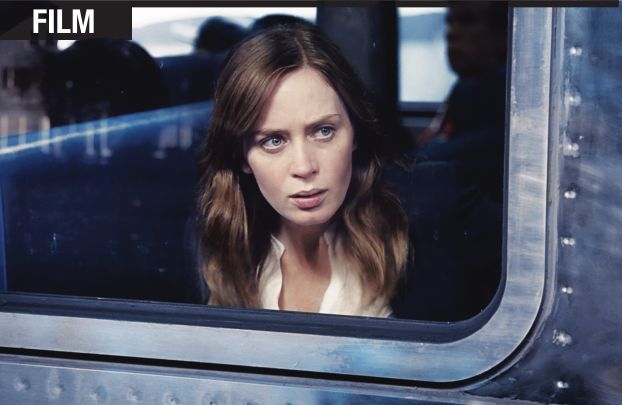
is told from the perspective of Rachel (Emily Blunt), a troubled woman
who has yet to recover from her divorce three years earlier and spends
her days riding the train into New York City and back to the ‘burbs
again and again, drinking herself into a stupor as she does. Her ex, Tom
(Justin Theroux), who has remarried, and his new wife Anna (Rebecca
Ferguson) live nearby with their baby as do Scott and Megan (Luke Evans
and Haley Bennett), a couple she does not know but has come to idealize.
In catching glimpses of their everyday life, Rachel has come to see
them as a romantic, loving couple in the sort of relationship she longs
to have. However, this image is shattered one day when she sees Megan
embracing another man and is found dead hours later.
The echoes of Gone Girl resound throughout the movie as Train too
deals with issues of identity, persona and trust, and how they shift
and change within relationships. Taylor and Wilson employ numerous
flashbacks and even flashbacks within flashbacks, stripping away
one layer after another where Rachel, Megan and Anna are concerned,
until we learn some version of the truth about who they truly are, if
they even know themselves. This is where the film is most fascinating
and effective, as we see these three women navigate the various
situations they find themselves in, striving to meet the expectations
society and others have put on them, losing themselves along the way.
Anna
gets short shrift in this area but Ferguson is still able to create a
distinctive character out of the outline she’s been handed. However,
Rachel and Megan are fascinating creations, women who are adrift after
having suffered traumatic experiences, each in a self-destructive spiral
as a result. Blunt and Bennett are quite good in their respective
roles, providing tragic portraits of these lost, damaged women that
never feels calculated, their performances grounded in sincerity.
As
for the mystery that sets these characters on a collision course …
well, once the smoke clears, you can see just what a simple matter it is
and why Taylor and Wilson have gone to the trouble they have to
distract us from the obvious. It’s an elaborate game of Three-Card Monte
with one piece of misdirection after another thrown at the audience,
while key pieces of information are revealed only until absolutely
necessary.
To be sure,
this is part and parcel of the structure of a mystery story but there
seems to be even more manipulation at play here than normal. This may
not bother fans of the book or those willing to give themselves over to
this particular story. However, the view from here is that Train is
just a bit too clever for its own good, so much so that I grew tired of
the shenanigans and simply wanted to know who did what to who and why.


