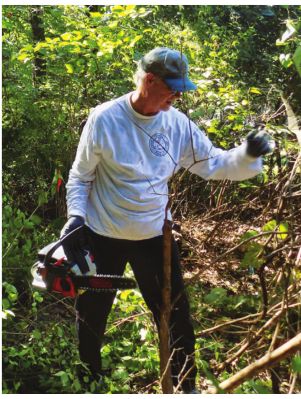
Lake Springfield gets some Friends
Chainsaws and herbicide and matches, it turns out, can be an environmentalist’s best friend.
After
more than two years of clearing brush with saws and poison and fire,
Friends of the Sangamon Valley, a nonprofit preservationist group
concerned with environmental issues, has completed its mission of
removing nonnative plants from 60 wooded acres on Lake Springfield near
Glenwood Middle School. Vern LaGesse, executive director of the
organization, says it took more than 400 hours of labor, much of it
provided by volunteers, to finish the job on land owned by City Water,
Light and Power.
It is hard work, often in hot sun with plenty of bugs. On the plus side, work “days” last just two hours.
“Pay money and go to Fit Club or come to Club Vern,” quips LaGesse, who, just like a gym, provides all the equipment.
One
thing about weeds and other plants no one likes: There never seems to
be a shortage. And so LaGesse’s group has recently moved from the
Glenwood site to a 10-acre lakeside wooded area, also owned by CWLP,
that is now choked with honeysuckle and other nonnative plants to the
point that nothing but dead leaves carpet what LaGesse hopes will one
day be a vibrant forest floor with plenty of life.
Just
a few fluorescent orange ribbons marking native plants that should
remain flutter in this thicket of what is mostly honeysuckle, an
invasive plant once thought to be good for birds because it produces
berries. But scientists have determined that honeysuckle berries have
virtually no nutritional value – LaGesse calls them potato chips for
birds.
“Honeysuckle is
a nasty plant, and the more I kill, the better I feel,” said Jim
Struebing, a retired schoolteacher who drives 45 minutes from his home
in New Holland to hack brush for free a few times each week. “I’ve been
working with these same guys for a long time and we just enjoy each
other’s company. And I get some exercise.”
The site has been deteriorating for years.
Workers
use chainsaws instead of lopping shears to cut through the thicket,
finding one honeysuckle stem with 20 years of growth rings. If all goes
as planned, the area near the Island Bay Yacht Club will be ready for
burning by late fall. Fire removes the last vestiges of non-native
plants so vegetation that’s healthier for the forest can grow. LaGesse
is predicting lots of flowers and grass.
“It’s
amazing,” says Dan Brill, a CWLP engineering technician and occasional
Friends of the Sangamon Valley volunteer who stopped by to check on
progress while LaGesse and his crew labored this week. “A fire in the
fall, and you come back in the spring and see what’s popped up.”
Beyond making wooded areas
pretty, the work benefits the lake by keeping silt out of the water. At
the Glenwood site, the group placed branches of honeysuckle and other
invasive plants across gullies to form dams that are capturing dirt from
runoff water before it gets to the lake. Eventually, LaGesse said, the
gullies will fill with dirt thanks to the dams and become swales instead
of conduits for pollution-laden stormwater.
“It’s
making a huge difference,” Brill said. The site near the yacht club is
the second on the lake to feel the love from Friends of the Sangamon
Valley. The restoration of the woods near Glenwood Middle School was
helped by money from the Illinois Environmental Protection Agency. This
year, the city contributed $5,000, which is paying for equipment, fuel
and labor that isn’t donated.
Eventually,
LaGesse would like to restore lakeside land that is in private hands,
which would require permission from private entities. Brill said that
homeowners are given plenty of warning before workers set fire to
property near their houses, with tanks of water close by just in case.
LaGesse,
who’s been doing these sorts of cleanups for years throughout the
Springfield area, hopes to one day set up an arrangement so that people
sentenced to perform community service by the courts can pay their debt
to society by culling invasive plants under his watch. He recalls a
survey done during the 1970s that showed just 3,000 acres of Illinois
remain in pristine natural condition.
“That means there’s quite a bit of opportunity,” LaGesse said.
Contact Bruce Rushton at [email protected].