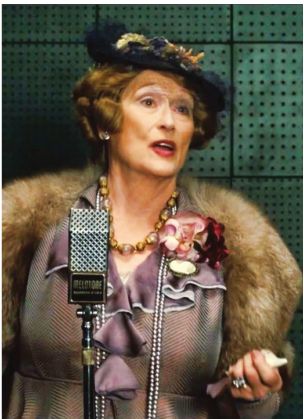
Where a film like Florence Foster Jenkins is concerned, finding the right tone is key to its success. Director Stephen Frears knows a thing or two about creating the proper mood and intent of a piece (Philomena, High Fidelity), and his skill is key to the success of this movie, a biopic of the title character, a well-to-do heiress with dreams of musical grandeur. That the filmmaker has Meryl Streep at his disposal certainly doesn’t hurt matters as she delivers yet another complex, poignant turn. However, the fact that Frears elicits two equally good performances from unexpected sources is a genuine boon and surprise.
Taking place in the early 1940s, Jenkins and her husband St. Clair Bayfield (Hugh Grant) are patrons to a fault of the New York music scene. While the heiress’ generous donations enable giants such as Toscanini to work, she also produces revues in which she and her friends perform for small audiences. While Jenkins’ sincerity can’t be questioned, the talent simply isn’t there, as evidenced when she takes to the boards to belt out an aria. Oblivious to the fact that every hound in the Big Apple howls along with each sour note she hits – and there are many – she blithely continues to perform, her intent to eventually rent Carnegie Hall for an evening and take the stage there. The planning of these events falls to Bayfield who plays along with his wife’s delusion, slipping money into the invitations sent to music critics to ensure good reviews, as well as making sure that many of the same audience members show up at these events, as they know that keeping Jenkins is happy is the key to a healthy New York music scene.
As written by Nicholas Martin, the film’s first act is masterfully constructed as it provides one intriguing surprise after another. We witness Jenkins performing in her latest program, see her husband take her home and put her to bed, and in doing so, we see that she is gravely ill; then we see Bayfield scurry to a run-down apartment where he lives with girlfriend Kathleen (Rebecca Ferguson). At this point, only 15 minutes in, our curiosity is peaked, our sympathies are with the title character, and there’s no turning away until our questions are answered. Frears is able to render these moments as well as the rest of the film with a deft touch, facilitating scenes of genuine humor as well as pathos. The key to all of this is that Jenkins is never presented as a person to be mocked or scorned but rather a passionate woman with a kind heart, relentlessly pursing her dream.
Streep, of course, is wonderful, giving us a fully rounded character and not a mere caricature, and Grant matches her step by step to deliver a career best performance. Much more than simply the charming cad he usually plays, the actor creates a character that’s conflicted by his own moral behavior but whose devotion towards his wife never falters. While we may not agree with every decision Bayfield makes, we never come to hate him; indeed, we come to admire the endgame he’s playing. Much of this is due to Grant’s subtle approach, while Simon Helberg (The Big Bang Theory) delivers a funny and ultimately touching performance as Jenkins’ accompanist Cosme McMoon, a serious musician who initially fears for his reputation but is won over by his employer’s passion in the end.
While Freers and Martin could have and perhaps should have been more critical of Jenkins’ oblivious nature where her social status is concerned, that’s not the intent of the film. No, this is a testament to finding your own voice and letting loose no matter what. This endorsement of individual expression in this age of forced social uniformity is a welcome statement, hard on the ears though it may be. Jenkins’ purpose is to inspire, and it does so without apology.
Contact Chuck Koplinski at [email protected].


