Arvin Pierce, a man on a mission to save, support and learn from the honeybee
As Arvin Pierce and I pull up to a house in Virden and step out of his small red pickup truck, a young boy cowers near the back steps. He glares up at an active swarm of honeybees near a catalpa tree about 15 feet away and exclaims, “I’m staying over here. I don’t like those bees.”
Arvin smiles as he walks through the cloud of bees and straight up to a hole in the tree where the creatures fly in and out and all around, buzzing around his head like a honeybee halo and assesses the situation.
“That’s all right,” he drawls. “They won’t bother you if you don’t bother them.”
During the 45 minutes Pierce takes to set a hive trap to safely capture the bees, the boy decides he’s glad they’re around and even comes up close to observe Arvin at work with bees flying everywhere. While driving away to our next bee-based adventure, Arvin grins and says that kind of reaction happens all the time.
So goes a day in the life of Arvin Pierce, a man on a mission to save, protect, support, educate others and learn from the workings of the honeybee. Pierce lives in his family home near Lowder and travels in a 50-mile radius of the little village west of Virden and south of Loami. He occasionally goes farther distances if called to remove a swarm, but generally he finds plenty to keep him busy as a bee close to home. People know he’s available mostly through word of mouth and his online presence. If someone calls the authorities about bee swarms, most likely Arvin Pierce is the name given out to help.
When I first arrived at Arvin’s place, we talked about his day’s schedule, including the upcoming visit to the house in Virden where the boy learned a new appreciation for honeybees. The boy’s father, in the process of purchasing the home and lot, requested a letter detailing Arvin’s plan and schedule for removing the bees.
The bank holding the mortgage required the bees to be gone before the upcoming closing. Thankfully, the new homeowner didn’t want to kill the bees and contacted Pierce.
Also on the day’s loose agenda was a stop in Carlinville at Blackburn College to remove a swarm of honeybees from a tree that had hosted a colony for nearly 35 years. The college was required to remove the bees by an insurance company that felt the hive was a liability factor. After being told by others the bees couldn’t be saved, the college administration contacted Arvin, who is in the process of successfully removing the colony. The school displayed interest in relocating the bees into a proper hive and keeping them on campus, making for a happy ending to this bee tale. Another visit would take us to the Macoupin County Historical Society grounds to check on a trap luring bees from a home they made inside a 1930s bulldozer donated to the society as a museum piece. To complete the day, we went to several rural locations where Pierce had set up hives with the landowner’s permission and checked on the condition of the honeycombs. Unusual for this time of year, according to Arvin, none of the hive frames were far enough along with nectar storage to be worth taking home for honey production. So goes the unpredictable bee world.
In these visits, some folks pay and some don’t, as Arvin leaves that decision up to the persons responsible. Pierce’s main payment comes in gathering the bees he takes home to add to his personal hives, but he makes it clear any money is gladly received to offset expenses. His main concern is to not lose a chance to save bees from extermination because someone would rather kill them than pay for a removal.
Before leaving on the day’s journey, we walk through his house as he proudly points out photos hanging on the wall portraying generations of his
family. In another room is the old player piano he repaired to surprise
his aging mother. Furniture pieces, including the dresser he had as a
child, are covered and filled with family memorabilia. Some of the items
are heirloom antiques, but many more are regular personal items, of
little or no value to anyone other than his relatives for the precious
memories they hold. On a wall next to generational family photos,
digital enlargements of honeybees prove his affinity for photography,
another of Arvin’s passions. A visit to his Facebook page or business
website reveals hundreds of high-definition shots using stills and
videos, including monarch butterfly cocoons opening, praying mantis
matings and many of honeybees alone and with Arvin at work. His bee
assistant and friend Jeanne Rautenbach also contributed many of the
photographs on the pages.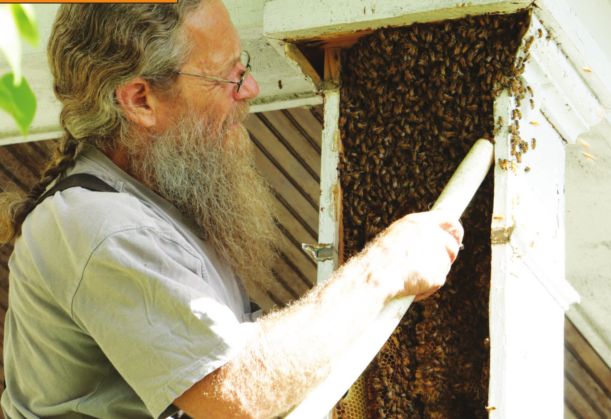
As
we headed into the backyard, there were piles of bee boxes, along with
various used farm implements scattered about in a seemingly disorganized
manner, but I get the feeling he knows where and what everything is.
Arvin keeps several free-range chickens, using the eggs for food or to
trade for necessary items. He also tends a good-sized garden of
vegetables along with starts of the honey bees’ favorite flowering
plants. As we walked along where his hives sat, near the border of his
yard and farm fields, I asked him how many working bee boxes he had
going on the property. He wasn’t sure, and jokingly recounted the old
beekeepers’ adage that “if you know how many hives you have, you don’t
have enough.” After a quick rough count of about 45 hives or “supers,”
as the containers holding the honeybees are called, Arvin said there
could be between 20 to 30 thousand bees or more in each one. My
calculations show an incredible number of almost a million of those
hard-working creatures in the hives. That’s nearly un“bee”lievable.
We
opened a hive looking for a comb with a few developing queen eggs for
use in the traps intended to lure the colonies out of where they aren’t
wanted by humans. Arvin treated the bees with respect and kindness, but
also with an attitude that he was the beekeeper and ultimately made the
decisions necessary for the health and well being of the insects. At the
same time he acknowledged they could do whatever they wanted, and
usually did. When he accidently dropped a hive lid of the super of a
swarm recently relocated to his property, the inhabitants reacted by
becoming agitated. Since they were new to him and he “didn’t know their
history,” he was leery of how the bees would be, so we walked back to
the house and got a smoker. Arvin stuffed the teapotlooking item full of
dried grass, lit a piece of scrap paper, dropped it in the smoker,
closed the lid and pumped out a few puffs of smoke.
“I
don’t like to use smoke, but there are times they can get a little
touchy, then I just light that smoker up and make a doggone chimney out
of that hive,” he says, laughing robustly. “Now, dang it, you’re gonna
settle down!” He claims smoke usually does the job of calming a hive.
When he first started working with bees, a Tennessee beekeeper teacher
always used pine needles, so Arvin did the same. After realizing that
there were a lot more pine trees in Tennessee than around here, he
decided to use other items more common to central Illinois. Finally,
after some experimentation and a lesson learned, he came to the
conclusion that many things worked OK. Now he uses dried plants that
light up easily and gathers some wherever he can find suitable material.
By
the time we got back to the excited hive, the bees had calmed down. Out
of the super he pulled a frame covered with busy female workers. He
pointed out the queen who was light-colored and known as an Italian
queen. Arvin prefers Russian queens since they do better in this area
and are hardier overall. We remove a comb with eggs that suit him and
head back toward the house, talking bees all the way.
“You
can think you know all there is about bees and follow all the rules,”
he explained, “but each time they’ll do something to surprise you. It’s
always interesting and always something to learn. They’re fascinating
beings.”
Pierce began
his apiary adventures in 2003 when he and his wife, Colleen, decided to
improve their health and diet by replacing refined sugars with honey.
Raised on a farm just a few miles from his present home, Arvin applied
farm boy mentality to the situation and decided to just get on with
producing his own honey. One hive led to another, and before you know
it, he had several colonies established. Soon Arvin was fully involved
in beekeeping, including membership in bee keeper organizations,
attending conferences and reading all he could about the age-old art of
raising bee colonies.
For
several years he continued to learn and apply that knowledge to the
ways of beekeeping while living the life of a father, husband and
working man. In 2014, Colleen died from complications of a hereditary
illness, and about a year and half after that, his mother passed, as
well. After a rough period of grieving death and refiguring life, Arvin
emerged more immersed and dedicated to his beekeeping than ever, making
it the focus of his life’s work.
In
the last two weeks alone, he’s done five removals, including his first
of bumble bees, set four hive traps, given a couple of educational
presentations, checked on several hives in rural and urban locations,
prepared honey for sale, attended farmers markets and tended to his
garden. While we drove around doing the bee chores, calls came in on his
cellphone with questions about swarms and possibilities of swarms,
wondering and worried folks concerned about how bees were acting and
what they could do to protect themselves and get rid of the pests. As he
answered them all in a calm and understanding voice, I was struck with
the thought of Arvin as an oldfashioned buggy doctor, listening to
patients and making house calls, soothing nervous and worried souls, all
the while taking care of the real patients, those thousands and
thousands of honeybees, unwanted by some, but vital to our human
existence as we know it.
Part
of what drives Pierce is his true love of being with bees, obvious in
his actions and words. Beyond that lies a strong belief in the working
order of the natural world. He doesn’t “medicate” his bees, a term for
using antibiotics and other medicines to prevent or fix a health problem
within the colonies. This common practice of medication – insisted on
by most beekeepers, especially the larger more commercial companies – is
controversial among natural beekeepers. When we discussed the popular
belief that our pollinators, and especially honeybees, are dying off in
huge numbers due to a new class
of pesticides known as neonicotinoids, he doesn’t deny the existence of a
possible problem. But instead of dwelling on the negative, he focuses
on the thousands of healthy feral bees he’s just recently removed and
relocated. In the same way as our large industrial types of monoculture
crops are unhealthy to the plants, us and the earth, bees kept in large
numbers, he feels, tend to have more health problems than those raised
in natural conditions.
As
a counterpoint to Arvin’s small operation of some 45 hives on his farm,
online I found the Coy Family, a large, family-owned beekeeping company
based in Arkansas and Mississippi with over 12,000 colonies of bees in
service. They have some 1,000 hives on site used to produce a million
pounds of retail honey annually, over 4,000 hives (about 11
semi-truckloads) for trucking to California almond orchards needing
pollinators and almost 10,000 queen bee cells for sale to beekeepers
around the world. With that many bees they must treat for specific bee
diseases and pests, making for a very “unnatural” way to raise bees, as
opposed to how they thrive and survive in nature.
While
there are arguments over how to best provide and maintain our food
supply, Arvin is content to prove his point by being successful his way.
Once at a conference when confronted by another beekeeper who is not a
believer in the natural methods, Pierce was forced to strongly defend
his position, but mostly he does his thing and lets the good work show.
He’s more concerned with educating the public about how bees live and
work than in bashing the big commercial guys or those with different
methods of beekeeping. Teaching and enlightening the public not to fear
bees, but to embrace them, and to understand their purpose and place in
our world, best fits Arvin’s style, attitude and belief system.
“I
love going to the schools with my observation hive and seeing the
reactions of kids,” he says, with obvious pleasure and satisfaction
in his voice. “That’s the best, seeing someone get an understanding of
what these amazing creatures do and their place in our world.”
Indeed
the most idealistic and exciting idea for his farmstead includes
turning the space into a bee sanctuary, complete with an education
center and hive demonstration area. Pierce sees his backyard as becoming
a beacon for bees and for people seeking to learn about our
hard-working friends. He plans to transform the foundation of a
demolished shed into a watering hole for the bees, complete with a
waterfall cascading down concrete steps. He envisions installing the
five major types of hive structures for educational observation
purposes, and he wants to grow fields of bee-friendly plants,
demonstrating what we can do to help replenish natural bee habitats. The
dream expands into school classroom field trips, business conference
meetings and everyday public visits, all designed to bring folks
together to learn about the wild and wonderful world of bees.
Arvin
was recently contacted by a nonprofit group based in California that
believes in and supports his work educating the public about bees.
They’ve already contributed monetarily to the cause and donated items he
couldn’t afford otherwise. He humbly and graciously takes the help in
the name of his co-workers, the honeybees.
When
he offered gentle advice to fellow current or future beekeepers, the
idea came simple and succinct, and could quite easily be applied to life
in general.
“Have fun
with your bees. If it’s not fun then be done with them,” he states.
“They are amazing and fascinating creatures that deserve our respect.
They’ll keep you entertained. I love what I do learning from bees, and
how they live teaches me, as well.”
Contact Tom Irwin at tirwin@illinoistimes.com. Contact Arvin Pierce on Facebook, at www.acbees.org or call or text to 217-638-6371.