Memories of a grand Springfield hotel
I often reflect on the past while washing the dishes – usually, trying to remember where I’d laid the scrub pad that I’d had in my hand a minute ago. But yesterday as I stood at the sink, I noticed for the first time how stained and scarred the dinner plate in my hand had become after another 42 years of almost daily use.
Which got me to remembering about when it was new . . . . It was 1973. I was poor and living in the Hickox apartments with the everpatient L. She thought it would be nice to have tableware that matched, because then I wouldn’t get confused about what to wash after a meal and what to throw away. The St. Nicholas Hotel up the street at Jefferson had just gone out of business after 118 years, and the leftovers from the auctions of furnishings and equipment had been piled into the ballroom and put up for sale. So off went L. in the hope of a bargain.
She cobbled together four six-piece settings, lugged them upstairs and called out, “Who’s a clever girl, then?” She was. It was first-class stuff from the “Best China” line of vitrified china made by Homer Laughlin, a venerable U.S. firm that catered to the tableware needs of the hotel and restaurant trade.
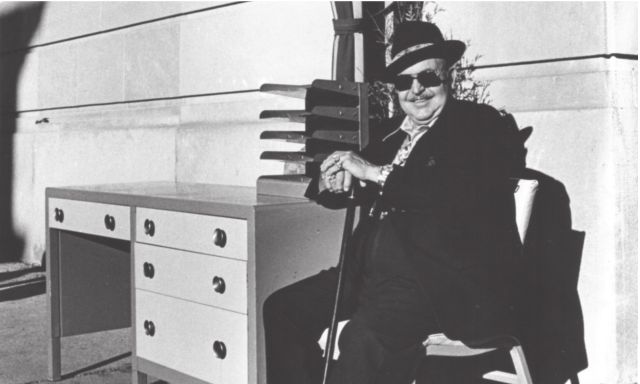
As it turned out, the St. Nick went out of business three or four times before it closed for good in 1977. Among the other people who thus were able to loot the place legally was the happy gent photographed near the hotel’s Fourth Street entrance by Jessie Ewing, IT’s estimable founding staff photographer. He was the proud purchaser of a kneehole room desk and a chair in the Motel Moderne style in which the hotel had been decked out during its last remodel. He had piled his booty on the sidewalk, pulled out the chair and was comfortably awaiting a ride. He wore a dark suit, flowered shirt open at the neck, embossed cowboy boots and a fedora with a bright patterned cloth band. In his hand was a walking stick, on his upper lip a pencil mustache, on his fingers were four rings and on one wrist a watch that could have doubled as a landing beacon at Capital Airport. He was a Damon Runyon story come to life.
That was the wonderful thing about Springfield’s old downtown hotels. They teemed with people who looked like they didn’t belong in Springfield, from sharpsters and bookies to lounge lizards and dames (I use the term as an honorific) of every description. The St. Nick was not my favorite big hotel – the Leland was more genteel, and the Abraham Lincoln (the real Abraham Lincoln Hotel, not the one that now bears the name) was like a grand old ocean liner that had somehow been docked at Fifth and Capitol. But the St. Nick was the largest in town, with 200 rooms, and the handsomest, and it was home to The Glade Room, which was as close as Springfield got to cosmopolitan. (The Glade offered Cantonese and American food, and its ads took care to explain that the dishes were prepared in separate kitchens, to reassure those worried about Maoists contaminating their precious bodily fluids.)
In those days the big hotels functioned as legislative offices and residences when the General Assembly was in session. Some readers may recall Andy O’Neill from the 1960s when he was the City of Springfield’s purchasing agent. In 1930, O’Neill recalled for a reporter his youth when (to borrow a phrase) he hopped at the ring of a bell at the St. Nicholas. He once had been given a tip of $150 (worth about two thousand dollars today) by a group of legislators whose party he had cleaned up after – an experience that might explain O’Neill’s later decision to go into politics. (He was later elected a state rep.)
The St. Nick was “the Democratic hotel.” (The Republicans gathered at the Leland. Where honest legislators met I’ve no idea.) The Young Dems lunched there and the Democratic state central committee slated there and Paul Powell dallied with his mistresses and stashed his loot there in his tax-paid suite. Or maybe he stashed his mistresses and dallied with his loot – I didn’t know anything about his personal habits. After Powell croaked in 1970, his associates found in Room 546 $750,000 in cash stored in shoeboxes, briefcases and strongboxes and, according to one report, a bowling bag.
And then I remembered that I’d first confronted the mysteries of a green salad at the St Nick, at a Golden Laurels Awards banquet. And that’s was where I first heard the Count Basie band live. And . . . . I really ought to take what’s left of what I regard as our gift from St. Nicholas out of the cupboard and put them on a shelf in the living room. They are no longer mere dishes but Artifacts, and respect must be shown.
Contact James Krohe Jr. at [email protected].
Editor’s note
At
its public “town hall” meeting Monday evening, HSHS St. John’s Hospital
impressed the crowd with its openness about plans for a new medical
offi ce building and its interest in the public’s ideas for ways to
commemorate the 1908 race riot which happened nearby. The building, to
house outpatient services for women and children, will be on Ninth
Street, directly across from HSHS St. John’s Children’s Hospital and
adjacent to where during work on the 10th Street rail line
archaeologists uncovered remains of houses burned during the riot. Among
the ideas brought forward were a mural about the riots and a healing
garden. Another idea, from Leroy Jordan of the Faith Coalition for the
Common Good, was to provide construction jobs and scholarships leading
to permanent health care jobs for people of color and women. Jobs for
those traditionally left behind would be the ultimate healing touch.
–Fletcher Farrar, editor and publisher. Questions or suggestions about
the project may be emailed to St. John’s at [email protected].