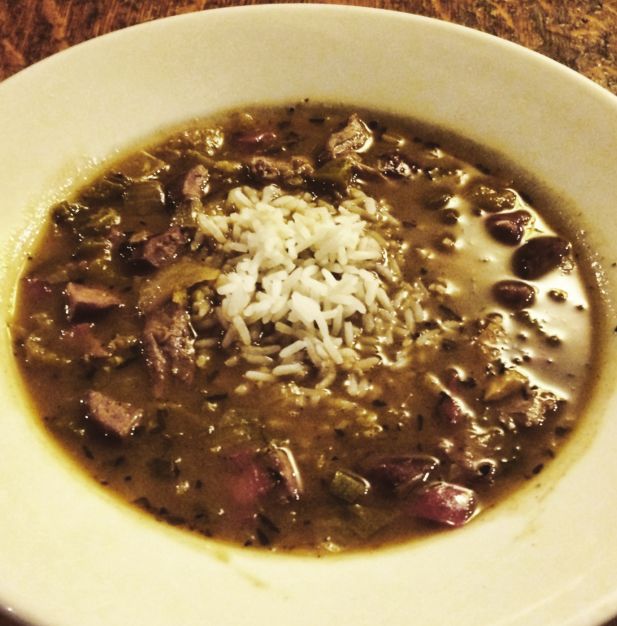
This is the third column in four weeks that I’ll have written about the food and people of Southern Louisiana. The first two were in response to culinary news: the passing of Paul Prudhomme, who was – literally and figuratively – a figure of immense importance in the evolution of America’s own culinary identity.
But I’ve been planning to write this year’s Thanksgiving column about turkey bone gumbo for almost a year, since I saw Pableaux Johnson’s turkey bone gumbo mentioned in The New York Times cooking blog.
“Gosh – I know Pableaux!” I thought.
In fact, I’d been talking with him a few weeks earlier at the Southern Foodways Alliance 2014 Symposium.
Pableaux Johnson is one of the most interesting and charming people I’ve ever met. (The New York Times labels him a “bon vivant.”) The Louisiana native, who lives in New Orleans, has many guises, chief among them a professional photographer and food/travel writer. His hospitality is legendary.
At first I thought that turkey bone gumbo was Johnson’s creation; I’d never seen it in a cookbook. But I soon found that it has a long tradition as a post- Thanksgiving staple in Southern Louisiana.
There are countless recipes, although turkey bone gumbo isn’t something that requires allegiance to a strict set of ingredients or quantities. Some suggest adding stuffing, which is logical: Southern stuffings are most typically made of rice or cornbread. I’m suspicious of using bread-based stuffing. Leftover turkey gravy and appropriate vegetables are also often added.
Johnson has taken the turkey bone gumbo tradition to new heights. His story begins in Austin, Texas, where he lived in “exile” for a decade. Appalled that his Texas friends typically threw away Thanksgiving turkey carcasses, he “developed a reputation as a one-man culinary clean-up crew with a curious mission of driving around on post-feast Friday, gathering turkey skeletons from friends…. That night I’d make a huge stock… and on Saturday I’d make a turkey bone gumbo spiked with hot links, and then have a party.”
His return to New Orleans heightened his obsession. No longer content with collecting leftover carcasses post- Thanksgiving, he realized that turkeys were often on pre-Thanksgiving sales. He begged freezer space from friends and took possession of a sophisticated smoker to add another flavor dimension. Johnson even has a blog, Gumbo Crazy, devoted to his
passion, appropriately subtitled “23 birds, one tiny kitchen, a delicious variant of OCD.”
Johnson
says that it’s become “a fivemonth, non-stop, large-format kitchen
project. It’s a time when I’m never not in some stage of gumbo
preparation. Until (mid-spring), I’ll be cooking big batches of
turkey/andouille gumbo on a semiindustrial scale.”
Last
year Johnson ended up making 54 gallons of gumbo. So what did he do
with it all? First, his once-a-year turkey bone gumbo party in Texas has
become a weekly event for five months back home in New Orleans. And he
gives quarts of turkey bone gumbo, suitable for the freezer, away to
anyone who contributed some of those bones to the cause.
What
follows is based on Johnson’s recipe as well as my own. The most
crucial difference for me is that every recipe I’ve seen for turkey bone
gumbo calls for the meat for the gumbo to be removed after the turkey
stock has simmered for hours. I like to remove the meat before
simmering, or at least just until things have warmed up. That way the
turkey retains its flavor; otherwise it’s tasteless.
The
basis for turkey bone gumbo – and the primary reason it’s so delicious –
is the broth below. Of course, you could use the broth to make other
soups: turkey rice, turkey vegetable, turkey noodle, etc. But if you
make Turkey bone gumbo with the stock, you will have something that,
according to Johnson, is better than you can possibly imagine.
Turkey bone broth
• 1 turkey carcass, including bones, skin, gristle, meat still on the bone and (optional) giblets
• 3 ribs celery, roughly chopped
• 2 medium onions, not supersweet, root end removed and roughly chopped (peeling not necessary)
• 4 garlic cloves, smashed (peeling not necessary)
• 1 T. whole black peppercorns
• 1 T. thyme leaves (not ground)
• 4 bay leaves
•
1 gallon water (4 quarts, 16 c.) or more as needed Remove as much meat
as possible from the turkey carcass; tear into bite-sized pieces. Set
aside; refrigerate the meat if you won’t be using it in a couple hours.
Place
the carcass in a large stockpot, breaking it up if necessary to make it
fit into the pot. Add the celery, onions, garlic, thyme, peppercorns
and bay leaves. Cover with at least a gallon of water; depending on the
size of the carcass, you may need to add more.
Bring
to a boil, then reduce the heat so that the broth is at a bare simmer.
Cook for at least 2 hours and up to overnight. If simmering for an
extended time, partially or fully cover the pot. The longer the broth
cooks, the more flavorful it will become.
Strain
the broth through a large colander or sieve and discard the solids. Let
the broth stand for about 15 minutes, then skim off the fat that has
risen to the surface. Alternatively, quick chill the broth in a sink
filled with cold water, then refrigerate until the fat has solidified
and can be easily removed. If not using immediately, refrigerate for up
to 3 days or freeze in quart-sized containers.
Makes about 3 quarts.
Turkey bone gumbo
• 3/4 c. vegetable oil
• 3/4 c. all-purpose flour
• 2 c. chopped onions
• 1/2 c. chopped bell peppers: red, green or a combination
• 1/2 c. chopped celery
• 1 tsp. – 1 T. minced garlic, to taste
• 1 T. fresh, or 1 tsp. dried thyme leaves (not ground)
• 3 quarts turkey broth
• 2 – 4 c. turkey meat, torn into bite-sized pieces from the turkey carcass and/or leftovers
• 1/2 lb. garlicky smoked sausage, such as andouille or kielbasa, cut into bite-sized pieces
• Salt, freshly ground pepper and ground cayenne to taste
• Cooked white rice Optional garnishes:
• Chopped parsley, preferably flat-leaf
•
Thinly sliced scallions (green onions) Have ready and at hand the
onions, peppers, celery and garlic. Whisk the oil and flour together in a
heavy-bottomed cast-iron pot or enameled cast-iron Dutch oven over
medium-low heat until no lumps remain. Stir slowly, sporadically at
first, then constantly as the roux begins to darken beyond golden brown
to a rich mahogany color to a deep chocolate. The darker the roux the
more complex its flavor, and, surprisingly, the less thickening power it
has. This should take about 20 to 25 minutes.
As
soon as the roux is a deep mahogany remove the pot from the burner and
immediately dump in the onions, peppers, celery and garlic, stirring
constantly. The roux should turn a shade darker. Don’t worry; that’s
what should happen.
Return
the pot to the heat and sauté the vegetable/roux mixture until the
vegetables have softened, about 5 minutes. Add the broth and bring to a
boil. Reduce the heat to medium-low and simmer uncovered for 45 minutes.
Add the reserved turkey meat and sausage and simmer for 20 minutes.
Season to taste with salt, pepper and cayenne; let simmer another 10 minutes. Check the seasoning and adjust if needed.
Place a mound of cooked rice in each soup bowl, surround with the gumbo, and sprinkle with parsley and scallions if desired.
Serves 6-8 or more.
Contact Julianne Glatz at [email protected].


