

Scientists, authors and activists predict the outcome of the upcoming UN Climate Talks in Paris
LettersToTheFuture.org
World leaders from more than 190 countries will convene in Paris during the first two weeks of December for the long-awaited United Nations Climate Change Conference. Will the governments of the world finally pass a binding global treaty aimed at reducing the most dangerous impacts of global warming? Or will they fail in this task?
Letters to the Future, a national project involving more than 40 alternative weeklies across the United States, set out to find authors, artists, scientists and others willing to get creative and draft letters to future generations of their own families, predicting the success or failure of the Paris talks and what came after.
Some participants were optimistic about what is to come, some not so much. Here we present some of their visions of the future.
Stephen K. Robinson
My endless sky
Dear future Robinsons, Back around the turn of the century, fl ying to space was a rare human privilege, a dream come true, the stuff of movies (look it up) and an almost impossible ambition for children the world around.
But I was one of those fortunates. And what I saw from the cold, thick, protective windows of the Space Shuttle is something that, despite my 40 years of dreaming (I was never a young astronaut), I never remotely imagined.
Not that I was new to imagining things.
As you may know, I was somehow born with a passion for the sky, for fl ight and for the mysteries of the atmosphere. I built and fl ew death-defying gliders, learned to fl y properly, earned university degrees in the science of fl ight, and then spent the rest of my life exploring Earth’s atmosphere from below it, within it and above it. My hunger was never satisfi ed, and my love of fl ight never waned at all, even though it tried to kill me many times.
As I learned to fl y in gliders, then small aircraft, then military jets, I always had the secure feeling that the atmosphere was the infi nite “long delirious burning blue” of Magee’s poem, even though, of all people, I well knew about space and its nearness. It seemed impossible to believe that with just a little more power and a little more bravery, I couldn’t continue to climb higher and higher on “laughter-silvered wings.” My life was a celebration of the infi nite gift of sky, atmosphere and fl ight.
But what I saw in the fi rst minutes of entering space, following that violent lifechanging rocket ride, shocked me.
If you look at Earth’s atmosphere from orbit, you can see it “on edge” – gazing towards the horizon, with the black of space above and the gentle curve of the yes-it’sround planet below. And what you see is the most exquisite, luminous, delicate glow of a layered azure haze holding the Earth like an ethereal eggshell. “That’s it?!” I thought. The entire sky – MY endless sky – was only a paper-thin, blue wrapping of the planet, and looking as tentative as frost.
And this is the truth. Our Earth’s atmosphere is fragile and shockingly tiny – maybe 4 percent of the planet’s volume. Of all the life we know about, only one species has the responsibility to protect that precious blue planet-wrap. I hope we did, and I hope you do.
Your ancestor, Stephen K. Robinson After 36 years as an astronaut – with a tenure that included four shuttle missions and three spacewalks – Robinson retired from NASA in 2012. He is now a professor of mechanical and aerospace engineering at the University of California, Davis.
Jane Smiley
Brief opportunities
Dear Great-Great-Granddaughter, Do you remember your grandmother Veronica? I am writing to you on the very day that your grandmother Veronica turned 7 months old – she is my fi rst grandchild, and she is your grandmother. That is how quickly time passes and people are born, grow up and pass on. When I was your age – now 20 (Veronica was my age, 65, when you were born), I did not realize how brief our opportunities are to change the direction of the world we live in. The world you live in grew out of the world I live in, and I want to tell you a little bit about the major diffi culties of my world and how they have affected your world.
On the day I am writing this letter, the speaker of the House of Representatives quit his job because his party – called “the Republicans” – refused absolutely to work with or compromise with the other party, now defunct, called “the
Democrats.” The refusal of the Republicans to work with the Democrats
was what led to the government collapse in 2025, and the breakup of what
to you is the Former United States. The states that refused to
acknowledge climate change or, indeed, science, became the Republic of
America, and the other states became West America and East America. I
lived in West America. You probably live in East America, because West
America became unlivable owing to climate change in 2050.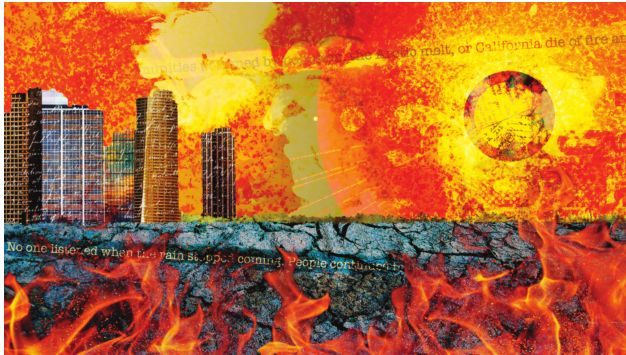
That the world was getting hotter and dryer, that weather was getting more chaotic, and that humans were getting too numerous for the ecosystem to support was evident to most Americans by the time I was 45, the age your mother is now. At fi rst, it did seem as though all Americans were willing to do something about it, but then the oil companies (with names like Exxon and Mobil and Shell) realized that their profi ts were at risk, and they dug in their heels. They underwrote all sorts of government corruption in order to deny climate change and transfer as much carbon dioxide out of the ground and into the air as they could. The worse the weather and the climate became, the more they refused to budge, and Americans, but also the citizens of other countries, kept using coal, diesel fuel and gasoline. Transportation was the hardest thing to give up, much harder than giving up the future, and so we did not give it up, and so there you are, stuck in the slender strip of East America that is overpopulated, but livable. I am sure you are a vegan, because there is no room for cattle, hogs or chickens, which Americans used to eat.
West America was once a beautiful place – not the parched desert landscape that it is now. Our mountains were green with oaks and pines, mountain lions and coyotes and deer roamed in the shadows, and there were beautiful fl owers nestled in the grass. It was sometimes hot, but often cool. Where you see abandoned, fl ooded cities, we saw smooth beaches and easy waves.
What is the greatest loss we have bequeathed you? I think it is the debris, the junk, the rotting bits of clothing, equipment, vehicles, buildings, etc, that you see everywhere and must avoid. Where we went for walks, you always have to keep an eye out. We have left you a mess. But I know that it is dangerous for you to go for walks – the human body wasn’t built to tolerate lows of 90 degrees Fahrenheit and highs of 140. When I was alive, I thought I was trying to save you, but I didn’t try hard enough, or at least, I didn’t try to save you as hard as my opponents tried to destroy you. I don’t know why they did that. I could never fi gure that out.
Sadly, Great-Great Grandma Jane Winner of the Pulitzer Prize for Fiction in 1992 for her novel A Thousand Acres, Smiley has composed numerous novels and works of nonfi ction.
Annie Leonard
Incredible people
It’s hard to imagine writing to the granddaughter of my own daughter, but if you’re anything like her – strong, smart, occasionally a little stubborn – then I have no doubt the world is in good hands.
By now your school should have taught you about climate change, and how humans helped to bring it about with our big cars, big homes, big appetites and an endless desire for more stuff. But what the teachers and textbooks may not have passed on are the stories of incredible people that helped make sure the planet remained beautiful and livable for you.
These are stories of everyday people doing courageous things, because they couldn’t stand by and watch communities poisoned by pollution, the Arctic melt or California die of fi re and drought. They couldn’t bear to think of New Orleans under water again, or New York lost to a superstorm. Right now, as politicians weigh up options and opinion polls, people are organizing an uprising. It’s amazing to see and be a part of.
In the year that led up to the 2015 meeting of global leaders on climate change in Paris, kayakers took to the water to stop oil rigs. Nurses, musicians, grannies, preachers and even beekeepers, took to the streets. The message was loud and clear: “We want clean, safe, renewable energy now!” Were it not for this glorious rainbow of people power, I don’t know whether President Obama would have stepped up and canceled oil drilling in the Alaskan Arctic or the sale of 10 billion tons of American coal, that were set to tip the planet towards climate chaos. But he did. This paved the way for an era of unprecedented innovation, as entrepreneurs and academics fi ne-tuned the best ways to harness the unlimited power of our wind, waves and sun, and make it available to everyone. We’ve just seen the fi rst ever oceanic crossing by a solar plane and I can only imagine what incredible inventions have grown in your time from the seeds planted in this energy revolution we’re experiencing right now.
I want to tell you about this because there was a time we didn’t think any of it was possible. And there may be times when you face similar challenges. Generations before you have taken acts of great courage to make sure you too have all the joys and gifts of the natural world – hiking in forests, swimming in clean water, breathing fresh air. If you need to be a little stubborn to make sure things stay that way, so be it.
Onwards! Annie Currently the executive director of Greenpeace USA, Leonard made the 2007 fi lm, The Story of Stuff, which chronicles the life of material goods and has been viewed more than 40 million times. She also wrote the 2010 New York Times bestseller by the same name.
Jim Hightower
Political boneheads
Hello? People of the future … Anyone there? It’s your forebears checking in with you from generations ago. We were the stewards of the earth in 2015 – a dicey time for the planet, humankind, and life itself. And … well, how’d we do? Anyone still there? Hello.
A gutsy, innovative and tenacious environmental movement arose around the globe back then to try lifting common sense to the highest levels of industry and government. We had made great progress in developing a grassroots consciousness about the suicidal consequences for us (as well as those of you future earthlings) if we didn’t act pronto to stop the reckless industrial pollution that was causing climate change. Our message was straightforward: When you realize you’ve dug yourself into a hole, the very first thing to do is stop digging.
Unfortunately, our grassroots majority was confronted by an elite alliance of narcissistic corporate greedheads and political boneheads. They were determined to deny environmental reality in order to grab more short-term wealth and power for themselves. Centuries before this, some Native American cultures adopted a wise ethos of deciding to take a particular action only after contemplating its impact on the seventh generation of their descendants. In 2015, however, the ethos of the dominant powers was to look no further into the future than the three month forecast of corporate profi ts.
As I write this letter to the future, delegations from the nations of our world are gathering to consider a global agreement on steps we can fi nally take to rein in the looming disaster of global warming. But at this convocation and beyond, will we have the courage for boldness, for choosing people and the planet over shortterm profi ts for the few? The people’s movement is urging the delegates in advance to remember that the opposite of courage is not cowardice, it’s conformity – just going along with the fl ow. After all, even a dead fi sh can go with the fl ow, and if the delegates don’t dare to swim against the corporate current, we’re all dead.
– Jim Hightower
So did we have the courage to start doing what has to be done? Hello … anyone there?
A national radio commentator, writer and public speaker, Hightower is also a New York Times bestselling author. His syndicated column, “Common Sense,” is published weekly in Illinois Times.
Michael Pollan
Shift the food system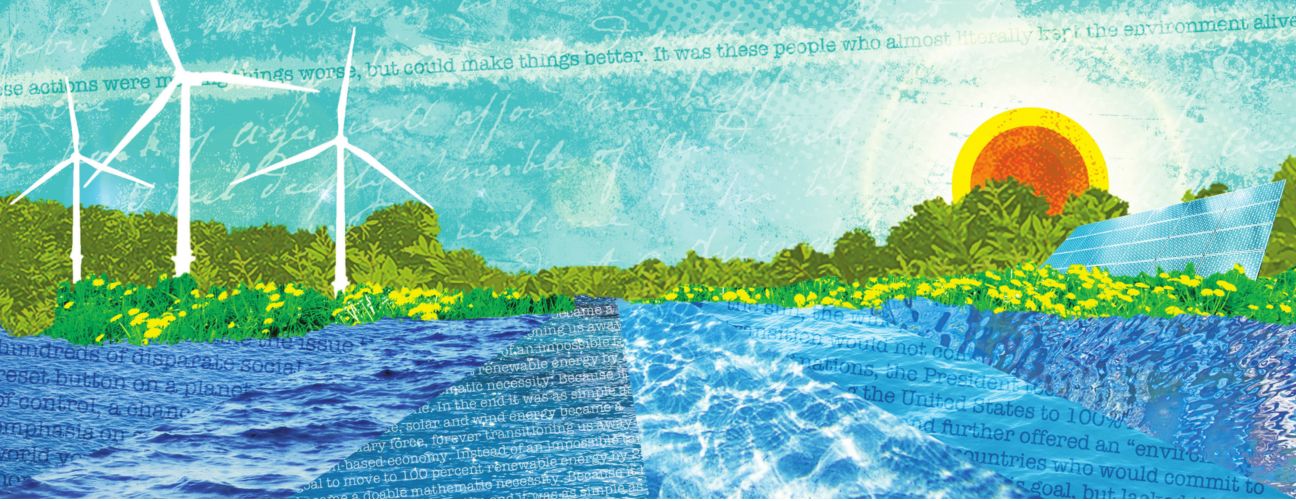
Dear future family, I know you will not read this note until the turn of the century, but I want to explain what things were like back in 2015, before we fi gured out how to roll back climate change. As a civilization we were still locked into a zero-sum idea of our relationship with the natural world, in which we assumed that for us to get whatever we needed, whether it was food or energy or entertainment, nature had to be diminished. But that was never necessarily the case.
In our time, the U.S. Department of Agriculture still handed out subsidies to farmers for every bushel of corn or wheat or rice they could grow. This promoted a form of agriculture that was extremely productive and extremely destructive – of the climate, among other things.
Approximately one-third of the carbon then in the atmosphere had formerly been sequestered in soils in the form of organic matter, but since we began plowing and deforesting, we’d been releasing huge quantities of this carbon into the atmosphere. At that time, the food system as a whole – that includes agriculture, food processing and food transportation – contributed somewhere between 20 and 30 percent of the greenhouse gases produced by civilization – more than any other sector except energy. Fertilizer was always one of the biggest culprits for two reasons: it’s made from fossil fuels, and when you spread it on fi elds and it gets wet, it turns into nitrous oxide, which is a much more potent greenhouse gas than carbon dioxide. Slowly, we convinced the policy makers to instead give subsidies to farmers for every increment of carbon they sequestered in the soil.
Over time, we began to organize our agriculture so that it could heal the planet, feed us and tackle climate change. This began with shifting our food system from its reliance on oil, which is the central fact of industrial agriculture (not just machinery, but pesticides and fertilizers are all oil-based technologies), back to a reliance on solar energy: photosynthesis.
Carbon farming was one of the most hopeful things going on at that time in climate change research. We discovered that plants secrete sugars into the soil to feed the microbes they depend on, in the process putting carbon into the soil. This process of sequestering carbon at the same time improved the fertility and water-holding capacity of the soil. We began relying on the sun – on photosynthesis – rather than on fossil fuels to feed ourselves. We learned that there are non-zero-sum ways we could feed ourselves and heal the earth. That was just one of the big changes we made toward the sustainable food system you are lucky enough to take for granted.
A teacher, author and speaker on the environment, agriculture, the food industry, society and nutrition, Pollan’s letter is adapted from an interview in Vice Magazine.
Tom Hayden
Green Global New Deal
Dear future generations, At the time I write this, the greatest fissure in global politics is between the affluent white North and the suffering and devastated victims of floods, fires, blazing temperatures, deforestation and war from the Global South. Writ large, the global crisis between rich and poor is the background to environmental and economic injustice.
At the December United Nations climate summit in Paris, the countries of Asia, Africa and Latin America, who will bear the greatest burdens of the crisis, will be demanding a Global Green Fund to pay for environmental mitigation and economic development. The price tag is a paltry few billion dollars at this point, compared to the $90 billion cost estimates for the wars in Iraq and Afghanistan plus the budgets of our surveillance agencies.
What is needed is a Green Global New Deal funded from public and private sources to begin saving the earth.
The mass movement will gain momentum, unfortunately, from repetitive climate disasters that require billions for infrastructure alone. Si, se puede, it can be done because there is no alternative. That’s why producing affordable zeroemission cars is important in Hunters Point (the African-American center of San Francisco) and Boyle Heights (the heart of Los Angeles’ Mexican- American community) and the barefoot Third World bloc representing a majority of the world’s nation states.
California Senate President Pro Tem Kevin De León, a leader in the cause of environmental justice, has legislated a remarkable shift in environmental and budgetary priorities in the state where I reside. Call it the California Model. Current law now requires that environmental funding go both to reduction of carbon emissions and co-equal benefi ts for disadvantaged communities. During the four years beginning in 2014 the state will invest $120 billion on such a climate justice program from sources including the much-debated cap-and-trade program which brings in at least two or three billion annually along with revenue from tax reforms funded by Tom Steyer, the billionaire San Francisco investor who has made climate justice his passion.
 This
model is being carried by California Gov. Jerry Brown’s administration
by a series of state and regional pacts with the goal of achieving a
more stable climate. Almost alone, the governor is pursuing energy
diplomacy with formal agreements with 11 U.S. states, and a growing list
of major countries from China to Brazil to Germany. Call it the
emerging Green Bloc. By Brown’s conservative numbers, the Green Bloc
represents 100 million people and a GDP of $4.5 trillion. But these
numbers are low: by my estimate we are talking about 166 million people
in states pursuing low- to no-carbon policies in American states with
262 Electoral College votes! Tea Party beware.
This
model is being carried by California Gov. Jerry Brown’s administration
by a series of state and regional pacts with the goal of achieving a
more stable climate. Almost alone, the governor is pursuing energy
diplomacy with formal agreements with 11 U.S. states, and a growing list
of major countries from China to Brazil to Germany. Call it the
emerging Green Bloc. By Brown’s conservative numbers, the Green Bloc
represents 100 million people and a GDP of $4.5 trillion. But these
numbers are low: by my estimate we are talking about 166 million people
in states pursuing low- to no-carbon policies in American states with
262 Electoral College votes! Tea Party beware.
We are entering the pre-post-Brown era in California along with the pre-post-Obama era in the nation, intensifying the urgency of electing a governor, president and offi cials with the best ability to navigate the critical transitions ahead.
A lifelong political activist and author, Hayden is a former member of the California legislature.
To read more letters visit www.illinoistimes.com or to write a letter of your own, please visit LettersToTheFuture.org. This is a collaborative effort between this newspaper, the Association of Alternative Newsmedia and the Media Consortium. You can also like us on Facebook at www.facebook.com/ LettersToTheFuture. ParisClimateProject.