
In his 23rd book of poetry, Springfield poet John Knoepfle uses his voice – customarily cagey and perhaps even more intimate than usual – to deliver quietly crucial insights about what it is to be a thoughtful nonagenarian in the U.S. in the 21 st century. Or maybe what it is to be John Knoepfle in the 21st century.
The 57 short poems often comment on their own aims, their own making, as in “night of the meteor shower”: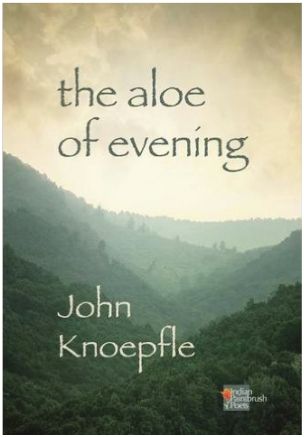
well just spinning lines this is what I can do always with that pressing desire they would be better … searching the sky in the early dark lost for a moment in outer space becoming someone other than the man you know you are
It sounds as if a lifelong poet isn’t sure of what he is doing. Perhaps that’s one of his messages – no one is sure what to make of life and the intrusions upon it. These poems often are populated with noise going on outside of them – ringing telephones, fuzz from the television – and also with the human infirmities that may hinder the poems’ creation, but also inform their subjects, as in “what to say about this”:
now my eyes are tearing the left eye especially … shivers too down my spine … what to do about my itches that time of year house too dry for an old man
And of course, as in “blessings to fill a long life,” there is the chief concern of poets and old men: “[i] need to turn from the past/ face into the future/ short as this will be perhaps/ this doorway to eternity.”
In Aloe, we do not see the prospect of death in the idealistic late T.S. Eliot or Wallace Stevens sense. Knoepfle’s carefully crafted, deceptively spare poetics draw us into a conversation with, not the poet, but with the man who is the poet. So, the simple but difficult gifts Knoepfle offers in this collection kindly require reader and writer to be brave together – to face the inevitable as a human experience of the mind and the body.
In the poem “Christmas at hickory glen” (the retirement community in which he lives), he reminds us “we are not made forever.” While traveling that distance toward that doorway to eternity, John Knoepfle’s plainly stated ambition is “to write these lines/ to come to a close.” He’s not just talking about the poem’s close, but also of our own. Accomplishing that close is not as easy as his poems would seem to make it sound. Sometimes, he looks back and sees “this empty page/ I so wanted to say something.”
In case he doesn’t know, let me say this publicly: John, you have said something.
For me, likely for many readers, you are that “stranger/ who went out of his way to help.” Your unflinching truths, your honest words do that.
Rodd Whelpley is a writer living in Chatham. His poems have been published in magazines, including The Minneapolis Review of Baseball and Elysian Fields Quarterly and other journals. His novel, Capital Murder, appeared in 2001 and disappeared shortly thereafter.
Book signing
A shared opening for John Knoepfl e’s The Aloe of Evening, Barbara Olson’s On the Rez and
Sandy Baksys’ A Century of Lithuanians in Springfi eld, Illinois will be Nov. 12, 5:30 to 7:30 p.m., First Presbyterian Church, Seventh and Capitol, garden entrance, with authors’ signings and refreshments.