
Rail project uncovers evidence of 1908 race riots
When Floyd Mansberger and Christopher Stratton at Fever River Research began their archaeological investigation of 10th Street between Madison and Mason streets in Springfield, they knew the probability was high that they would uncover something significant. Thanks to extensive archival research on this particular site, they had a good idea of who had occupied this block, and why those occupants left. The only question was the status of the site’s integrity, and to what degree the material record would corroborate the written record.
And then, with a few scrapes of the backhoe against the test area, they found it. The foundation of a humble house, which had been home to several working class families over the 60-odd years it stood at that spot. And within the foundation, under a thin layer of yellow silt loam, was the ash that had been deposited the night of Aug. 14, 1908, when that house was burned down by an angry mob during the Springfield race riots. Further excavation revealed the foundations of seven houses, five of which had evidence of being destroyed by fire.
Rail consolidation triggers discovery
 The houses were excavated as part of the Springfield Rail Improvements Project to consolidate all railroad passenger and freight traffic from the Third Street corridor to the 10th Street corridor in an effort to reduce congestion, improve safety and enhance livability in Springfield. The consolidation effort is being led by the City of Springfield, in cooperation with Sangamon County and the Illinois Department of Transportation, and managed by Hanson Professional Services, Inc.
One aspect of the consolidation project involves the construction of eight underpasses designed to relieve automobile congestion at railroad crossings. Work began on the first of these underpasses, at 10th and Carpenter streets, after the adjacent land was acquired from St. John’s Hospital in the fall of 2014. The scope of work includes lowering Carpenter Street between Ninth and 11th streets, constructing dual-track railroad bridges, and completing three blocks of draining, grading and sub-ballast south of Carpenter Street.
Because the consolidation project relies in part on federal funds ($152 million of the estimated $315 million price tag), it must obey federal environmental planning and historic preservation laws, including Section 106 of the National Historic Preservation Act, which requires that projects receiving federal funds consider effects on historic properties.
 In compliance with Section 106, Hanson contracted Fever River Research to do a Phase I archaeological survey of the land associated with the Carpenter Street project to determine the site’s potential for intact archaeological resources. This initial survey consisted of extensive archival research into maps, census records, city directories and chains of title to determine the history of occupancy on the site.
Mansberger quickly realized that the area under investigation included the sites of several houses in the area devastated by the Springfield race riots in 1908.
“Our archival research suggested there were a series of houses there that had been destroyed by the race riots. The only question was, would they be undisturbed and intact?” he explained.
Based on their research, the Fever River team identified multiple areas where historic structures had been documented, subsequent ground disturbance appeared to be minimal and the research potential was high. In consultation with the Illinois Historic Preservation Agency, it was decided that these areas would be subjected to further archaeological investigation.
At the first test area (Block 3), located along 10th Street between Mason and Madison streets, Phase II investigation of the site began with the excavation of a single backhoe trench. As soon as the trench was opened, however, Mansberger and Stratton discovered the intact structural remains of seven houses. The investigation broadened to a larger block excavation. Each house was mapped, and at least one test unit was dug by hand at each house to assess the depth of the archaeological deposits, the presence or absence of cellars and the nature of the fill deposits in each house.
The second test area (Block 14), located between Mason and Reynolds streets, was subjected to a similar investigation. A backhoe was used to strip the top layer of soil, revealing the remains of two structures dating to the mid-19 th century, as well as several privy pits at the rear of the lot lines. Ten of these privy pits were sampled.
The fragments of the past that are coming to light at these sites paint a fascinating and dynamic picture of the transformation wrought by social changes in 19 th century Springfield.
“It’s the story of an evolution of an urban environment in Illinois,” Mansberger said.
“From a white working class area to an integrated neighborhood to a neighborhood in decline.”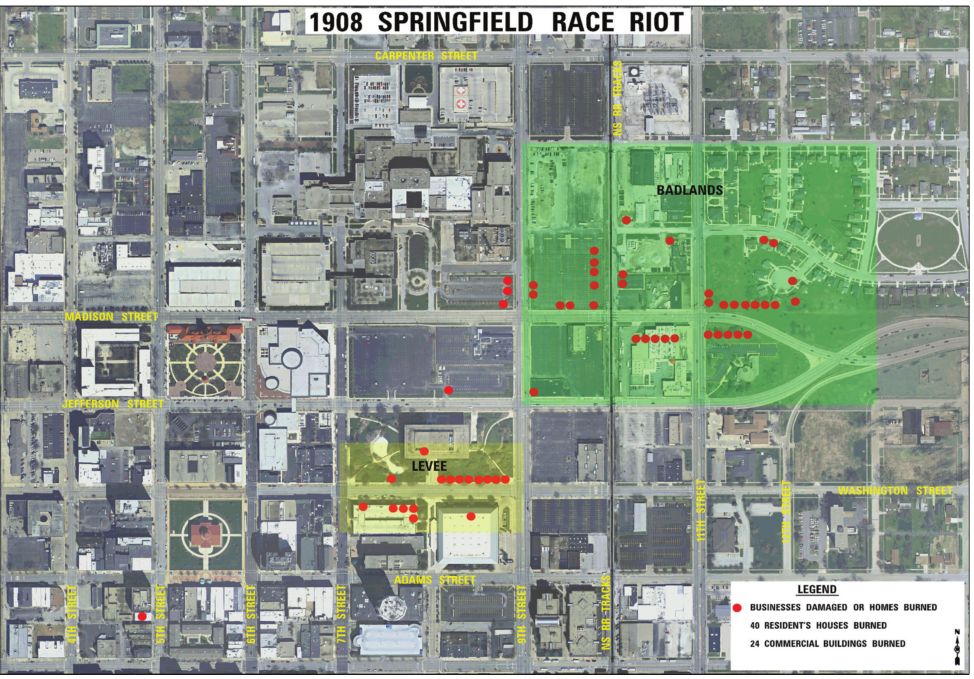
And ultimately, to the destruction of that neighborhood, during one of the darkest chapters of Springfield’s history.
Evidence of a dynamic neighborhood
The
small houses along 10th Street that ended their existence as
dilapidated shacks torched by an angry mob started as the tidy dwellings
of upwardly mobile white working class families built in the 1840s and
1850s. The near north side neighborhood in which they were located
offered affordable housing that was close to the central business
district. The residents of this neighborhood were a mix of nativeborn
Americans as well as German and Irish immigrants. Many of them were
tradesmen (cabinetmaker, hatter, etc), while others worked as millers or
firemen at the nearby Phoenix Mill. Two of the houses were likely
constructed by John Roll, a local building contractor, and operated as
rental properties. Roll was a friend of Abraham Lincoln’s who had also
done work on Lincoln’s house. In 1861, the Lincoln family left their
dog, Fido, with Roll, who had small sons near Willie and Tad’s age.
A
little to the north, in Block 14, were the homes of several Portuguese
families, in an area representing the southern extension of a near north
side neighborhood known as “Little Madeira.” After fleeing religious
persecution in their home island of Madeira, several hundred Portuguese
emigrants settled in Springfield between 1849 and 1852. “Little Madeira”
was one of the earliest and largest Portuguese settlements in the
Midwest [see “When Springfield took in Portuguese refugees,” by Erika
Holst, IT, Sept. 24].
The
project area includes the archaeological remains of two structures. One
is a residence built as a single-family home in the mid-1850s and
converted to a duplex by c. 1860 on a lot owned by Portuguese immigrant
Mary Ferreira. The second is a two-story frame structure that housed a
grocery store on its first level and residential quarters on the second
floor. The grocery story was likely built by Portuguese immigrants John
and Manuel Mendonca around 1867.
Although
the structural integrity of the duplex and the grocery store has been
compromised by 20th century construction, the lots on which they sit
show evidence of several suspected privy pits. Because privy pits served
as garbage receptacles in the 19 th and early 20 th centuries, these
features have the potential yield and exciting array of artifacts that
would provide a wealth of information on the early life and foodways of
this ethnic population.
Orgy of violence
By the late 19 th century, the neighborhood represented
in the archaeological project area was in decline, comprised of aging
and dilapidated low-income houses, many of which stood vacant. It was in
an area of town known as the “Badlands,” populated by poor
African-Americans and immigrants. There, in the sweltering heat of
August 1908, longsimmering racial tensions erupted into an orgy of
violence and destruction that reduced more than 40 black-owned homes and
businesses to smoldering heaps of ash.
Tension
had been building in Springfield for years before the race riots broke
out. Springfield’s factories and coal mines drew a large influx of
Southern blacks to the city; native-born white American and European
immigrants alike resented black competition for blue-collar jobs. And in
an era where whites clung to rigid ideas of social and racial
hierarchy, the arrival of a large influx of blacks seemed to threaten
white social and economic dominance.
This simmering racial tension reached the boiling point on Aug.
13, 1908, when 21-yearold Mabel Hallam claimed that a black man had
crept into her home, dragged her from her bed and assaulted her. She
identified her assailant as 36-year-old George Richardson, a laborer who
had been working in Hallam’s neighborhood. Despite Richardson’s
protests that he had been at home with his wife when the attack took
place, he was arrested and taken to the Sangamon County jail.
 The
public was outraged at the alleged crime. The idea that a black man
would assault a white woman was the specter that haunted many a white
supremacist nightmare, and countless acts of racially motivated violence
against blacks have been perpetrated in the United States in the name
of protecting white women’s honor.
The
public was outraged at the alleged crime. The idea that a black man
would assault a white woman was the specter that haunted many a white
supremacist nightmare, and countless acts of racially motivated violence
against blacks have been perpetrated in the United States in the name
of protecting white women’s honor.
On
Aug. 14, not long after Richardson’s arrest, a vengeful crowd gathered
outside the jail building, their mood growing darker as the hours crept
by and the mercury in the thermometer rose. Knowing that there was a
real possibility the crowd might try to forcibly drag Richardson out and
lynch him, the sheriff, Charles Werner, arranged to have Richardson and
another black prisoner spirited out of the jail and put on a northbound
train to Bloomington.
The
crowd’s temper was not improved by the realization that the objects of
their vengeance had been spirited away. They milled about uncertainly
for a time, then were energized by the news that restaurateur Harry
Loper had loaned his car as the getaway vehicle. With shouts and
threats, the crowd made its way south to Loper’s restaurant.
After
an hour-long standoff with Loper, who stood in the door of his
restaurant with a loaded rifle, violence erupted. Loper’s car, parked in
front of the restaurant, was turned over and set ablaze. A brick was
sent crashing through the restaurant’s plate glass window. Amid shouts
of “curse the day that Lincoln freed the niggers,” the mob rushed into
Loper’s establishment and utterly demolished it, smashing tables chairs,
plates, glasses and mirrors.
The
flame of violence, once ignited, was not readily extinguished. From
Loper’s restaurant, the crowd moved on to the Levee, a red-light
commercial district along East Washington Street which housed several
black-owned businesses. There they laid waste to whole blocks of
black-owned businesses, being careful to spare property owned by whites.
The Journal reported that “within a short time the east end of
the levee was the scene of a brilliant illumination which cast its
baleful glare over the entire city.” When firemen tried to put out the
blaze, the mob promptly cut their hoses. Weapons were fired with
impunity, resulting in dozens of injuries and a handful of deaths.
Finally,
the mob moved on to the Badlands, where it continued its hellish
devastation. Torches were applied to black-owned homes, while those of
whites (indicated by white handkerchiefs) were spared. According to the Journal, “terror-stricken
men and women rushed from the houses and fled for their lives, with
frenzied whites in wild pursuit.” A black barber named Scott Burton was
beaten senseless, dragged from his home, and lynched from a dead tree;
his body was then riddled by bullets and slashed by knives.
By
the time the riots were finally quelled by the state militia on
Saturday, Aug. 15, two black men had been killed by the mob, five white
men had died of wounds sustained during the melee and more than 100
people had been injured.
One
of them was a black man named William Smith, of 301 N. 10 th St. The
newspaper reported that Smith was “tied to telegraph pole and face
beaten to jelly.” The foundation of the house where Smith lived was one
of those unearthed by the Carpenter Street underpass archaeology. The
stoop across which Smith was dragged from the safety of his home by a
violent mob survives, preserved under the earth for more than a century.
Deposits of ash and charred artifacts within the foundation testify
that Smith’s house was destroyed by fire even as he underwent physical
assault in the riots.
In the aftermath of the riot, the Journal reported that “on both sides of 10th Street north of Madison Street, there were a row of huts, which were destroyed
by the torch of the mob.” Thanks to archaeological investigation of the
Carpenter Street underpass, we know that there were five houses in that
row, plus two adjacent that escaped destruction. These sites,
undisturbed archaeologically for more than a century, represent a
horrific moment frozen in time.
“The
fact that this block largely was cleared of housing in one devastating
event and never reoccupied, presents a unique opportunity to examine one
enclave of African-American residents at one pivotal point in time,”
Mansberger and Stratton wrote in the site’s executive summary. “The
houses and their contents can be considered part of the forensic
evidence of what was in essence a crime scene.”
The future of the site
For now, excavation at the sites has halted.
The
features were filled with sand and covered with geotextile fabric to
prevent erosion and the site is fenced and monitored by security
cameras. These actions were taken on the recommendation of the Illinois
Historic Preservation Agency to secure the site until a federally
mandated consultation process determines appropriate treatment or
mitigation for the cultural resources contained within.
The
significance of the findings at the Carpenter Street underpass site
means that the project area meets criteria A and D for inclusion on the
National Register of Historic Places as defined by the National Park
Service. Criterion A includes places “that are associated with events
that have made a significant contribution to the broad patterns of our
history.” This criterion is met by the site’s association with the
Springfield race riots, which had a direct role in the formation of the
National Association for the Advancement of Colored People (NAACP) the
following year. Criterion D, which includes places “that have yielded,
or may be likely to yield, information important in prehistory or
history,” is met by the site’s potential to reveal material evidence of
the evolution of an urban environment as well as the race riot.
Because
it meets these criteria, the site is currently subject to the review
process stipulated by Section 106 of the National Historic Preservation
Act. Major participants in the Section 106 process include the Federal
Railroad Administration, the Illinois Historic Preservation Agency, the
City of Springfield and the federal Advisory Council on Historic
Preservation.
As part
of the review process, a series of open meetings were held to give
members of the public a chance to learn about the project and provide
their views. Individuals or organizations with a demonstrated interest
in the project were invited to become “consulting parties,” who will be
involved in the plans for the management of the site’s cultural
resources as the rail consolidation goes forward.
Kevin
Seals, chief environmental scientist at Hanson Professional Services,
explains: “When you have a protected resource, you want to first avoid
[impacting] it, then minimize the impact on it, then mitigate for it. If
impact can’t be avoided or minimized, then we would mitigate.”
Rev.
T. Ray McJunkins, pastor of the Union Baptist Church and cofounder of
the Faith Coalition for the Common Good, is dismayed by the prospect of
the archaeological site being destroyed by railroad tracks.
“In
that case, there’s nothing you can do to memorialize this as an
historical site. When someone wants to visit this site, all they would
see would be railroad tracks,” he said. McJunkins would like to see
further excavations done on the site and the planned tracks adjusted to
accommodate the site.
“Let
us not forget the history of Springfield. The race riots are a part of
that history. More should be done to interpret that story than a marker
placed at a site that isn’t even the actual site of the event,”
McJunkins said.
As
currently conceived, the 10th Street rail consolidation plans call for
the new railroad right of way to go directly over the seven excavated
house foundations. The “consulting parties” sent a letter to Union
Pacific asking the railroad to alter its footprint to avoid the
archaeological features. They are still awaiting a response.
In
the meantime, the “consulting parties” are weighing in on the best
course of action to protect the site, mine its information and share
that information with the public.
Frank
Butterfield, Springfield field office director for Landmarks Illinois,
said “Through community engagement and the consultation process, we hope
to find a solution that minimizes disturbance to this historically
significant site. Our local partners continue to explore ways to
protect, share and interpret the archaeological site and the information
that has been gathered from this ongoing process.”
Suggestions
include erecting a historical marker on the site, conducting further
archaeological excavations of the site, and creating a traveling
exhibition of artifacts recovered from the site.
Fortunately,
the archaeological site is in no immediate danger. Construction of the
railroad right of way will not begin until all eight underpasses have
been built, a process which will take several years. Because the
archaeological discoveries are several blocks away from the Carpenter
Street Underpass, work on that project is proceeding on schedule.
Ultimately,
the city of Springfield has reaped cultural benefits from the railroad
consolidation project because of its use of federal funds. Had the site
in question been under private development, the cultural resources it
contained could easily have been destroyed with no one being the wiser.
As
it is, the excavation has brought to light new information on the
evolution of Springfield as a 19 th century urban environment as well as
on a pivotal, if tragic, moment in this city’s history.
Erika Holst is an historian and author. She is Curator of Collections at the Springfield Art Association.


