
Congressman John Lewis’ new graphic novel and several lectures shine a light on equality
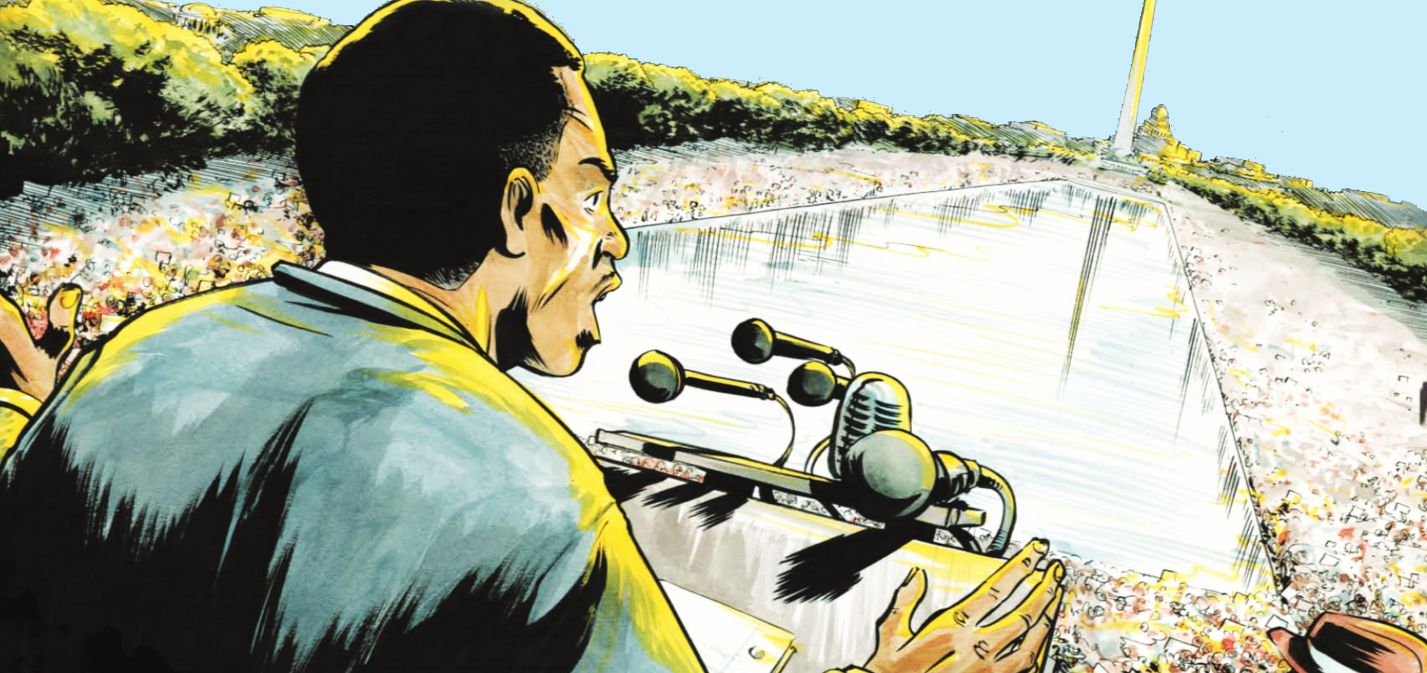
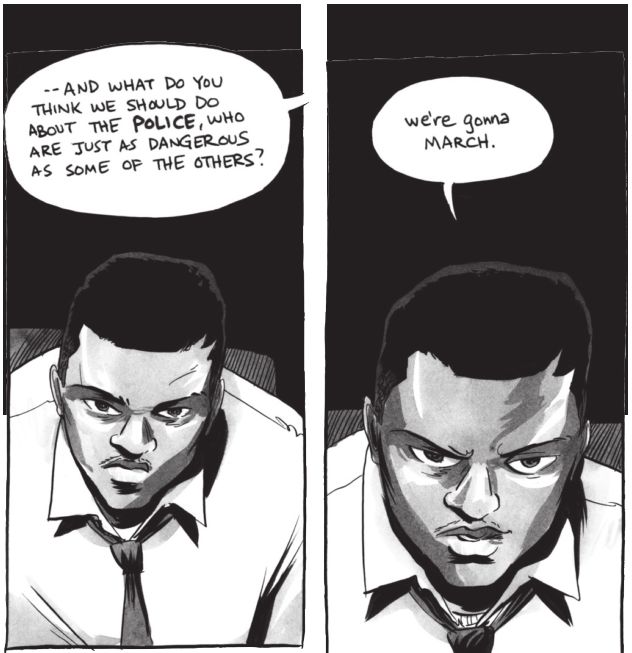
“We are tired. We are tired of being beaten by policemen. We are tired of seeing our people locked in jail over and over again. And then you holler, ‘Be patient.’ How long can we be patient? We want our freedom and we want it now.” – John Lewis speaking at the March on Washington, Aug. 28, 1963 These stirring words, uttered more than 50 years ago, still ring true today. While the struggle for civil rights in the United States has seen a staggering amount of progress since the early 1960s, incidents of racially motivated violence and discrimination are still part of life in America in the 21 st century. A recent study published by the Guardian distressingly indicated that African-Americans are “more than twice as likely to be unarmed when killed during encounters with police as white people.” Names such as Eric Garner, Michael Brown and Trayvon Martin have become associated with the public’s most recent realization that there is still much work to do in our country’s struggle against racism.
This week sees a flurry of activity in Springfield relating to the history – and prehistory – of the civil rights movement. On Oct. 7, James A. Lewis, U.S. attorney for the Central District of Illinois, spoke at Lincoln Library about his days as a freedom rider and civil rights lawyer in the 1960s. On Thursday, Oct. 15, at 7 p.m. the 2015 Lincoln Legacy lecture series will present multiple speakers on the subject of “Lincoln and voting rights.” Perhaps most impressively, on Monday, Oct. 19, Congressman John Lewis (no relation to James) will be appearing, along with his artistic collaborators, at Sangamon Auditorium as part of the university’s “One Book, One UIS” series to discuss the ongoing multivolume memoir MARCH, co-written by Lewis and Andrew Aydin and illustrated by Nate Powell. The book details, in graphic novel
form, Presidential Medal of Freedom recipient Lewis’s experiences as a
young man at the forefront of the 1960s nonviolent civil rights protests
alongside Dr. Martin Luther King. Book one of MARCH was published in 2013, book two came out earlier this year and a third volume is forthcoming.
The two available volumes of MARCH are
beautifully executed and emotionally affecting in ways a straight
memoir might have difficulty achieving. At one time, using the graphic
novel format to tackle serious historical and journalistic subject
matter may have seemed like a novelty, but more than 20 years after Art
Spiegelman’s holocaust remembrance Maus won the Pulitzer prize for literature, it isn’t so strange. The late Harvey Pekar’s American Splendor series and Our Cancer Year medical
memoir long ago proved that “comic books” can be a powerful means of
autobiographical reflection, while Joe Sacco’s many dispatches from war
zones in Bosnia and the Middle East have taken graphic storytelling to
new heights of reportage. The two extant volumes of MARCH stand comfortably in this company.
The
book brings into sharp, vibrant focus the life experiences of
Congressman Lewis – an iconic figure in the civil rights movement who
worked closely with Dr. Martin Luther King and has served as U.S.
Representative for Georgia’s fifth congressional district since 1987.
The narrative bounces back and forth in time between the 2009
inauguration of President Barack Obama to Lewis’s experiences in the
civil rights movement in the late 1950s and early 1960s. Early scenes of
his childhood as the son of sharecroppers in Alabama, including an
extended sequence depicting his relationship to the chickens he was
tasked with raising, seem to bring the reader into the narrator’s mind,
seeing what he saw and feeling what he felt. Later in the narrative, as
Lewis takes increasing risks in sit-ins, is fumigated at a Southern
lunch counter or held captive on a bus with fellow Freedom Riders, the
tension and sense of danger is palpable to the reader.
The already considerable power of Lewis’s remembrances are amplified in MARCH by
the expressive and arresting visuals of artist Nate Powell, who brings
these historically and culturally weighted anecdotes to life. “This
material definitely had some unique challenges,” Powell says of taking
on the project, noting that it had much higher stakes than his previous
work in terms of the accurate and responsible representation of
recognizable historical figures. “There was a sense of shared
responsibility to pass on this part of history and to be faithful to the
humanity behind it. One of my first tryout pages was one where young
John Lewis meets Dr. King for the first time. I realized right away that
in rendering the likeness of Dr. King – one of the most recognizable
people on earth – a stray line on his face could change the nature of
recognition and pull the reader out of the drama.”

Powell describes the work on MARCH as
a true collaboration, one that is ongoing as the team continues to work
together on book three. Lewis and his assistant and co-writer Aydin had
been writing and researching the script for years before Powell came on
board, but they soon found a rhythm together. One of his tasks as an
artist was to intuit the emotions between the lines of the script.
“There are moments of anxiety or dread that can’t really be described in
the prose and I rely on my own powers and experience as a writer and
artist to capture those highly subjective moments.”
Touring
the country with the celebrated congressman to spread the word about
the book has been a gratifying and sometimes surreal experience,
according to Powell. “There are unreal moments where we’re getting to be
on ‘Rachel Maddow’ or having breakfast with Al Gore – these are moments
which are mindblowing,” he says. “In the process of drawing these books
I’m meeting some of these figures. And we’re reaching a threshold of
history in which a lot of these folks are passing away even as I’m
rendering them in the book.”
Powell has found public reaction to the book, which reached number one on both the New York Times and Washington Post bestseller
lists, extremely gratifying. “I knew this book was going to be a little
bigger than anything I’d been a part of previously. But I think none of
us had any idea of the potential scope or scale of the project, just
the level of passion and intensity, especially from teachers, librarians
and parents, bringing classes or their entire family to come meet
Congressman Lewis.”
The
experiences and perspective of U.S. Attorney James Lewis, along with
the historical analysis provided by the Lincoln Legacy speakers, (see
article p13) provide insight into and illumination of a struggle that
stretches back centuries and continues today. When added to the
appearance by the creators of MARCH on Monday, this may be one of
the most significant weeks Springfield has yet seen for education in
the vital issues of the right to vote and of civil rights in general.
John
Lewis speaking at the March on Washington, Aug. 28, 1963: “My friends,
let us not forget that we are involved in a serious social revolution.
By and large, American politics is dominated by politicians who build
their careers on immoral compromises and ally themselves with open forms
of political, economic and social exploitation. There are exceptions of
course. We salute those. But what political leader can stand up and say
‘my party is the party of principles’?”
Contact Scott Faingold at [email protected].


