
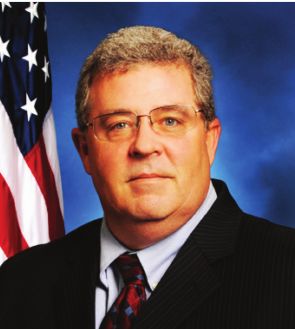
 By all accounts, Illinois Auditor General William “Bill” Holland made the leap from a Senate Democratic chief of staff to his current role as a fiercely independent auditor with ease. He adamantly avoids injecting politics into the audits his office conducts, and he rarely even expresses personal opinions about anything publicly. But Holland is retiring at the end of the year, and his replacement has an even larger chasm to cross.
 On Oct. 6, a legislative panel nominated Rep. Frank Mautino, D-Spring Valley, to replace Holland. Mautino has been a state lawmaker for 24 years, even longer than Holland has been auditor general, and his nomination on Tuesday exposed a rift between Democrats and some Republicans over whether a longtime partisan can transition to a nonpartisan watchdog role.
While Mautino is well-regarded among both Democrats and Republicans in the Illinois Statehouse, two Republicans on the panel took the opportunity to air their concerns about whether the process was transparent and whether Mautino was the best pick for the job.
The office of the Illinois Auditor General examines state agencies and other governmental bodies for mismanagement of finances, programs and property, as well as for adherence to state law and regulations.
The process of replacing Holland fell to the Legislative Audit Commission, a 12-member panel composed of six senators and six representatives, with an even number of Republicans and Democrats from both chambers. After selecting four finalists from the 14 applicants, the panel met in Springfield on Tuesday to decide which of the four finalists to recommend to the full Illinois General Assembly. In addition to Mautino, the three remaining finalists were state Rep. Elaine Nekritz, D-Northbrook; Mary Modelski, division chief of internal audits for Alameda County, California; and Marion attorney Larry Sanders, general counsel of the Rend Lake Conservancy District. A three-fifths vote in each chamber of the General Assembly is required for a candidate to become auditor general.
Of the 12 members of the Legislative Audit Commission, five were present in Springfield for the Oct. 6 meeting; the remaining seven participated by phone.
Before and during the meeting, Republican senators Jim Oberweis, R-Sugar Grove, and Dale Righter, R-Mattoon, suggested that “the fix is in” regarding whom the panel would nominate.
“We’re just going to rubber stamp it,” Righter said on speakerphone while waiting for the two co-chairmen to return from a private conversation in the hall that Righter took for a secret negotiation. “We may not know we’re doing it, but we’re going to.”
“I’m not,” insisted Sen. Iris Martinez, D-Chicago.
“You mean you’re not going to vote for Frank?” Righter asked, implying that Mautino was the presumptive nominee.
Commission co-chairman Sen. Jason Barickman, R-Bloomington, explained that the panel could recommend zero candidates, a single candidate or multiple candidates. Each candidate receiving eight affirmative votes would be recommended to the full Illinois General Assembly, he said. Eight votes constitutes a three-fifths majority of the panel. Co-chairman Rep. Robert Rita, D-Blue Island, urged the panel to select only one candidate to recommend, but Righter and Sen. Jim Oberweis, R-Sugar Grove, pushed the panel repeatedly to recommend two or more candidates.
Barickman asked whether any member of the panel moved to recommend Sanders. No motion was made. Barickman asked the same question regarding Nekritz, but no member spoke.
At that point, Barickman and Rita stepped into the hallway, followed by the three remaining panel members in physical attendance, each of whom seemed puzzled by the interruption. When the group returned about three minutes later, Rep. Barbara Flynn Currie, D-Chicago, nominated Mautino, citing his previous record of service as co-chairman of the Legislative Audit Commission and his years in the Illinois General Assembly. Currie and other members of the panel – both Republican and Democratic – lauded Mautino’s knowledge of government and his willingness to question leaders of both parties.
Before the panel could vote on Currie’s motion to recommend Mautino, Oberweis moved to amend Currie’s motion by adding Modelski, the government auditor from California, as an additional nominee. The panel voted 5-7 against Oberweis’ amendment. Rep. David Reis, R-Willow Hill, originally passed on the vote, but switched to a “no” vote on Oberweis’ amendment after it became clear it would not pass.
The panel then voted 11-1 to recommend Mautino to the full legislature, with Oberweis providing the lone “no” vote. Immediately following the vote on Mautino, Oberweis made a motion to recommend Modelski. Righter called Modelski “eminently qualified,” adding that “the only thing she lacks is political connections.”
Currie responded by saying she takes “strong exception” to the notion that Modelski only lacks political connections. Currie said Modelski’s experience with auditing is mostly financial -- not evaluating programs, as the Illinois auditor general must do. She also said Modelski hasn’t managed an office as large as the auditor general’s staff, and her experience as a certified public accountant dealt more with information technology.
“It has nothing to do with a lack of clout,” Currie said.
Speaking before the hearing, Modelski told Illinois Times by phone that she couldn’t comment on her candidacy. The commission voted 5-7 against recommending Modelski to the full General Assembly.
Mautino told Illinois Times after the hearing that he has no doubt he’ll be an independent auditor general if approved by the legislature. He served for 18 years on the Legislative Audit Commission, 15 of them as co-chairman.
“Most of my history in the House and most of the bills I’ve handled have had a geographic and bipartisan balance,” he said. “I’ve been trusted with sensitive negotiations for that reason.”
He cited his involvement in negotiating a deal on concealed carry of firearms, the University of Illinois trust fund, and a business permitting bill pending in the current legislative session.
“One of my strengths is being able to bring people together with diverse concerns, to cross party lines,” he said. “I think that transitions pretty well into the auditor general’s role.”
Mautino says the auditor general’s 10-year term also helps protect the office from political pressure.
“You’re there beyond the scope of partisan politics and administrations,” he said.
If approved, Mautino wants to pursue a “revisory bill” each session to remove obsolete mandates from state law that result in many agencies being cited for noncompliance even though the legislature hasn’t appropriated funds for certain programs in many years.
Mautino says he’s proud of the fact that his fellow lawmakers from both parties chose him as the only recommendation.
“They said, ‘We believe you can do this with transparency and integrity,’ ” he said. “I’m proud of their confidence in me, and I will work every day to prove them right.”
The current salary for the auditor general is $154,127.