 The ancient story told by Dickson Mounds
The archaeological museum, threatened with closure, sits at a confluence of human history
ARCHAEOLOGY | Erika Holst
In the morning, the landscape is shrouded in mist, and a profound stillness permeates the air, interrupted only by the beating wings of a thousand snow geese as they take flight from the wetlands below. From the observation deck at the top of Dickson Mounds Museum, looking over the ancient terrain, the enormity of the course of human history dances at the edges of one’s awareness, provoking an almost spiritual contemplation of one’s place in the world.
At Dickson Mounds, history is measured not in generations, not even in centuries, but in millennia. The museum’s location near the confluence of the Illinois and Spoon Rivers has witnessed more than 10,000 years of human occupation. Although those ancient native people left no written record of their lives, clues to their culture in the form of personal possessions, remnants of dwellings, and even physical remains survive in the archaeological record and are interpreted by the museum.
“The archaeological legacy of this landscape is extraordinary,” notes Dickson Mounds Museum Director Michael Wiant. “The Illinois River Valley has a remarkable record of human history.”
Dickson Mounds Museum has been interpreting that archaeological legacy to the public for more than eight decades. In 1927, a local chiropractor named Don Dickson discovered a prehistoric burial mound on his family farm. Such discoveries were not unusual in the Illinois River Valley, where plow blades would regularly turn up artifacts and even skeletal remains. But while most farmers viewed these relics as a nuisance and discarded them, Dickson had a personal interest in prehistoric cultures and worked to preserve the burials intact. Drawing on his knowledge of the human skeletal system, Dickson carefully unearthed more than 200 skeletons and left them in situ.
Word of his excavations spread and sparked intense curiosity. Thousands of visitors flocked to view the burial site, which was likened to an American Pompeii or King Tut’s Tomb. The remains they saw were those of an early Mississippian society dating to around 1200 A.D. Many were buried with artifacts such as pottery bowls and jars, mussel shell spoons, bone tools and arrow points.
Although the cultural significance of these artifacts was not well understood at the time, “it was apparent that the objects had been intentionally placed with the remains and probably represented offerings for the afterlife. This practice underscored the cultural sophistication of people long and unfairly The Rauner administration
has said it will retain three employees to care for the museum’s
collections after the buildings are shuttered.
Rauner plans to close Dickson Mounds
Gov. Bruce Rauner still has plans to close the Dickson Mounds museum as part of the Illinois State Museum system, according to the Illinois Department of Natural Resources. That could take place Sept. 30. That’s the date layoff notices take effect for 65 of 68 Illinois State Museum employees, according to Chris Young, spokesman for IDNR.
Earlier this month, the General Assembly’s bipartisan Commission on Government Forecasting and Accountability voted 7-2 against closing the museums, but the vote was a recommendation only, and not binding on the administration. Rauner has said little about the proposed closure, only that it is necessary because of the state budget defi cit. –Fletcher Farrar considered savage,” explained Wiant.
Eager to preserve and share his discovery with the public, Dickson first erected a tent, then constructed a building over the burial mounds and, with his family, operated the site as a private museum. Within 10 years of his initial excavation, more than 250,000 people had visited the Fulton County burial site. Attendance dropped during the Great Depression and World War II. In 1945 Dickson sold the site to the State of Illinois, which continued to operate it under the name Dickson Mounds Museum. In 1965, the site was transferred to the Illinois State Museum system, and in 1972 its current facility was built.
The skeletal remains that Don Dickson first excavated in 1927 remained on view until 1992. That year, in reaction to widespread concerns about the disposition and treatment of Native American remains, the burial exhibits closed. The museum was renovated and new exhibits opened in 1994.
Today, Dickson Mounds Museum is a nationally recognized place to explore and appreciate Native American history. Its 230-acre campus includes a 2,000-year-old mound group called Ogden Site; remains of three 900-year-old buildings called the
Eveland village; two one-room schoolhouses; an 1840s, octagonshaped toll
station for an early plank road, and a picnic area that is available to
the public free of charge.
Inside
the museum, exhibitions lead visitors through 12,000 years of human
history, beginning when the earliest inhabitants arrived shortly after
the close of the last Ice Age to the dynamic social upheaval that
occurred when Native people came face to face with European settlers for
the first time.
Groups
of visitors overwhelmed by the sheer scope of human experience
interpreted within the museum can request a guide through exhibits.
Often Wiant personally conducts tours of the facility. He delights in
taking visitors through the collections area where the museum’s more
than 2,000 boxes of prehistoric artifacts are stored and offering
glimpses of projects in development.
One
such project is the construction of a replica log cabin which will
house 19 th century archaeological artifacts which document the arrival
of American settlers to the Illinois River Valley. This exhibition is a
product of Dickson Mounds Museum’s first major public-private
partnership. Local citizens stepped forward and contributed more than
$30,000 to the creation of new exhibits at the museum.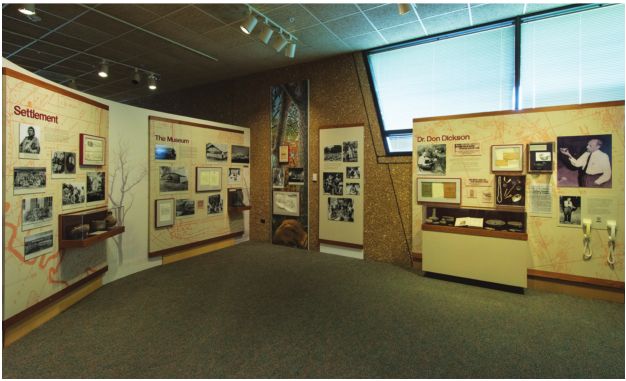
That
public-private partnership is also funding the creation of the Emiquon
Gallery, which will feature the story of the transformation and
restoration of the floodplain by the same name adjacent to the museum’s
campus. Once a complex system of wetlands and lakes that were home to
abundant native plants and animals, the floodplain was drained in the
1920s to be used as farmland. In the early 2000s, The Nature Conservancy
began restoration of this area to its natural wetland state. Today
Emiquon is once again home to abundant native flora and fauna, much as
it was for hundreds of generations prior.
The
Emiquon project “literally pumped new life into the museum,” according
to Wiant. In addition to drawing visitors to Fulton County for
recreational outdoor activities, the project spurred creation of the
Emiquon Partnership, a coalition of sites and organizations that
includes The Nature Conservancy, the U.S. Fish and Wildlife Service, the
UIS Therkildsen Field Station; the Stephen A. Forbes Biological
Station, the Illinois River Biological Station and Dickson Mounds
Museum.
“The Emiquon
Partnership added real muscle to our ability to provide programming,”
said Wiant. “It allows us to do things we can’t do on our own.”
One
of the Partnership’s most anticipated events is the Eagle Day Festival,
which celebrates the return of eagles to the Illinois River Valley each
winter through a variety of exhibits, kids activities, tours and
programming at multiple venues.
Educational
programs draw more than half of the museum’s 50,000 annual visitors.
Another popular program is Artifact Identification Day, at which local
citizens are invited to bring in their collections of artifacts and
fossils, often discovered on their own property, for identification. The
long-running Hickory Ridge Concert series of folk music concerts draws a
regular crowd from as far away as Lincoln, an hour to the southeast,
while the more recent, award-winning Tot Time programming has been
extremely popular with families and children.
“The
importance of this museum as a cultural resource cannot be overstated,”
Wiant said. “In a rural area, people don’t always have the same kind of
access to cultural events as you do in an urban area.”
Luckily
for the citizens of Fulton and Mason Counties, and for Illinois as a
whole, we do have a cultural institution where a team of dedicated
individuals is committed to preserving and interpreting 10,000 years of
human history in our state. For nature enthusiasts and history lovers,
for archaeology buffs and anthropology students, for anyone who wants to
learn more about our place in the world and how we got here, Dickson
Mounds Museum is well worth a visit.
Erika
Holst is Curator of Collections at the Springfield Art Association. Her
first “real” job out of school was at Dickson Mounds Museum.


