New operating system
Nonprofit gets a new operating system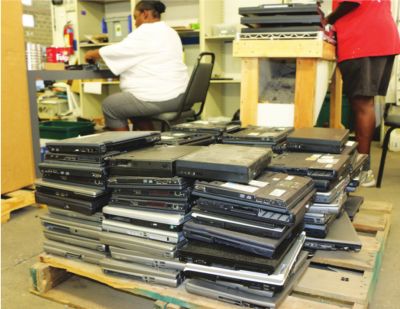
TECHNOLOGY | Bruce Rushton
When Computer Banc first moved into its new headquarters on East Groth Street last spring, the 12,000-square-foot facility, formerly used by United Cerebal Palsy as a sheltered workshop, seemed huge.
No longer. Now, the charity that recycles and refurbishes computers is storing donated computer gear in trailers that haul as much as 13,000 pounds of unusable digital scrap at a time to a Granite City recycling center. Workers, many of them sent to Computer Banc by the Springfield Urban League and Capital Township, tear apart the innards of desktops to salvage what can be used again. More than 1,000 refurbished laptops and desktops, once considered obsolete, are sent out each year to schools, seniors, nonprofit agencies and other deserving recipients.
It’s a long way from the basement of First Presbyterian Church, where Computer Banc was launched in 1999. Just six years ago, Computer Banc, out of money and lacking computers, shut down for two weeks. David Fowler, the agency’s executive director, now works full time at Computer Banc, a step up from the part-time hours he once worked. He is one of four full-time employees who work alongside two part-time employees. The agency, which ran a deficit just a few years ago, now has an annual budget of $320,000, Fowler says.
“When I came here six years ago, we had a $48,000 budget,” Fowler says. “We’ve gone from 120 computers a year to 120 per month.”
Fowler credits corporations for the turnaround. Computer Banc once relied on individuals to donate computers. Now, the charity relies on big business to donate devices en masse and sees opportunity where others see problems.
The demise of Windows XP, for instance, might have been a headache for a lot of us, but it was a blessing for Computer Banc as corporations got new computers instead of swapping out operating systems in devices that were nearing the end of their useable lives in terms of depreciation. Computer Banc simply replaced Windows XP, the digital equivalent of a buggy whip, with current software, and computers that had been considered junk were useful again.
“Memorial (Medical Center) has 2,500 computers in their system,” Fowler says. “You can bet, on any given day, close to 2,000 of them are identical – the big corporations all work that way. Switching from XP to Windows 7, we would get, literally, hundreds of identical computers. … The quality of what we’re offering consumers is much higher. A lot of these computers are only three or three-and-ahalf years old, just off lease in most cases.”
What was once a Springfield-centric collection strategy has now stretched throughout central Illinois, with companies as far away as Jacksonville and Bloomington donating computers to Computer Banc, which has widened its distribution strategy. In the old days, the charity concentrated on providing low-cost computers to low-income families.
Now, Computer Banc also provides computers to schools, nonprofit agencies, veterans, lowincome college students, adults with special needs and military personnel and their families. And the agency aims to get even bigger.
Look out, Microsoft
For years, Computer Banc, by necessity, swore by PCs.
Unlike Microsoft, Apple doesn’t have reduced software licensing fees for nonprofits that provide low-cost computers to the poor. Without access to low-cost operating systems, Computer Banc couldn’t exist, given that a legally licensed Windows operating system typically costs at least $100.
“Other than being altruistic, they’re (Microsoft is) trying to keep the Linuxes of the world at bay,” says Bob Pietras, a retired Horace Mann IT manager who once served on Computer Banc’s board and remains a volunteer at the agency.
The online operating system called Linux is free, an f-word that
software companies dread. Android smartphones and some netbooks operate
on Linux, but it has, historically, been fairly rare in the world of
consumer computers – fewer than 2 percent of the planet’s desktop
computers run on Linux.
Then
came Google. In 2010, Google debuted the Chromebook, a super-cheap,
super-light, super-easy-to-use laptop intended to revolutionize the
world of portable computers. Dubbed Cr-48, the first Chromebook was
never offered for sale. Rather, Google in a pilot program distributed
60,000 free ones to participants who signed up online and were warned
not to expect miracles from the machine that ran on a Linux-based
operating system called Chromium.
“The
pilot program is not for the faint of heart,” the company told
applicants who promised to tell the company what they liked and didn’t
like about the new devices. “Things might not always work just right.”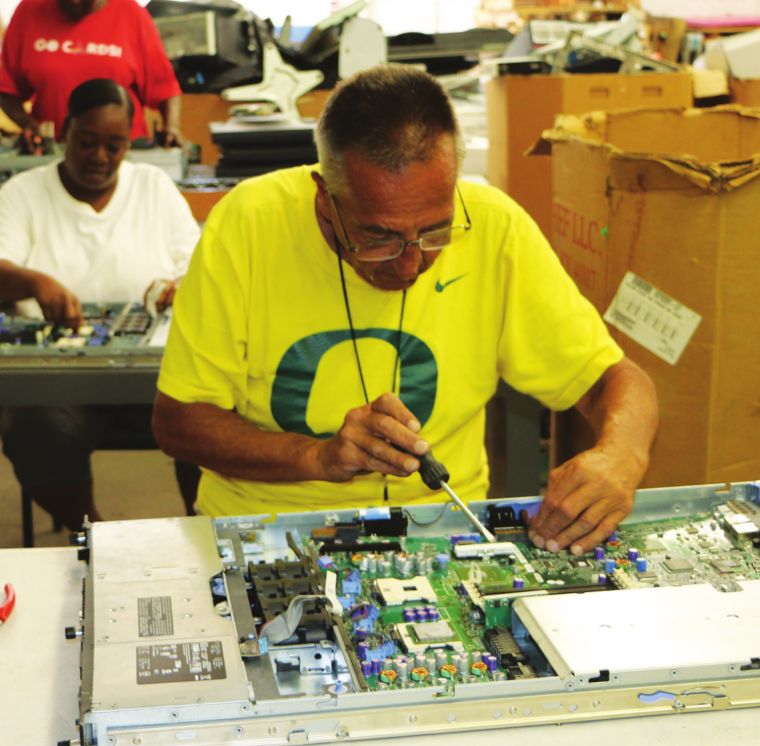
Things
worked wonderfully. Within six months of Google’s rollout, Samsung
introduced its own Chromebook. Acer, Lenovo, Dell, Hewlett Packard and
other companies weren’t far behind.
Unlike
a PC, which relies on a hard drive to store information internally, a
Chromebook uses remote servers to store data in the so-called Internet
cloud. A Chromebook is, essentially, a portable browser with a keyboard
that relies on a free operating system rather than one that costs money.
With the same amount of data storage as on a typical smartphone, a
Chromebook starts up in seconds, typically weighs less than three pounds
and sells for as little as $150.
Without
the Internet, a Chromebook is near useless. But they’re ideal for folks
who don’t need a computer for much more than surfing the Internet,
sending email and poking around Facebook. And they have taken the
nation’s education system by storm.
Computer Banc goes chrome
Computers in schools have proven both godsends and disasters.
Los
Angeles, where taxpayers have spent $1.3 billion to provide every
teacher and student with an iPad, has seen one of the biggest debacles.
Equipped with specialized software, the iPads, which cost $968 apiece,
didn’t work as billed, with students able to easily bypass security
filters designed to keep them focused on their studies while software
glitches made it impossible to access curriculums. The FBI raided Los
Angeles Unified School District offices last year as part of an
investigation into suspected bidding improprieties, and the district has
notified both Apple and the curriculum software provider that it will
seek millions of dollars in refunds.
While
Los Angeles’ experiment with iPads imploded, Chromebooks in the third
quarter of last year outsold Apple in the U.S. education market, with
Google shipping 715,000 of the devices to schools compared with 702,000
iPads, according to Financial Times. Suddenly, what seemed like a
solid grip by Apple on the educational market for computers wasn’t such
a sure thing. The trend has not gone unnoticed in the Springfield area.
Starting
in the 2013-14 school year, the Rochester School District has issued a
Chromebook to every student in grades 4 through 12. Families pay $75 per
year for each computer and own the devices after three years. Students
eligible for free lunches can use loaner computers free of charge. Only
Chromebooks are allowed in classrooms – the district says that all
training is geared toward Chromebooks and that use of other devices will
consume precious bandwidth.
There
have been no FBI investigations or demands that Chromebook vendors
refund money in Rochester. Thomas Bertrand, superintendent of the
Rochester School District, says that the technology is working well, and
he predicts that demand for computers in schools will only grow.
“We’re
all about career readiness and college readiness,” Bertrand says.
“Every kid gets a computer. I’m not sure that people would appreciate it
if we tried to go back.”
It’s that kind of thinking that grabbed the attention of Computer Banc, which had never strayed from PCs and Windows.
“Six months ago, we decided, ‘If you can’t beat ’em, join ’em,’” Fowler says.
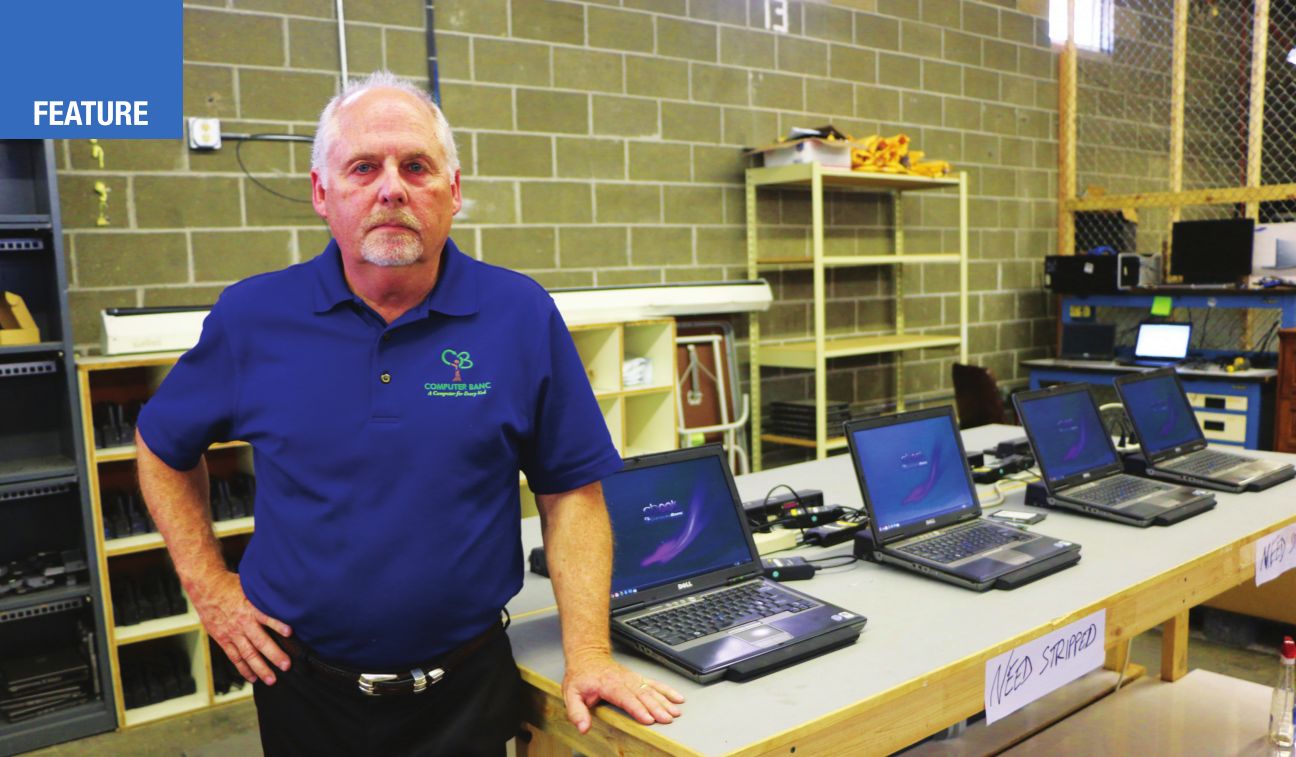
So began an effort to convert castoff PC laptops into Chromebooks.
While
Chromebooks are thin, light and available in all sorts of colors,
Computer Banc chose the tried-and-true Dell Latitude D620 to become what
Fowler and his colleagues call the cbook – the “C,” they say, stands
for “cloud,” not “chrome.”
Once the darling of
corporate America that needed laptops en masse to distribute to
employees, a black-and-grey Dell Latitude D620 is not anyone’s idea of
sexy. An optional extended-life battery plugs into the outside and hangs
off the unit below the keyboard, like some sort of electronic tumor.
Even when they debuted nine years ago, with an MSRP of nearly $900, they
weren’t considered elegant. In a 2006 review, notebookreview.com
described the appearance as “an industrial and muscular look.”
“The
industrial looking aesthetics are true to the actual build of this
business laptop,” the reviewer wrote. “The D620 is very sturdy. It uses
an all magnesium-alloy case. This results in strong overall physical
protection of the notebook, worry-free of case cracks appearing or
problems with excessive flexing. The hinges are constructed of steel.
Dell claims they have been tested for up to 20,000 cycles (openings and
closings) to assure freedom from loosening and wobble.”
In
short, Fowler and his cohorts figured, the perfect beast to withstand
punishment only a sixth-grader can deliver, and they are quick to point
out that Chromebooks used by school districts are often made from
plastic. Districts also tend to use Chromebooks with 11-inch screens. A
Dell has a 14-inch screen.
“Which would you rather look at all day?” Pietras asks.
Corporations
snapped them up, and Dell D620s have become cheap and easy to find now
that they’ve been surplused. They sell for as little as $35 apiece
online.
“If I had the funds in my pocketbook, I guarantee I could buy 10,000 in 90 days,” Fowler says.
Parts
are also ubiquitous. And a Dell D620 is simple to fix if something goes
wrong. Joshua Hawkes, lead technician, boasts that he can completely
disassemble one with a flathead screwdriver and a Phillips screwdriver.
“Put it this way: I was in management for 20 years,” Pietras says. “Even I can take one of these things apart.”
Inventing software
Once
a computer was chosen to become Computer Banc’s version of Chromebook,
the next step was creating an operating system to mimic the
Google-designed system used on bona fide Chromebooks. The task fell to
Hawkes.
"We can’t save you money on all of your computers, but we can save you money on some of your computers"
“First off, the term ‘hacker’ is a bit of a misnomer,” Hawkes said.
Hawkes, in fact, didn’t do anything illegal.
Linux, the open-source software on which the Chromium operating system is based, comes with a significant string attached.
“If anybody asks ‘How did you do this?’ you have to provide code,” Hawkes says.
With
the inner workings of Chromium available for anyone to see online,
Hawkes figured out how to clone Chromium so that a cbook would work
exactly the same as a Chromebook. Converting PCs to Chromebooks had been
done before – as long ago as 2011, software geeks were posting howto
instructions on the Internet. But Computer Banc developed a way to do it
on a scale that makes it possible to produce large numbers of devices
at a low cost.
“No one
out there has offered to take on any kind of mass production, even a
small mass production like ours, where you’re selling the hardware and
the software as a package,” Fowler says. “No one in the country, except
for Computer Banc, has been able to do this.
Here in your little backyard of Springfield, you’ve got a nonprofit that’s doing something revolutionary.”
In
addition to developing a copycat of Chromium, Computer Banc says that
it has also made it virtually impossible to remove, alter or replace a
cbook’s operating system, an important factor for school officials and
parents who want to make sure that everyone uses the same operating
system and that security devices work. Similarly, USB functions and DVD
players on the Dells have been rendered inoperable to mimic true
Chromebooks, which have no such functions.
There
is a way to turn a cbook into a PC again, but Hawkes is confident that
kids won’t be able to figure it out, nor will they be able to disable
security functions the way that students in Los Angeles were able to
bypass security functions on iPads designed to keep the darker reaches
of the Internet off limits.
“Nothing’s
bulletproof – anything can be hacked,” Hawkes says. “But you have to
have experience to know how to do that. We have a lot of experience
figuring out how to prevent that. We don’t make it easy.”
The
cbook has inspired a new way of thinking at Computer Banc, which has
divided its production floor in half, one side for PCs, the other for
cbooks. Fowler dreams of the day that he’ll be purchasing Dell laptops
in bulk to meet demand for cbooks instead of relying on donations. But
first, Computer Banc needs customers.
Making the sale
Stockpiling
cbooks and waiting for customers isn’t practical for an organization
the size of Computer Banc, which perfected the cbook last spring and has
so far produced only a handful.
“We
need purchase orders,” says Fowler, who figures Computer Banc could
produce 1,000 or so cbooks in relatively short order. “The schools need
to, at least, seriously look at what we’re doing. If they’re going to
make a major purchase, why wouldn’t they test our computers? … I’m not
saying Chromebooks are bad. But there is an alternative. These guys can
save money.”
Fowler
made his pitch last April at a regular meeting of area school
superintendents organized by the Sangamon-Menard Regional Office of
Education. It was, Fowler recalls, a promising start.
“One of the superintendents looked at me and said out loud, ‘Sold,’” Fowler recalls.
But,
aside from the regional superintendent’s office, which has ordered 17
cbooks for students who have been suspended or expelled and attend
special classes at Capital Area Career Center, no school system has, so
far, ordered a cbook.
Jeff
Vose, regional superintendent, said that low cost was behind his
decision to buy cbooks. The regional office got a reduced price and is
scheduled to receive 17 cbooks and five desktop computers for $2,000.
“It’s
a cost-effective way to provide laptops or computers to students and to
districts versus a traditional way of getting a bid from a large
contractor,” Vose said.
Vose said his only concern is service and response time in the event a computer breaks.
“If they can do those two things, I’m pretty confident we’ve made the right decision,” Vose said.
If
a cbook breaks for any reason within two years, Computer Banc will
replace it for $45. If the cause is a defective part or workmanship,
repair or replacement is free. That’s a lot less than most three-year
Chromebook warranties that typically cost about $100 and may never be
used, Fowler says. A cbook equipped with a new battery, hard drive and
charging cord costs $148, and if it doesn’t break, a district pays
nothing further. The cheapest Chromebook costs about $150, plus the cost
of an extended warranty, plus a $30 fee to register the device with
Google, Fowler says.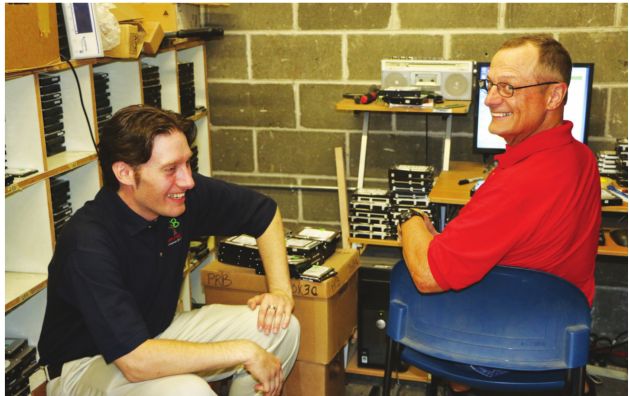
On
the other hand, a cbook weighs more than 5½ pounds, nearly twice the
weight of a Chromebook. Battery life is mediocre, with the battery on a
cbook tested by Illinois Times lasting four hours, half the time that a typical Chromebook will run on battery power.
For
Vose, such issues aren’t major, given that cbooks won’t be going home
with kids or straying far from electrical outlets. But it can be an
issue for districts that want computers that kids can tuck under their
arms and take between classes before toting them home.
“The
hardest thing in the middle of the day is to find a charging station,”
says Jennifer Gill, superintendent of Springfield School District 186.
“The heaviness, I think, is a factor.”
Fowler
has no illusions. There are 11,000 students enrolled in Springfield
schools, and there is no way that Computer Banc could produce enough
cbooks for all of them. But he says that Computer Banc could be part of
the solution for the district that is now considering computer options
for students and staff.
“We can’t save you money on all of your computers, but we can save you money on some of your computers,” Fowler says.
The
district in 2014 dramatically cut computer expenses due to budget
concerns, opting not to renew a deal with Apple, which had supplied the
district with 6,000 computers, upgrades and maintenance at an annual
cost of nearly $2 million. But computer purchases are expected to pick
up again. The district has experimented with Chromebooks, distributing
eight different types to students in fifth grade to high school in a
pilot project to see which brands work best.
Gill
praises the affordability of Chromebooks, and she isn’t ruling out
Computer Banc. What’s best for students, she emphasized, has to be the
priority.
“It
certainly isn’t anything we want to shut the door on,” says Gill, who
met with Fowler for an hour last week to talk about cbooks.
Other superintendents, however, are wary about large computer purchases.
In
the Williamsville School District, students have access to computers,
but there are not enough for everyone. During last year’s state-mandated
standardized testing that required computers, every available unit was
used for tests, leaving no computers available for classroom
instruction, said David Root, superintendent of Williamsville schools.
“It
was almost two months where teachers who wanted to use computers, they
couldn’t because the computers were being used for the (standardized
tests) the state has imposed on us,” Root said.
Root
is a fan of Computer Banc and has acquired computers from the charity
in the past. But he’s not certain that spending money to provide every
student with a laptop is a wise use of resources for cash-strapped
school districts. He also says that computers have to be used wisely.
It’s not enough for students to know how to use a computer to find the
answer to a question, he says. Rather, they must know how to find the
answer without a computer. Root says that he would never choose a
machine over a teacher.
“Nothing will replace one-to-one instruction with your students – human contact is a priority,” he says.
Contact Bruce Rushton at [email protected].


