
Some Springfield food pantries see drop in demand
COMMUNITY | Patrick Yeagle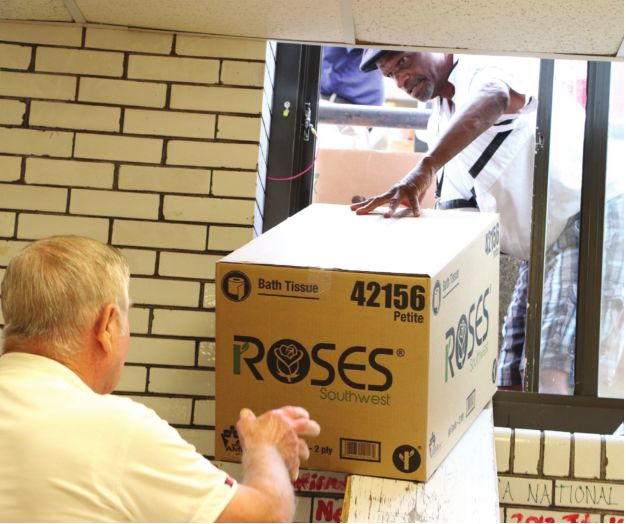
It started in a closet more than 35 years ago, eventually growing to help as many as 1,250 people per month. Lately, however, significantly fewer people have sought help from the Grace Lutheran Food Pantry in Springfield, leaving the charity’s volunteers scratching their heads.
The puzzling drop in demand at Grace Lutheran conflicts with economic trends that would seemingly lead to more need for food aid. Even more puzzling is the fact that not all food pantries in Springfield have experienced a decrease in demand.
The food pantry at Grace Lutheran typically serves about 1,000 people per month, but that has dropped to about 800 people per month so far this year. In past years, the pantry has served as many as 15,000 people in a year. They’re on track for just 9,600 people this year. The all-volunteer pantry accepts zero government funding and provides bags of food and toiletries to anyone with a referral from a social service agency or church which doesn’t have its own food pantry. Most of Grace Lutheran’s referrals come from Contact Ministries in Springfield.
Helen Appleton, a volunteer at the pantry, says the fourth week of July was the first time this year that the pantry saw its demand reach 250 clients in a week, putting the total for July at 971. While that’s close to the 1,000-people mark, the two highest previous months this year were June with 803 people and April with 813.
The decrease runs counter to conventional wisdom that demand for food aid increases in times of economic distress. The U.S. Department of Agriculture tracks what’s known as “food insecurity” – a lack of consistent access to nutritious food. The agency’s data shows an increase in food insecurity coincided with the onset of the economic recession in 2007. The level of food insecurity nationally had hovered around 11 percent for the decade preceding the recession, but it promptly rose to 14.6 percent by the end of 2008. That has since become the new normal, with the food insecurity measure at 14.3 percent in 2013, the latest year for which data is available. Data for Sangamon County shows 14.2 percent of residents were food insecure in 2013, which totals about 28,150 people.
Additionally, the income of people classified as food insecure under the USDA’s measure has declined. In 2009, 40 percent of food insecure families made less than 130 percent of the federal poverty level, which is low enough to qualify for the modern version of food stamps. That has since increased to 50 percent. Meanwhile, the proportion of people earning more than 185 percent of the federal poverty level – currently about $29,500 for a family of two – has decreased from 43 percent to 38 percent. That means families which were already low-income have fallen even farther behind the rest of the nation.
Still, Krista Lisser, spokeswoman for the Central Illinois Foodbank, says their research shows no clear trends in demand between the nearly four dozen agencies the Foodbank supplies.
“Some are up and some are down,” she said. “We can’t really pinpoint why.”
The Central Illinois Foodbank serves 21 counties and is part of Feeding America, a nonprofit network which supplies food pantries across the nation.
Lisser says it’s fairly typical for demand to fluctuate between different food pantries.
“In years past, we didn’t see numbers go up and down together,” she said. “It really just depends on where the community is located if the pantries see a rise or decrease in the people coming in. It’s not a collective rush of people … It’s really just an ebb and flow everywhere.”
Sharon Brown, executive director of Kumler Outreach Ministries, says her group’s food pantry has also seen a decrease in demand since the start of the year. However, even with the lower demand, Brown says the Kumler food pantry still receives new clients every day.
Brown speculates that the lower demand may be attributable to the start of the Affordable Care Act, the federal health insurance reforms that require most people to have health insurance and also came with an expansion of Medicaid eligibility for people living in poverty. If more people have health insurance and therefore have to spend less on medical expenses, Brown reasons, perhaps families have more money available to pay for food. She has also seen evidence against that theory.
“Strangely, we also have a medicine program, and we’re still seeing some people coming in unable to afford their co-pays,” Brown said.
Appleton says the food pantry at Grace Lutheran could easily serve an additional 200 clients per month. She says she wrote letters to several churches in town asking for more referrals but received more donations instead.
“We would like to get the word out that we can serve more people,” she said.
Contact Patrick Yeagle at [email protected].