Law enFARCEment
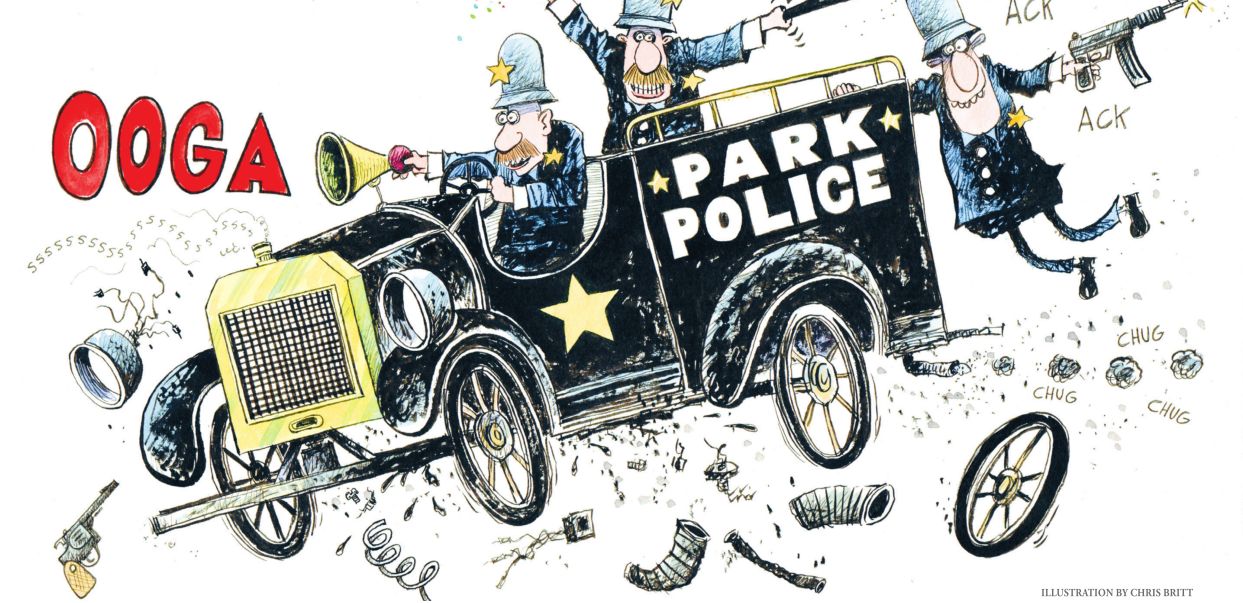
Park cops protect, serve and screw up
POLICE | Bruce Rushton
The Springfield Park District police department doesn’t sound like a tight ship or a fun place to work. Consider a memo titled “Rumors” that former Capt. Jonathan Davis wrote to his officers in January 2014.
“Recently, it has been brought to my attention that there are many rumors floating around the department about me,” Davis, the department’s de facto chief, began.
The captain went on to say that he wasn’t mad at anyone. Sure, I keep my office door closed, but I’m a busy guy – just knock and I’m happy to talk. Don’t read anything into the fact that I ripped my name tag off my door, and don’t jump to conclusions just because I’ve been cleaning out my office. And stop gossiping and spreading rumors.
“I have not hidden the fact that like most of…you I’m seeking other employment,” the captain wrote. “I have not ‘checked out.’ I’m still here and completing the tasks assigned to me and completing my duties which include making sure you are carrying out your duties and tasks assigned to you.”
Hardly what one expects to hear from the commander of a police department that is, at least in theory, supposed to be run like a paramilitary organization, with the man at the top giving orders and underlings carrying them out. But that isn’t what has happened at the Springfield Park District police department, according to documents released under a state Freedom of Information Act request. And dysfunction could prove expensive for taxpayers as Davis, who says that he was forced to resign last month after being placed on paid leave, has signaled that he may sue the district.
Records show a series of disciplinary issues in the park police department, with Davis’ superiors not accepting his recommendations for punishing officers who violated department regulations and perhaps even laws. Ultimately, conflicts between Davis and his troops became so great that Jeff Wilday, the managing partner of the law firm that serves as the district’s counsel, recommended that the department’s three officers and Davis receive counseling so that they could learn to get along with each other.
Tension heightened and morale plummeted in the department as the number of officers was reduced in 2013 and 2014, records show. Officers griped about Davis, and park administrators often didn’t back the captain on disciplinary matters. And some officers who complained about Davis were hardly model cops themselves.
A “mediocre” officer
Prior to being hired in 2012, Officer Lawrence Bomke, the son of former state Sen. Larry Bomke, failed a written test designed to weed out unsuitable candidates, according to Davis, who declined an interview request but provided information via emails. Davis writes that he sent a letter to Bomke, informing him that he would not be hired. But the former captain says that when he returned from a vacation, he found that Bomke had been hired in his absence.
District files show that Bomke repeatedly screwed up as a probationary officer, prompting Davis to recommend that he be fired before probation expired, which would bring Bomke union protection that could make discipline difficult in the future.
During his first few months on the job, Bomke in a Facebook comment complained about working 13 days in a row and wrote that anyone who wasn’t behaving themselves would receive a citation unless they were “cute.”
In May of 2013, Bomke discharged his AR- 15, a military-style assault rifle, inside police headquarters in the early morning hours. His text message notifying Davis was the essence of understatement: “Call me whenever you get a chance.” He later told the captain that he believed that Davis was asleep at the time and he didn’t want to alarm or confuse him.
Bomke said that it was an accident, and there was no evidence to the contrary. But Davis, noting the prior Facebook incident, said that it was one mistake too many.
“Bomke’s overall performance has been mediocre at best,” Davis wrote in his report on the incident. “At this point, I believe that… Bomke has not demonstrated that he has the drive or discipline to continue on with his probationary status as demonstrated by his two issues of discipline which both show severe lapses in judgment.”
But Derek Harms, executive director of the park district, rejected Davis’ recommendation and suspended the officer
for three days after Bruce Stratton, an attorney for the district who
has contributed to former Sen. Bomke’s campaigns and other Republican
political causes, recommended a lesser sanction.
“We
believe that you have what it takes to become a credit to the
department and yourself,” Harms wrote in a letter to Bomke notifying the
officer of his suspension. “This suspension is not meant to punish, but
is intended to refocus your attention on certain aspects of your job
that we consider to be of the greatest importance.”
Twice
more before his probationary period expired, Bomke violated department
rules, once for putting a camera in a lost-and-found box instead of
logging it as evidence to be held for safekeeping and a month later for
doing the same thing with a wallet that contained currency and a debit
card. He received a verbal warning for the second incident but wasn’t
otherwise disciplined, files show.
In
the fall of 2014, after his probationary period ended, Bomke refused
the captain’s order to drive a fellow officer to an automobile repair
shop at the end of his shift to pick up a patrol car. Bomke said that he
was scheduled to close on a house purchase after work and didn’t want
to be late.
“Officer
Bomke appears to have taken on an attitude that he can choose what
orders he wishes to comply with and what orders he does not,” Davis
wrote in a report on the incident.
Davis gave Bomke a verbal reprimand, but it was removed from the officer’s personnel file after he filed a grievance.
Davis’ superiors didn’t back him, even while acknowledging that Bomke had disobeyed an order from the captain.
“We
questioned a bit if it (picking up the patrol car) really had to be
done at that exact time and why it couldn’t wait until the following
day,” Justin Reichert, an attorney for the district, wrote in an email
to Harms memorializing their conversation about the incident with Davis.
As
captain and the department’s de facto chief, Davis didn’t have
authority to discipline his officers for even minor issues. For
instance, when an off-duty officer used a department vehicle and wore
his department uniform while providing security at a store, contrary to
instructions, and Davis issued a verbal warning, Harms chided the
captain in an email, telling him to check with administrators before
taking such disciplinary measures.
In
January of 2014, Bomke succeeded in getting out of a shift after a
fellow officer called in sick. Bomke, who had been ordered by Davis to
work the shift, was the only officer available. But after calling
Reichert, Bomke went home after working just 90 minutes of the extra
shift.
Bomke told
Reichert that there was no activity in the parks due to snowy weather.
After checking with Harms, who gave his blessing, Reichert told Bomke
that he would not have to work the overtime shift. Only then did
Reichert notify the captain that Bomke wouldn’t be working the extra
shift. Davis brought up public safety – what if a sledding accident
occurred in a park? He also said that if the department’s staffing was
going to be further reduced, the district might just as well leave
policing in the parks to the Springfield Police Department. And he
complained about meddling.
“If
we’re going to make these kinds of decisions and respond to officers
calling us directly perhaps we should just run the department,” Reichert
wrote in an email to Harms and Davis memorializing what the captain had
said.
Two days later,
Bomke sent an email to Davis notifying him that a patrol car had an
exhaust leak that could be smelled inside and outside the car.
“Contact Justin Reichert and see what he advises,” the captain answered back. “Let me know.”
Repeated misbehavior
Bomke wasn’t the only park police officer who ran afoul of Davis.
Sgt.
Brian Crolly landed in trouble in August of 2013, when he stopped a
couple in Chatham, well outside his jurisdiction. He was driving his
personal vehicle at the time. The sergeant, who was wearing a vest
emblazoned with the word “police,” pulled alongside the couple after
tailgating them with his headlights on bright and yelled, “I’m a cop,
pull over!” The driver’s boyfriend said it appeared as if the sergeant
was having “a bad day,” according to district files.
Crolly
told the driver that he thought that she was intoxicated and summoned
Chatham officers, who released the couple after the sergeant left and a
portable breath test showed the woman had a blood-alcohol content of
.07-percent, below the legal limit.
It wasn’t the first time that Crolly had misbehaved.
Less
than two months before the Chatham traffic stop, Crolly admitted that
he had engraved a depiction of a penis on a cabinet at police offices
with “Bomke Loves” next to the picture. Crolly had also engraved obscene
images on a water bottle used by Bomke as well as equipment the officer
used to hold citations.
Crolly,
who sanded the engraving off the cabinet, told Davis that on a scale of
one to 10, the engravings were a five in terms of seriousness. Davis
thought otherwise. Intentional damage of government property can be
prosecuted as a felony, he noted in his report, and Crolly’s actions
violated the district’s policy on sexual harassment.
It
wasn’t the first time that Crolly had been involved in an incident that
could be construed as sexual harassment, Davis wrote in his report.
There had been a 2010 case, but Davis gave no details in his report and
the park district provided no detailed records pursuant to a request
from Illinois Times, which asked for documents pertaining to any
incidents of alleged misconduct by department employees dating back to
2008. The district, however, did turn over a handwritten note indicating
that Crolly in 2010 had told an employee “don’t be gay” when the
employee questioned the wisdom of locking up park bathrooms in the midst
of a lightning storm.
Davis wrote that Crolly wasn’t fit to be a supervisor after the sergeant admitted to defacing park property with vulgar images.
“Sgt.
Crolly’s actions in this incident range from criminal to immature,”
wrote Davis, who recommended that Crolly be demoted to patrol officer.
“Based upon his actions, I do not feel that Sgt. Crolly is any longer
capable of leading a young group of officers. I would also recommend
that the entire department undergo sexual harassment awareness training
as well as an ethical refresher course.”
But
Crolly wasn’t demoted, district files show, and Davis says that
employees didn’t undergo sexual harassment awareness or ethics training,
as the captain had recommended. Instead, Mark Bartolozzi, then director
of human resources, issued a 10-day suspension, with five of those days
held in abeyance and the district warning Crolly that he would be
suspended for those additional five days if he got in trouble again. Two
months later, the Chatham police chief was on the phone, complaining
about Crolly pulling over a vehicle outside his jurisdiction.
District files released to Illinois Times contain
no record of discipline for the Chatham incident; Davis says that
Crolly was counseled, the least-severe discipline possible, and did not
have to serve the five days of suspension that had been held in abeyance
for defacing park property two months earlier. Crolly’s rank was
eventually reduced to patrol officer, but not for disciplinary reasons.
Rather, it didn’t make sense to have a sergeant in a department with
just three officers and a captain, according to district files.
Problems
with Crolly continued in 2014, when he submitted three inaccurate time
cards within a span of less than two months indicating that he had
worked when he had actually taken sick or vacation days. He received
counseling, a verbal warning and a written warning.
Davis under fire
Davis
became the department’s de facto chief after Chief George Judd was
forced to resign in 2007 after forwarding an email to officers titled
“Proud To Be White.” Judd had also used the terms “nigger” and “sand
nigger” in conversation, according to Davis, who filed complaints.
Mike
Stratton, then the district’s executive director, gave no hint of
trouble in an email to employees announcing Judd’s departure. The chief,
Stratton wrote, wanted to spend more time with his son and
grandchildren.
“Chief will be missed as he set forth a great vision for the police department,” Stratton wrote.
Davis’
last year with the department was a rocky one. After Reichert and Harms
overruled the captain and told Bomke that he didn’t have to work an
extra shift as ordered in January 2014, tension between district
administrators and Davis mushroomed.
In
an email, Reichert told Davis that he was “clearly being difficult and
defiant” the day after the lawyer overruled the captain and told Bomke
that he didn’t have to work the extra shift. In a second email, Reichert
warned the captain to “discontinue difficult behaviors.”
“We
do not want to see you go down a negative path,” Reichert wrote.
“You’ve made it clear you don’t like our direction or our interference
with giving instructions to your officers. We will attempt to limit that
but believe better communication on your part with your officers and
management will help that.”
Strapped
for cash, the district had decided to reduce police staffing through
attrition, which didn’t sit well with Davis. Staffing was so thin that
when Davis went on vacation at the end of 2013, either Harms or
Bartolozzi, then the human resources director who has since left
district employment, filled in as head of the police department, even
though neither man has law enforcement experience.
By
the spring of 2014, the district had decided to remove the captain from
the department’s collective bargaining unit, a move that wasn’t opposed
by the union, according to district files. Reichert and Harms told
Davis it was a question of divided loyalty – he could not effectively
supervise officers while also being in their union. Davis saw it as the
first step toward termination.
“OK,
you’re trying to fire me,” the captain later told Wilday, the lawyer
who investigated alleged misconduct by Davis. “You don’t want me here,
you want me gone.”
Reichert
in the spring of 2014 told the captain to spend no more than 20 percent
of his time on patrol and the balance of his time on administrative
tasks, even though the department had just three officers. When he was
removed from the union last fall, Davis began wearing polo shirts
instead of his uniform and stopped logging in to the dispatch center
when he arrived at work. Officers complained that Davis always closed
his office door and locked it when he went to the bathroom. They also
complained that the captain rarely communicated with them except via
email and text messages.
Last
fall, as Davis’ separation from the union neared, Crolly in an email to
Harms accused the captain of not being available for calls and said
that Davis had signed time cards for a part-time ranger who wasn’t
working hours for which he was being paid.
“Captain
Davis has routinely let down his department and needs to be held
accountable for his actions,” wrote Crolly, who at the time was being
counseled and warned himself for submitting inaccurate timecards.
In
January, Davis was suspended for 10 days for signing the ranger’s
inaccurate timecards. The district figured it had paid the ranger $2,000
for hours that were never worked. Davis never returned to his job.
On
Jan. 9, shortly before Davis’ suspension began, Officer Nick Capranica
accused the captain of improper disposal of evidence by burning crack
pipes, clothing, marijuana and myriad other items without a court order.
That prompted the district to put Davis on paid leave pending an
investigation at the end of his 10-day suspension. While the captain was
off the job, officers on orders from Harms entered Davis’ office and
found four assault rifles, several pistols and thousands of rounds of
ammunition that were not secured in a gun safe.
Destruction
of evidence without a court order was the most serious matter, Wilday
concluded, but the park district had no policy on evidence disposal and
an Illinois State Police agent had told the lawyer
that Davis hadn’t committed a crime. Similarly, the park district had no
policy on securing weapons, Wilday found, but keeping weapons outside
gun safes didn’t seem prudent. In his report, Wilday wrote that the
district’s three officers thought that the captain should wear a
uniform, but Davis pointed out that park administrators frequently saw
him in polo shirts and never complained.
“Clearly, there are two sets of rules within the park district”
After Davis was placed
on leave, Bomke complained that the captain often arrived for work late
and left early, but Wilday couldn’t determine whether the accusation was
true. Harms and Reichert told Wilday that Davis had been uncooperative
and resisted their questions about the department; the captain countered
by complaining that administrators had undermined his authority by
allowing officers with concerns to go to Harms instead of through the
chain of command. Wilday also spoke with two representatives of the
National Organization of Black Law Enforcement Executives, who shared
the captain’s criticism that his authority had been usurped.
Davis,
Wilday concluded, had fallen short of expectations. He should have worn
a uniform, logged in to the dispatch center when he reported for duty
and logged off when he left, and he should have been more accessible to
officers, the lawyer found. Harms should evaluate Davis’ performance in
writing every two months, Wilday recommended, and the captain should
draft performance evaluation forms for officers. The captain should also
write policies to govern the destruction of evidence and securing of
firearms. The district should attempt to expand Davis’ hours spent on
patrol. And both the captain and his officers should go to counseling
through the district’s employee assistance program to improve working
relationships.
“Assuming
that Capt. Davis accepts the fact that changes in his leadership style
and his communication skills are needed, he should be able to rebuild
his working relationship with his patrol officers in the short term,”
Wilday wrote in his May 5 report.
That
never happened. The day after Wilday issued his report, Davis resigned,
saying that he had been forced to quit. In an email to Illinois Times declining
an interview request, Davis wrote that Crolly and Bomke got wrist slaps
for their misdeeds, while he was placed on leave for more than three
months for baseless charges.
“Clearly,
there are two sets of rules within the park district,” Davis wrote. “I
will remain optimistic that these issues can be resolved through the
proper channels and if need be the legal system.”
Contact Bruce Rushton at [email protected].


