Frank’s fixer-upper
City patient with pol’s code violations
ENFORCEMENT | Bruce Rushton
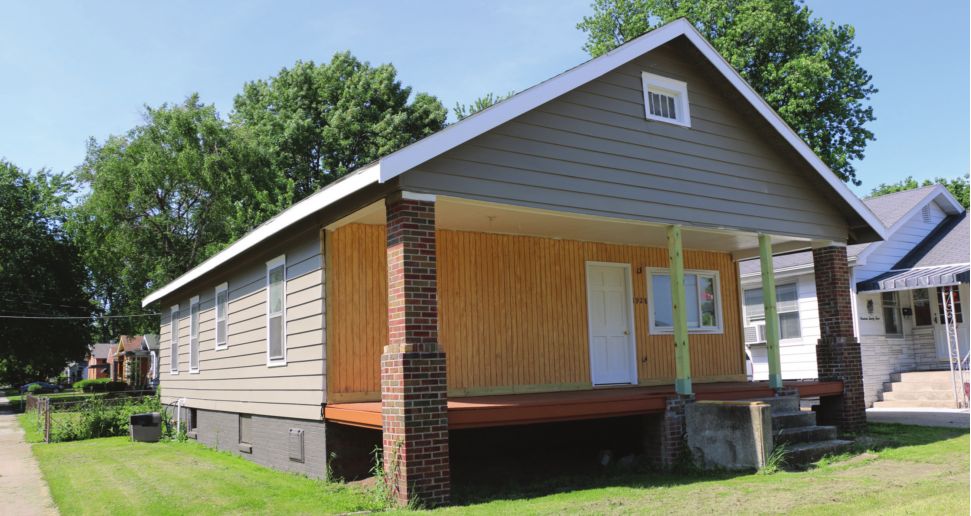
For more than a decade, a vacant home crumbled on Sangamon Avenue across the street from St. Aloysius Church on Springfield’s north end.
City code enforcers in 2007 placarded the home as uninhabitable and started pressuring the home’s absentee owner to fix it up. Files show that the city was concerned about peeling paint, a broken window sash, a missing handrail on a porch, roof shingles that were curling and gutters and downspouts in need of repair.
Vacant buildings with two or more code violations must be registered with the city, and so the city ordered the owner to register the house, but it didn’t do any good. Nothing had been fixed when the registration expired after six months, and so the city sued the owner in Sangamon County Circuit Court in an effort to force repairs and collect unpaid fines. That didn’t work either, and the house, which had been vacant since 2003, continued to fall apart.
Then Frank Lesko, at the time a city alderman and now city clerk, bought the home in 2009. And pressure to fix the premises vanished.
Between Lesko’s purchase in December 2009 and the spring of 2014, code enforcers who had placarded the home and hauled the prior owner to court did nothing to force repairs. By all appearances, Lesko also did nothing, and the home’s condition apparently worsened, even as he voted in 2011 for a get-tough ordinance aimed at requiring owners of dilapidated homes to either fix or demolish them.
Under the 2011 ordinance that Lesko supported while on the city council, owners of vacant buildings with two or more code violations have to register them with the city every three months at a cost of $1,800 for the first year and $2,000 per year thereafter. Once a building has been registered, the owner must make repairs sufficient to get a certificate of occupancy within three years or demolish the building.
The upshot is, registration can be a powerful incentive to make repairs. But it’s a hammer the city has never used against Lesko, who received a notice to register the property in the spring of last year. He didn’t do it, and the city didn’t force the issue. The home at 1928 E. Sangamon Ave. remains uninhabitable, given that it has no electricity and there is no indication in city files that problems with plumbing and heating systems have been fixed. Nonetheless, the city on May 13 told a hearing officer that all violations at the home had been abated and so registration was no longer required.
John Sadowski, city planning coordinator, could not explain why files show that city inspector Rich Benanti told a hearings officer last month that all violations at the home had been abated when there is no record in building department files showing that heating, electrical and plumbing problems identified more than a year ago have been addressed.
Was Lesko treated the same as the city treats everyone else?
“We attempt to treat everyone the same,” Sadowski answers. “There’s no guarantees in life. … I don’t go to all the court cases and all the inspections. If I were involved, I would treat everyone the same. I wasn’t there all the time.”
Former mayor Mike Houston, who left office in May, says that he was aware of code violations at the house. Lesko, the former mayor insists, got no favors from the city.
“I guarantee you he did not,” Houston said.
“My direction was, ‘No special treatment, handle this as you would handle anything else.’ … If you know John Sadowski, you know he wasn’t giving anybody any breaks.”
Between 2007 and 2014, the number of code violations mushroomed from four to 10, according to city files. Lesko says that he didn’t know that the home was out of compliance with building codes until the city notified him in 2014, even though the home had been placarded seven years earlier. He says he hasn’t gotten any favors from the city.
“I didn’t ask for any special treatment or preferential treatment and I don’t believe that I got any,” Lesko says. “When I talked to corporation counsel on it, I told them specifically when I went in that I didn’t want any preferential or special treatment whatsoever. Just tell me what I need to do.”
From the beginning, public works director Mark Mahoney, Sadowski’s boss, was kept abreast of developments in the case.
In April of 2014, three days after the city sent a notice to Lesko telling him that he needed to register the house and fix violations, Sadowski emailed a list of violations to Mahoney.
“Since the owner hasn’t registered, our next step is to refer him to legal,” Sadowski wrote.
“Let’s discuss,” Mahoney emailed back.
“Thanks.”
There’s no record of what Sadowski and his boss might have discussed. Mahoney says that he can’t recall. Sadowski said that it’s not unusual for the public works director to be informed about details of specific cases, particularly if they involve high-profile cases or issues important to neighborhood associations.
“The directors need to know what’s going on in their departments,” Sadowski said.
After being referred to the legal department, the case landed in administrative court last summer, with a hearing officer on July 23, 2014, ordering Lesko to obtain an occupancy permit by the next court date. But violations persisted.
At the next hearing, on Oct. 29, a hearing officer ordered Lesko to abate “all exterior violations” before Jan. 26.
“If all exterior violations are not abated on or before (Jan. 26), owners must register the vacant structure,” the hearing officer ordered.
It’s not clear why the hearing officer dropped the previous order that Lesko get an occupancy permit, which would require that plumbing, heating and electrical issues be addressed. Regardless, Lesko hadn’t completed repairs to the home’s exterior by Jan. 28, the next court date, although he had installed a new roof. A hearing officer ordered that all exterior violations be corrected by May 13, “weather permitting.”
Despite the October order decreeing that registration would be required if exterior violations hadn’t been fixed, Lesko, by then a candidate for city clerk in the upcoming April election, was not required at the January hearing to register the house, which would have cost hundreds, if not thousands, of dollars while mandating repairs sufficient to obtain an occupancy permit.
On March 26 this year, an inspector found that four of the seven exterior violations cited nearly a year ago were still present, plus there was a fifth having to do with substandard handrails and guards that had previously not been identified. The inspector in the March 26 report also wrote that registration was required.
That
same day, Sadowski emailed a city lawyer charged with enforcing
building codes. What he told her is a mystery. Everything except the
words “I recommend” were redacted by the city in the body of the email
released to Illinois Times. What the lawyer said in response is
even more mysterious. The city redacted the entire content of her email
sent in response to Sadowski’s message. Mahoney received copies of both
emails.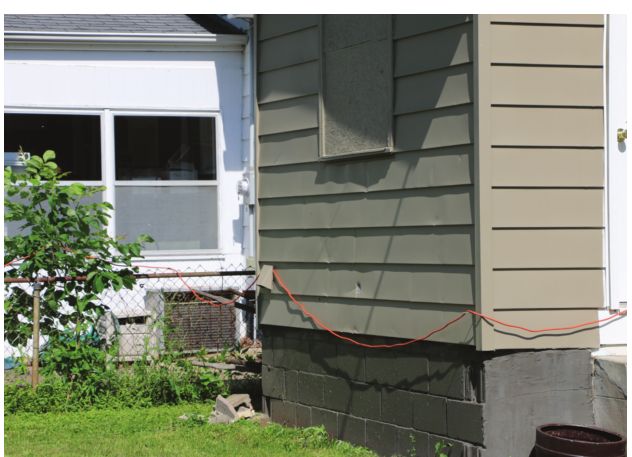
The
city redacted content from the emails on the grounds of attorney-client
privilege and an exemption in the state Freedom of Information Act that
allows public bodies to withhold information if it is preliminary in
nature or if it contains opinions. While the law allows the city to
withhold such information, it does not require it, and so the city could
release unredacted emails if it chose to do so.
Illinois Times appealed
to both corporation counsel Jim Zerkle and Mayor Jim Langfelder, who
campaigned on a platform of transparency and instilling public
confidence in city government, to release the redacted information. They
declined, with both men stating that the city should be consistent –
what city officials thought and said when it came to enforcing building
codes at an elected official’s property should be as confidential as if
an ordinary citizen was involved.
Two
days before the next court hearing on May 13, a month after Lesko was
elected city clerk, an inspector visited the house and described the
result as “partial comply.”
“Progress
is significant,” the inspector wrote in his report, which does not
specify which problems had been addressed and which remained.
Two
days later, the code-violation case against Lesko was dismissed at the
request of the city, which told a hearings officer that all violations
had been abated and registration was no longer required. Nearly a month
later, an extension cord runs out of the back door of the house and over
a fence onto adjacent property. Lesko acknowledged that the house has
no electricity.
Mahoney confirms that once inspectors identify code violations such as lack of electricity, repairs must be made.
“Obviously, you have to have utilities and those sorts of things,” Mahoney says.
Sadowski
and Mahoney agreed that the decision on whether to force a property
owner to register a building is often up to the city’s legal department,
which handles cases in administrative court. But the city can be
flexible.
“Typically,
we’ll work with anyone if they’re willing to work with us,” Mahoney
said. “There are times when I think they (the legal department) work
with people on registration.”
Lesko,
no longer under pressure from the city to make repairs, says that the
plumbing and heating works, even though there is no record in city files
that problems found last year have been fixed.
“The
house is basically operational,” he said. “When they (city inspectors)
went through it, they said their concern was from the outside, and when
they work with people their main concern is to make sure it’s not
dangerous and is aesthetically pleasing to people.”
Lesko
said that his constituents often complained about the deteriorating
house prior to his buying the property, and he saw a chance to help the
neighborhood when he bought it. Lesko said that he cut back overgrown
trees and plants shortly after he purchased the home. He said that he
hopes to have it occupied this summer. And he encouraged others to
follow his example.
“Don’t
be afraid, in your neighborhood, to go for it,” Lesko said. “If you
find a blighted house, you can buy it and fix it up. If you work with
the city, I think they’ll work with you.”
Contact Bruce Rushton at [email protected].


