On the stump
Mayoral candidates differ, but you have to listen carefully
POLITICS | Bruce Rushton
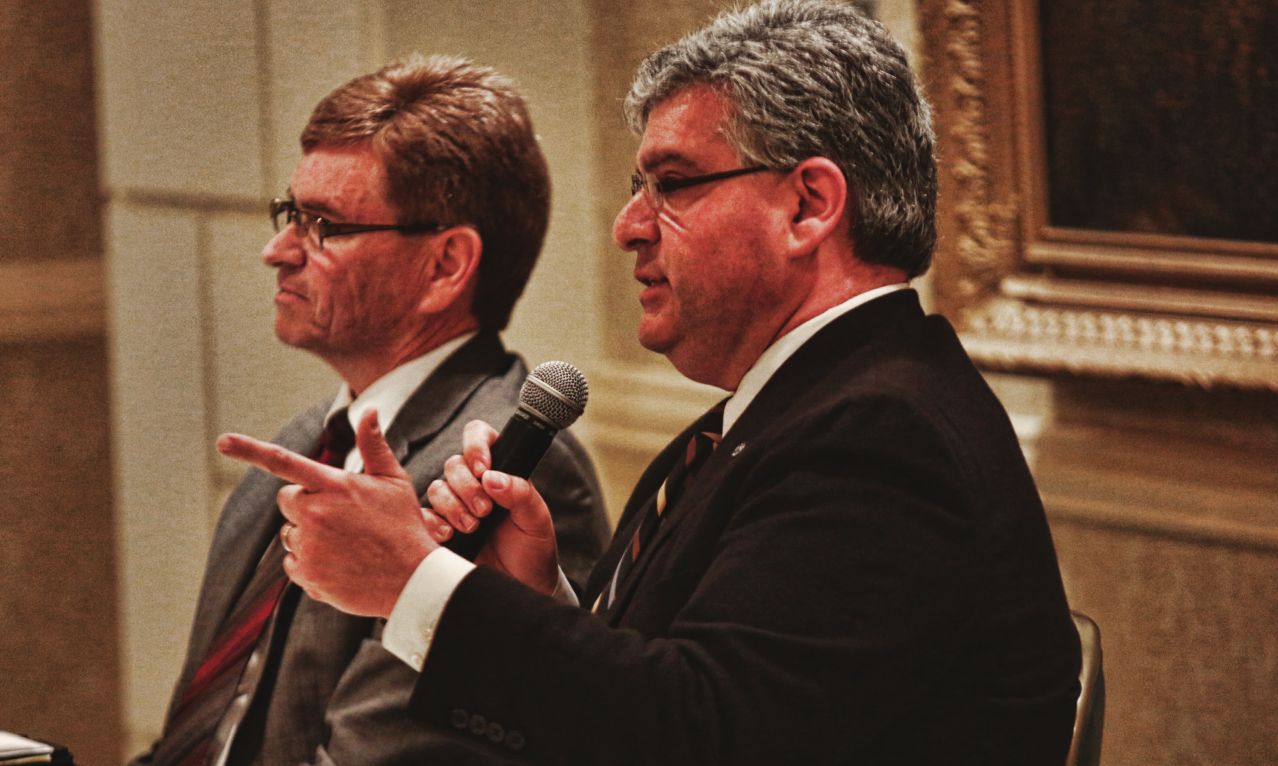
It is near the end of a grueling day on the campaign trail. The two candidates for Springfield mayor are sitting side by side in a Lincoln Library meeting room, where they’ve spent more than 90 minutes fielding questions at a candidate forum sponsored by the Faith Coalition for the Common Good.
How many times since announcing your candidacy have you participated in events on the east side? What would you do to increase minority hiring in city government? Should City Water, Light and Power bills include tabs for trash disposal? How do you feel about regulating food trucks?
From sewers to cops to video gambling to economic development, the subjects are covered in answers lasting 90 seconds or so, with a good portion of the questions coming from the crowd of nearly 100. Finally, it is closing down, and WMAY radio host Jim Leach, who is tonight’s moderator, tosses a softball.
“Since we are in the library, what book do you wish everyone would read and discuss, and why?” Leach asks. “Jim Langfelder?” The city treasurer, whose father, Ossie, served two terms as mayor starting in 1987, hits it out of the park.
“My Incredible Journey,” Langfelder answers.
“That’s my dad’s book.”
Langfelder, now in his third term as city treasurer, talks about his grandparents and father, then just 12 years old, fleeing Austria to escape Nazi occupation and settling in Springfield. The elder Langfelder was a bridge of sorts, with his terms as mayor spanning the era between the city’s commission form of government and the current aldermanic form, constituted in response to a lawsuit brought under the federal Voting Rights Act so that minorities might have a chance to win elective office. He lost a bid for a third term and selfpublished his autobiography in 2011.
“I remember to this day when he was elected mayor,” Langfelder says. “And he said ‘This is incredible. I came from a dictatorship, and now I’m mayor of the capital city.’ For me, he’s my mentor. When he lost the election, people said ‘I might not have agreed with him, but I always took him at his word, and you could believe what he said.’ And that’s what it’s all about.”
Sangamon County auditor Paul Palazzolo, who has pushed for economic development during his campaign, talks about A Christmas Carol, quoting at length the reaction of Jacob Marley, Scrooge’s dead business partner, to the notion that the ghost had been a good businessman while alive.
“Business? Mankind was my business. The common welfare was my business. Charity, mercy benevolence, forbearance were all my business,” recites Palazzolo with power and drama and perfect diction. “And Dickens writes a beautiful line when he closes what Marley says – he says, ‘The dealings of my trade were but a drop of water in the comprehensive ocean of my business.’ And, indeed, if the dealings of our trade are but a drop of water in the comprehensive ocean of our business when it comes to mankind, we can offer Springfield as a place where we are welcoming and open and service-minded.”
A Charles Dickens narration is not the sort of thing one expects to hear on the mayoral campaign stump, but it works well for Palazzolo, underscoring his flair for eloquence while also suggesting his goals: Economic prosperity in a city where people want to live and neighborhoods are beautiful, or, at least, better than they are now.
Langfelder,
of course, wants the same things, but listen carefully to the
candidates and a tale of two cities begins to emerge. Goals may be
similar, but the paths Langfelder and Palazzolo describe have some key
differences. And voters will decide which path to take in the April 7
general election.
Bureaucracy and business
Langfelder
finished first in the Feb. 24 primary with nearly 40 percent of the
vote; Palazzolo came in second with 34 percent. Incumbent Mike Houston, a
Republican who failed to get party support, got 19 percent, so which
way his supporters go could well decide the nonpartisan race. Ward 2
Ald. Gail Simpson, who is a Democrat, and political newcomer Samuel
Johnson, who said that he was an independent during the primary
campaign, together got 7 percent of the vote.
Langfelder
and Palazzolo agree on several things. Both support a residency
requirement for city workers. Both are against establishing
right-to-work zones pushed by Gov. Bruce Rauner. Both say that the city
should set up Wi-Fi zones downtown, and perhaps elsewhere. They both
support the development of Hunter Lake, a proposed backup water supply
for the city that has languished for decades.
They
differ on putting garbage pickup tabs on CWLP bills, with Langfelder in
favor and Palazzolo opposed. Differences also emerge in the setup of
city bureaucracy, with Palazzolo saying that the city needs a
planner/implementer.
During
a March 12 forum sponsored by the Illinois Association of Realtors,
Capital Area Realtors and the Greater Springfield Chamber of Commerce,
Palazzolo at least seven times pushed for a planner/implementer who
would do all sorts of things. Asked about bike lanes, Palazzolo said
that they’re a good way to lure young people to Springfield, and a
planner/ implementer could help figure out how to make them work. Should
rules for downtown festivals be changed to ensure revelers and
residents can coexist? A planner/implementer could help determine that,
Palazzolo said, and the same person could help figure out ways to make
downtown more urbane. A planner/ implementer could help figure out
whether the city has a sufficient number of firehouses and whether they
are in the right locations, Palazzolo said, and, of course, a planner/
implementer would work on zoning issues.
“We’re
the only city outside the city of Chicago (of) our size that doesn’t
have a planner to help us engage with these issues,” Palazzolo said at
the March 12 forum.
Palazzolo
also says that the city should have a diversity director and a
neighborhood revitalization coordinator modeled after a position
established a year ago in Peoria aimed at battling blight. The diversity
director and neighborhood revitalization coordinator would be created
by modifying existing jobs so that no new hires would be needed, he
says. Money for the planner/implementer could come from money that’s now
going for an inspector general recently established by the city
council. The city hasn’t yet committed to a long-term inspector
general’s office that could cost more than $200,000 a year.
Langfelder
doesn’t see the need for a new planner. He notes that the city already
has a planning coordinator in the public works department as well as a
planning and design coordinator who concentrates on downtown.
“I’m
not going to create any positions,” Langfelder said at a March 19 forum
sponsored by the Illinois Government Bar Association. “My first year is
going to focus on transitioning and changing the culture of city
government as we know it today.”
Langfelder
says the city should establish a community development finance
commission without creating any new positions. Such a commission would
help businesses find the best places to locate with a minimum of red
tape, he said. For example, he says, a commission could have helped
Roberts Automotive put a car sales lot on MacArthur Boulevard that was
ultimately built on the far west side of town. After strong opposition
from the MacArthur Boulevard Association, Roberts couldn’t get city
council approval to put a lot at the empty Esquire Theater property, but
Langfelder says that a commission could have helped put together a deal
to put Roberts at the corner of MacArthur and South Grand Avenue, where
a currency exchange business now sits. That corner property, once home
to a gas station, is tougher to redevelop than the Esquire property due
to potential environmental issues, Langfelder says, but it would have
been ideal for a car lot, which would have sparked redevelopment on
empty or underused properties elsewhere on MacArthur south of South
Grand Avenue.
“Everybody
talks about economic development, but we don’t have the city focusing
on that,” Langfelder told lawyers at last week’s bar association forum.
“Under my administration, that’s going to be the focus.”
After
pushing the idea hard during the March 12 forum, the first held since
the February primary election, Palazzolo dialed back talk of a planner.
At the March 18 forum sponsored by the Faith Coalition for the Common
Good, for instance, he barely mentioned the planner idea. During that
same forum, Langfelder rejected Palazzolo’s call for a diversity
director.
“I’m not
going to hire a diversity director,” Langfelder said. “I am the
diversity director. It goes back to being the leader of this city. And
any faults with regard to minority hiring stops at the mayor’s office. I
will be the standard bearer for diversification for the city of
Springfield.”
The
candidates differ sharply on the city’s Office of Community Relations,
which helps the homeless and handles complaints about discrimination in
housing and employment. Palazzolo says the department should be merged
with the city’s Office of Planning and Economic Development. He
explained his logic at the March 12 forum.
“If
we can move economic development (in) with community relations,
community relations then has a lens through which they can see their
mission, and that’s a focus on bringing attractiveness and jobs and new
businesses and customers and residents to the city of Springfield
through their responsibilities in community relations,” Palazzolo said.
“It provides an overarching mission to help us bring more jobs to the
city. And if we can do that, providing that coming-together of purpose
and service, then we can focus on jobs. …Combining means bringing a new
focus toward their mission in life. That doesn’t change what they do,
but that changes their mission’s purpose for what they’re doing.”
The response prompted a follow-up query from moderator Bernard Schoenburg, political writer for the State Journal-Register:
“Creating
new business or business opportunities – is that really in…the same
umbrella about hearing complaints about discrimination?” Schoenburg
asked.
“If it means
bringing the attractiveness level up for the city of Springfield, to be
an open and attractive city that welcomes all races, genders, faiths and
creeds, yes, that helps us to be an attractive city, which can then be a
marketable aspect to bringing more jobs, businesses and residents to
the city,” Palazzolo answered.
Langfelder opposes merging the two departments.
“The
Office of Community Relations has a distinct difference from economic
development,” said Langfelder at the March 12 forum. “I think when you
bring groups together, entities together, with mixed goals it can bog
down those goals.”
Utility woes
Both candidates are calling for changes at City Water, Light and Power.
Palazzolo
is emphasizing low utility bills, saying that the city should wean
itself away from CWLP’s annual payments in lieu of taxes (PILOT) to the
general fund that now stand at more than $8 million. He has suggested
reducing city employment or giving incentives for some workers to leave
city employment and replacing them with lower-paid employees, but has
not said how long it would take to eliminate PILOT contributions that
now help fund city operations such as fire, police and public works.
Langfelder
has called for reexamining PILOT payments but stops short of saying
that they should be eliminated. Rather, he says, a portion of the PILOT
was supposed to have gone toward reducing the city’s pension
liabilities, and to the extent that has not happened, the city should
reexamine payments from the utility that fund city operations.
Langfelder
has called for an emphasis on renewable energy, particularly solar
energy. The city currently buys wind energy as part of a deal with the
Sierra Club, which had threatened to sue to block construction of the
city’s main coal-fired generator that began producing power in 2009. The
wind contract, which generates about 20 percent of CWLP’s power, staved
off a lawsuit and allowed construction of the generator, but Langfelder
says that solar is a better option. Until recently, Langfelder had
cited a federal requirement that 25 percent of power come from renewable
sources by 2025, but it turned out that he hadn’t done his homework.
The federal requirement applies to investor-owned utilities, not ones
such as CWLP that are owned by municipalities.
After
learning the true federal requirements, Langfelder stuck to his guns
during a March 19 forum sponsored by the Jewish Federation of
Springfield. CWLP, he said, should invest in renewable energy even after
the Sierra Club deal requiring wind power expires in 2018.
“I’m looking toward the future,” Langfelder said.
“You
can go there, but it will be expensive,” responded Palazzolo, who
opposes investment in renewable energy and says that he wants low rates
and reliability.
That
same forum saw Palazzolo make a gaffe when asked what he would do if a
movement materialized to boycott products made in Israel and discourage
speakers with pro-Israeli viewpoints from making appearances in
Springfield. After asking that the question be clarified, Palazzolo,
apparently confused, started his answer.
“First
of all, we have to see if there’s any resources necessarily expendable
for that, but if there’s value in such an effort, absolutely, we would…”
Murmurs and low chuckles from the audience interrupted the candidate
while Melissa Hahn, director of communications for the Illinois Chamber
of Commerce who is serving as Palazzolo’s media contact for his
campaign, shook her head from the back of the room as the candidate
tried to regroup.
“I’m still not quite sure exactly what…” Palazzolo said.
The moderator stopped Palazzolo and repeated the question for Langfelder.
“That
goes back to community relations,” said the treasurer, whose
grandfather was Jewish. “I would be, unequivocally, against any kind of
movement with regards to that. If the city council was not informed
enough and passed such an initiative, I would veto it. … Antisemitic
behavior is not acceptable anywhere in the world.”
Given a second chance, Palazzolo said that he had misunderstood the question.
“The
answer is simple: Whether it’s Mayor Palazzolo or Mayor Anybody, there
is no room for any kind of racist or antisemitic attitudes,” Palazzolo
said. “As mayor, we have to ensure that we abhor and do not allow any
kind of racist attitudes anywhere throughout the city. If we are to have
Springfield be a welcoming city that’s encouraging (to) businesses and
customers and residents of the city of Springfield, if something like
that would slink through the city council, which I doubt it would…it
would definitely be discouraged, avoided and sent back from whence it
came, because there’s no room for it in Springfield, there’s no room for
it under a Palazzolo administration and there shouldn’t be any room for
it in the United States of America.”
Politics
This year’s mayoral campaign may continue a trend of campaigns that cost less than in past election cycles.
In
2011, Mayor Michael Houston raised $163,000, a fraction of the nearly
$583,000 his predecessor, Tim Davlin, raised in the 2007 election cycle
and less than half of the $347,000 that Davlin raised to win the 2003
mayoral election. This year, the candidates say they each expect to
raise about $200,000. Palazzolo credits the rise in social media with
reducing the cost of campaigns.
As
of March 22, Palazzolo was in the lead moneywise, having raised more
than $148,000 in cash and in-kind contributions that includes a $19,000
in-kind contribution from the Sangamon County Republican Central
Committee that is going to Hodas & Associates, a Springfield
political advertising firm. Glenn Hodas, a firm principal, was honored
in 2013 by the American Association of Political Consultants for
creating the year’s “best” negative campaign ad, which featured a video
of former state Rep. Randy Ramey, R-Carol Stream, getting arrested for
drunken driving, attempting to recite the alphabet and asking the
officer “Do you know who I am?” The mayoral campaign has stayed positive
so far, with the candidates focusing on issues, but, asked directly,
Palazzolo, whose primary campaign literature included a flier pointing
out that Houston had promised that he would not run for re-election,
won’t say whether he will run negative ads. It is appropriate, he says,
for ads to point out differences in experience and accomplishments.
“That’s not negative, that’s providing information,” Palazzolo said at the March 12 forum.
Langfelder, who has raised more than $113,500 as of March 22, says that he won’t go negative.
“I
will maintain my pledge of running for the office,” Langfelder said at
the March 12 forum. “I won’t run against an individual. I’m here to help
build people up and bring people together.”
Go to www.illinoistimes.com to see video clips of the candidates talking about issues and themselves.


