Keeping things clear 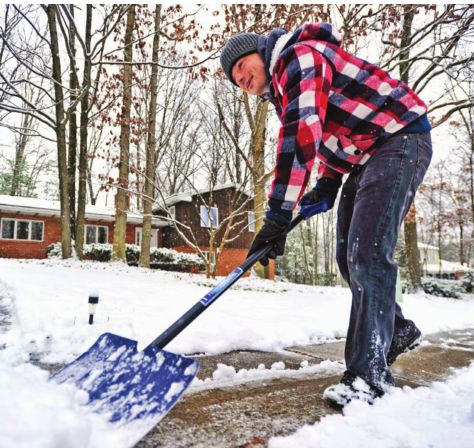
Schoolkids in the street? Must be Springfield after a snow
DYSPEPSIANA | James Krohe Jr.
[Note to readers: The snow has gone, as snow does, but it will be back – probably in July, given how wacky the weather has become. Time now, while memories of the drifts are fresh, to ponder how best to cope with them a few months from now.] To most people, a deep snowfall is a nuisance, a maintenance cost, a hazard. For us inveterate wonks, snow is an opportunity to ponder the niceties of public policy. As I noted in “Honey, where’s the snowshoes?” (Dec. 29, 2010), a city’s public sidewalks are an integral part of its transportation system. Millions of taxpayer dollars are spent every winter in this part of the country clearing roads and alleys of snow, but when it comes to clearing sidewalks, Springfield’s ambulatory citizens, like those in most Illinois cities, are forced to depend on the kindness of strangers.
The City of Springfield has a snow removal ordinance on the books, but it is widely disobeyed, as the property-owning public includes many people who are infirm, lazy, indifferent or irresponsible. A practical failure, the ordinance also offends principle in the judgment of more than a few citizens. Being neighborly is one thing; being coerced to be neighborly is, well, it isn’t neighborly. The city’s snow clearing ordinance seeks to coerce private property owners into performing labor for the City of Springfield’s benefit, much as farmers used to have to donate work days in the 1800s to maintain country roads in lieu of taxes. Except that property owners in Springfield aren’t exactly coerced, because the city never writes tickets.
Most cities resort to exhortation in the hope of avoiding unpopular enforcement actions. The City of Chicago says residents should clear the snow because “it is our responsibility to each other during the winter.” In Somerville, Massachusetts, it’s all politeness. “We need your Cooperation,” the town website states (only a liberal town would capitalize “cooperation”) and then the iron fist in the velvet glove: “Doing your part is the neighborly thing to do, it’s the law, and it will help you avoid a fine for noncompliance.”
I for one would resent being talked to by my government in the tone used by a parent telling her three-year-old, “Mommy needs you to be quiet.” Many other cities cut the cajoling. When a property owner fails to clear snow, the city does it for him and bills him for it. In Missoula, Montana, the city bills a minimum of $25 for a half-hour of work plus actual additional time at $50 per hour plus an administrative fee of $35; that’s on top of a daily fine of $25 to $50. Duluth, Minnesota, doesn’t fine owners, it in effect fines their houses by use of “clean-and-lien” procedures. As for enforcement, Somerville city inspectors regularly patrol the city following each snow event, tracking uncleared properties whose owners are documented using city databases.
Snow police will never patrol the streets of the capital as long as Springfield’s Gang of Ten is on the case. In this the aldermen might be wise. That is not necessarily a bad thing; compelling citizens to obey the law is never wise if the law is not considered legitimate. Sure, lots of Springfieldians clear their walks because they’re nice people. A much smaller faction do it because they believe they owe it to their neighbors, accepting as they do that certain social obligations come with the privilege of property ownership. A tax-paid sidewalk network, like the street it is part of, adds value to a property by adding value to the neighborhoods. Against all of them are those who disdain the idea of community for philosophical reasons and believe that a man’s home is his castle, and that an unplowed sidewalk makes a dandy moat.
A solution that is both simpler and philosophically more coherent would be for the government to relieve the public of an obligation that so many find onerous or otherwise obnoxious, and maintain the public ways at public expense. Many town and village governments on Chicago’s North Shore clear some or all sidewalks as part of their regular street-clearing operations (usually by paying private contractors to do the work). In Winnetka and Skokie, for example, public sidewalks are usually plowed after snowfalls of 3 to 4 inches or more; in Highland Park, sidewalks flanking arterials are plowed.
In Wilmette, sidewalks used by commuters walking to trains are plowed and salted. (The target is to get that done by 6 a.m.; sidewalks in business districts are to be cleared by 8 a.m.) When school is in session, “highpriority” sidewalks near school zones are plowed after two inches of snow has fallen, and after four inches of snow all residential sidewalks are plowed within 48-72 hours after the storm has ended.
A simple and philosophically coherent solution to the problem, but not cheap. Instead, the capital city will continue to opt for the traditional alternative that is (to repurpose a phrase from Springfield’s snow removal ordinance) “conveniently free” – wait for warm weather.
Contact James Krohe Jr. at [email protected].
Editor’s note
The
drip, drip of records related to the city’s Shredgate scandal continued
this week with the city’s release of minutes, a transcript and an audio
recording of an hour-long city council executive session held on May 7,
2013. The council, ostensibly, met in private because they were
discussing collective bargaining, personnel and pending litigation, but a
review of the materials shows the main topic of discussion was dirty
laundry. There was virtually no discussion of legal strategy, and it
took nearly 50 minutes before Ward 2 Ald. Gail Simpson asked about the
city’s chances in a lawsuit fi led over the illegal destruction of
internal affairs fi les. The council received a primer on how changes to
labor contracts are negotiated but did not discuss any pending contract
negotiations. City offi cials also talked about who was responsible for
the shredding and said that the names of public employees who
participated in shredding discussions before the fact should be kept
secret. And they spent a lot of time talking about media leaks and how
bad the whole thing looked. Listening to the confab, it’s diffi cult to
fi nd a reason why this meeting should have been held behind closed
doors. Discussing violations of open records laws is not exempt from
open meetings laws. –Fletcher Farrar, editor and publisher


