Promises, promises
How mayoral candidates are contending for the east-side vote
ELECTIONS | Patrick Yeagle
Springfield has never elected a black mayor. It’s been 16 years since an African-American candidate even ran for mayor.
Allan Woodson was one of Springfield’s first black aldermen and the last black person to run for mayor. Following a historic voting rights lawsuit and resulting transition from the commission form of city government in 1987, Woodson and former alderman Frank McNeil, also African- American, were elected to the newly formed city council. It was such a big deal that even the New York Times ran an article on it.
Woodson says many of the problems facing people of color on Springfield’s east side – poor infrastructure, lack of blackowned businesses, inadequate affordable housing and more – haven’t changed since his 1999 loss to now-former mayor Karen Hasara. However, one thing has changed: candidates for mayor in this election are paying unprecedented attention to the needs of the east side. Woodson attributes it in part to the high-profile killings of Michael Brown and Eric Garner, two black men who were killed by police in 2014. Those cases and others like them spawned a nationwide debate on race and focused attention on government relations with communities of color, Woodson said.
Additionally, the presence of two African- American mayoral candidates and an intense effort by east side groups to mobilize black voters have made overlooking the east side politically perilous. The east side could be a priority for the next mayor – assuming the winning candidate keeps her or his campaign promises.
Springfield Mayor Michael Houston is running for re-election, facing questions about what he promised four years ago and what he has delivered for the east side. Meanwhile, the other four candidates are making their own promises. [See “The candidates,” p14.]
East side issues
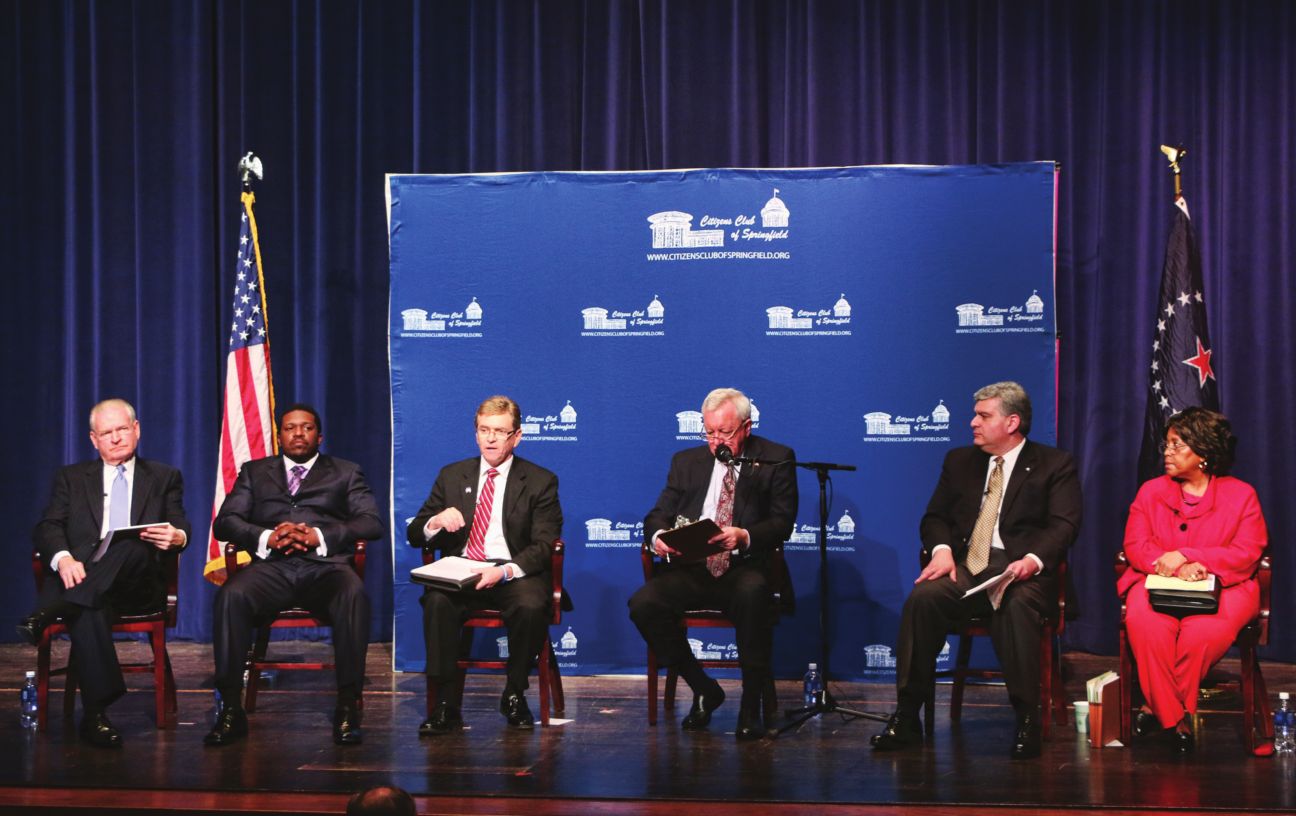
It’s natural for an incumbent candidate for re-election to defend his record in office, and a mayoral candidate forum on Jan. 26 found Houston fending off criticism – sometimes veiled and sometimes direct – of his policy decisions.
The issue of a residency requirement for city employees is one of the most divisive policy questions in the election, and Houston supported such a requirement during his 2011 campaign. However, he now defends his stance that the city can’t implement such a requirement without incurring untenable costs. He says a residency requirement would be disputed by the 24 unions representing city employees, and the issue would go to arbitration and possibly prompt a strike at City Water, Light and Power. The result, Houston forecasts, would be an agreement in which the unions accept a residency requirement in return for higher salaries. Those
prospective pay increases and the costs associated with possible union
strikes would be expensive for the city, Houston said.
For
residents of the east side, the issue is one of fairness: the city’s
record of hiring minority workers in proportion with their share of the
population is poor at best, and people of color see city jobs going to
white people who live in bedroom communities outside Springfield instead
of people of color who live within the city. At the Jan. 26 candidate
forum, the four candidates who said they support a residency requirement
got applause. Meanwhile, the crowd grumbled in disapproval as Houston
explained why he hasn’t already implemented it.
Related
to the residency requirement issue is minority hiring. Houston
distributed a handout at the Jan. 26 candidate forum saying 20.2 percent
of new hires in his administration have been nonwhite workers. If
tested positions like police and fire jobs are excluded, that number
jumps to 24 percent, according to Houston’s campaign. Looking at 2014
alone, Houston says 25.6 percent of all new hires have been nonwhite
workers, and 32.1 percent of hires in untested positions were nonwhite.
In
June 2011, shortly after Houston took office, 7.8 percent of city
employees were nonwhite, Houston’s campaign says. That number increased
to 9.7 percent by June 2014, according to the campaign.
When
Houston ran for mayor four years ago, he promised to hire 25 percent
minority employees for the first two years of his administration and
reevaluate hiring numbers after that. Houston’s cumulative minority
hiring numbers for all four years appear below the 25 percent mark,
although his minority hiring numbers for 2014 alone are significantly
higher.
Houston also
says he has “revamped” how hiring works in city government, with a human
resources worker sitting in on every interview and a standardized list
of questions asked of each candidate. He says he has met with several
community groups associated with the east side, and his administration
sends job listings to those groups, along with posting them on websites
aimed at employment diversity.
“We showed you exactly what we have done over the last four years to
improve the minority participation within city government,” Houston
said. “We are operating a professional organization, and not a political
organization.”
“We
showed you exactly what we have done over the last four years to
improve the minority participation within city government,” Houston
said. “We are operating a professional organization, and not a political
organization.”
Ward 2
Ald. and mayoral candidate Gail Simpson cast doubt on Houston’s hiring
numbers at the forum and attacked the current mayor’s record.
“I
know statistics can represent what you want them to represent,” Simpson
said. “You have to make a more concerted effort to hire minorities. …
For anybody to think that there are not political hires, I’ve got an
island that I can sell you.”
She
said city employees often call her with tips about other employees who
just started working for the city, are under-qualified and are related
to someone with influence.
“Look at the rolls of city government, and you’ll see a lot of names that are the same,” Simpson said.
Simpson and candidate Samuel Johnson took aim at Houston for not having more people of color in positions that control hiring.
“People
hire people they can identify with,” Johnson said. “If you have someone
of minority that’s in a higher level, nine times out of 10, out of
human nature, they’re going to hire
somebody that looks like them. When you have the majority of white
citizens that are in the top level, they’re going to hire people that
look like them. That’s just human nature.”
City
treasurer and candidate Jim Langfelder touts his experience with
disadvantaged communities as evidence of his commitment to the needs of
people of color. He says the city must make law enforcement and
firefighting attractive jobs for young people of color, which he
proposes to do by partnering with schools and trade unions. He also
calls for implementing an automatic review when minority job applicants
with similar qualifications are passed over in favor of white
applicants.
Sangamon
County Auditor and candidate Paul Palazzolo said he would apply his
experience with diversity – such as serving on the board of the
Springfield Urban League and other organizations – to finding ways to
recruit more people of color for city jobs. Palazzolo said he attended
many years ago the Crossroads antiracism training that Houston and about
50 members of his administration went through later.
Although
Houston faces criticism on issues like the residency requirement and
minority hiring, he is mostly silent about his ongoing effort to
eradicate systemic racism within city government. After going through
the Crossroads antiracism training, Houston charged the city’s Office of
Community Relations, headed by director Sandy Robinson, with examining
all aspects of the city’s business, hiring, contracting and policies to
identify areas that benefit white residents more than or at the expense
of black residents. [See “Rooting out systemic racism,” Jan. 15, 2015 by
Patrick Yeagle.] There is no disagreement among the five mayoral
candidates on the need for redevelopment on the east side, and little
difference between the candidates on how to accomplish it. Houston touts
his ongoing efforts to demolish blighted buildings and his work on
redevelopment even during his private sector business career through the
Nehemiah Project and other groups. Simpson said she would work on small
business development and balancing growth between different parts of
the city. Langfelder calls for east side TIF districts, one-stop
employment information centers, entrepreneurship projects and more.
Palazzolo says he would bring more businesses to Springfield, keep
utility and tax rates low and work to improve education, infrastructure
and transportation. Johnson wants to build a work-oriented community
center on the east side featuring help with finding employment and bidding for city cotracts.
The vote
The
Faith Coalition for the Common Good is one of several groups in
Springfield working to register voters on the east side. The groups are
encouraging early voting and are holding candidate forums for the
mayoral race and contested aldermanic races. Shelly Heideman, executive
director of the Faith Coalition, says they’ll also work to get voters to
the polls on election day. Additionally, the six-way contested primary
race in the mostly black Ward 2 means there is potential for increased
turnout among black voters.
Both
Gail Simpson and Samuel Johnson say they don’t worry about splitting
the black vote. Johnson said he weighed that possibility before jumping
into the race, but he concluded that the black vote would already be
split somewhat between Simpson and Langfelder.
“I
had to ask myself, ‘Am I doing this for political reasons, or am I
doing this for the people,’ ” Johnson said. “I knew that the people
whose votes I was going to target would be the ones that the other
candidates wouldn’t target, the people they wouldn’t waste their time
on.”
Simpson says she doesn’t want to be seen as only concerned with issues affecting African-American residents.
“ I know statistics can represent what you want them to
represent,” Simpson said. “For anybody to think that there are not
political hires, I’ve got an island that I can sell you.”
“This race is,
to me, about individuals across the city who have been left out of
representative government, in terms of the leadership knowing and
understanding their needs,” she said. “That’s across the city; it’s not
race-related at all. … This race ought not be about race. It ought to be
about the most qualified individual. It ought to be about the
individual that they can trust and believe in, based on their record.”
Could
Springfield elect a black mayor this election? Allan Woodson, the
former alderman and last black mayoral candidate, isn’t holding his
breath. He says any winning candidate has to meet five criteria: lots of
money for campaigning, previous experience in city political office, an
endorsement from one of the two major political parties,
higher-than-usual support in predominantly black precincts and
significant support among white voters.
“I
think in a future election, a black candidate can be elected mayor of
Springfield, but I don’t see that happening in 2015, with all due
respect to Alderman Simpson and Mr. Johnson, neither of whom meet all
the aforementioned criteria,” Woodson said.
Support
from white voters is “absolutely critical,” Woodson says, but he looks
to the election and re-election of President Barack Obama as proof that a
black candidate can get the support of white voters. Woodson himself is
proof that it can happen in Springfield. When he was elected to the
Springfield City Council in 1987, he represented the mostlywhite Ward
10. When he lost his mayoral bid to Karen Hasara in 1999, Woodson still
won 40 percent of the vote, which means a significant portion of white
voters had to have voted for him.
Whether
or not Springfield is better off than it was before Houston took office
is only half the question; for many east side residents, the answer is
no. It remains to be seen which promises made in this election will be
kept and which – like too many residents – will fall through the cracks.
Contact Patrick Yeagle at [email protected].


