
A drummer who hasn’t missed a beat in 90 years
DYSPEPSIANA | James Krohe Jr.
I can only barely keep time, but while I could never be a drummer I love to talk with my father about the drummer’s craft. He’s worked as a professional musician for 76 years now – he’ll turn 90 this week – which means he’s been supplying the beat for other people to dance to even longer than Mike Madigan. He’s a drummer, mostly, but he’s also earned money as a bass player, teacher, band leader, conductor and arranger.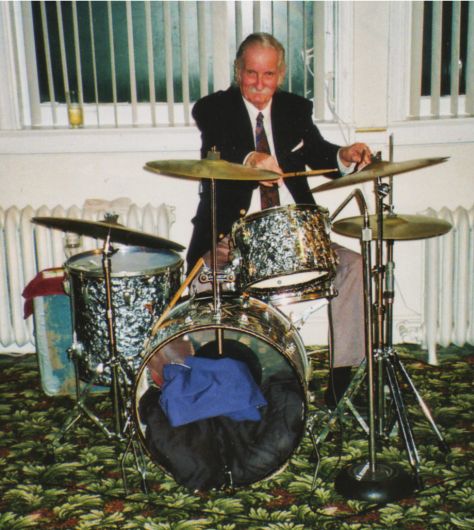
Growing up in Beardstown, he started banging on his big brother’s snare drum. He had, as they say, a knack. Apart from a few perfunctory grade school lessons, he was essentially self-taught, watching and learning from older players. His neighborhood pals happened also to be musicians, and they regularly gathered at the local malt shop (yes, really) to play the jukebox, which featured the latest tunes by the Ink Spots, Harry James, the Dorsey brothers and the like. In time they came to hang out with musicians on the big summer excursion boats that chugged up from New Orleans. Their favorite was the S.S. Capitol, because the house band was Walter “Fats” Pichon’s 10-piece orchestra, which played the latest swing. They got to know the musicians, and were allowed to hang out during breaks.
The man I think of as Springfield’s real Jim Krohe began his professional career before he was old enough to drive. At age 17 he was touring the Midwest with a band after most of its adult musicians had gone off to war. After a year spent lobbing mortar shells at scared German kids, Dad played in military bands in Austria and directed one (for the Illinois National Guard) in Springfield, Minnesota and, for a while during Korea, in the West Coast.
For years the Guard band was his day job.
Weekends and evenings usually found him behind his Ludwigs somewhere in and around Springfield. He played at social clubs and fraternal clubs and posh restaurants and lounges and nightclubs and hotels. The capital was a livelier place in those days. People still danced, every function had to have live music, and Dad not infrequently played three jobs a weekend. He learned a lot – the names of night-shift cops, and waitresses, and where a guy can cash a check at 2 in the morning, and which 24-hour diner has the best scrambled eggs.
A career as a freelance percussionist in a small city is as much a test of keeping one’s nerve as keeping one’s beat, seeing as how often you have to adapt to players one’s never played with, often playing music he’s never seen. He’s played on rooftops and beer tents and marching down the street, on a riverboat, in country clubs and in private rail cars, in clubs where you didn’t want to know what was going on the back room and in the pit of the Opera House Theater in Salzburg. He’s played for horse shows, fashion shows, beauty contests and water shows (white jackets and bow ties), ice shows, motorcycle races, horse races, even a rodeo once. He’s played in polka bands, rock bands, country bands, clown bands and square dance bands, jazz trios and of course big bands.
Dad has played with a lot of big bands. His first love is the 15-17-piece band playing dance and jazz first popularized in the 1930s, but he’s set up shop in the pit at the Muni Opera, behind the tympani for the Springfield Symphony Orchestra and marched and concertized with the Springfield Municipal Band on and off for more than 30 years. The Muni Band was an all-weather ensemble that supplied music for all occasions, from soccer field openings to wreath-layings. They also used to serenade the crowds at just about every event at the Illinois State Fair that attracted a crowd – endless August days, with every event preceded by a few marches and, of course, the national anthem, usually sung by Miss Viola Suits. They even provided dinner music of a sort at ice cream social nights at the Douglas Park bandshell.
Dad’s indoor career has been even more interesting. He’s helped provide musical accompaniment to movie stars and nightclub chanteueses, girls’ choirs and barbershop quartets; after playing in the pit band at a Coliseum show, he watched from backstage as The Who’s drummer, Keith Moon, wrecked his drum set – which must have made an old drummer feel the way that the founding faculty at Sangamon State felt when the U of I took over.
On it’s gone – accompanying daring acrobats in the circus (circuses, in fact, five different ones) and not-at-all daring dignitaries doing rhetorical tricks during Memorial Day speeches. He played for Illinois governors and, once, in California for the queen of the Netherlands, which is the sort of thing that happens when you live in California, as he did during the Korea call-up. He even played on the soundtrack for the Old State Capitol soundand-light show; that was a bust, but you can’t blame a drummer for that.
Contact James Krohe Jr. at [email protected].
Editor’s note
This month’s Illinois Issues cover story on “Young black males” is recommended reading as the nation turns its attention again to Ferguson, Missouri. In the article by Maureen Foertsch McKinney, the guidance dean at Springfi eld’s Lincoln Magnet school is quoted saying her sixth-, seventh- and eighth-grade black boys are “terrifi ed” with thoughts that what happened to Michael Brown could happen to them. A parent of African-American males explains that she teaches her teenagers that if they get pulled over by police to roll down the window and put both hands out, rather than reach for their papers in the glove compartment. A Benedictine University professor says feeling under constant threat – from poverty, violence and police – is a way of life for many African-American teens and can be “powerfully discouraging.” –Fletcher Farrar, editor and publisher