Advice and dissent
How to turn the Y block into a “why not?” block
DYSPEPSIANA | James Krohe Jr.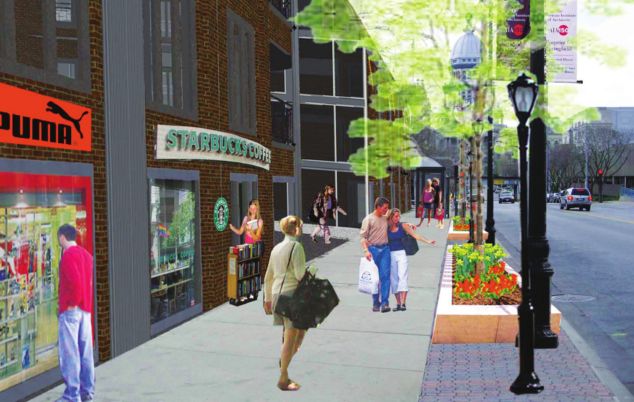
“Give it back to the Indians,” I thought when I read the State Journal-Register’s call for ideas about what to do with the YWCA block downtown. “Give it back to nature. Give it to anyone other than the City of Springfield.”
The city, as you probably know, bought the city block south of Capitol between Fourth and Fifth for use as a – well, the city doesn’t know yet. Something (to borrow the SJ-R’s description) that offers “mixed-use development, “green space” and “multi-level parking.” Problem is, most of Springfield’s Gang of Ten react to consultants who use such phrases as “mixed-use development, “green space” and “multi-level parking” the way they react to a waiter who suggests a menu choice in French – they don’t understand what they’re being told and they resent being expected to.
What the City of Springfield needs is people who will listen to good advice; it’s had people giving it good advice about how to revitalize downtown since the first of the so-called urban design assistance teams landed in the capital in 1979. That project focused on the preservation of downtown historic structures. The R/UDAT
report from 2002 and its follow-up S/DAT are better known; sometimes overlooked is the 2005 master plan intended to guide development on downtown’s northern fringe in the Mid-Illinois Medical District in Springfield.
In 2011, the local chapter of the American Institute of Architects joined a collaborative team that drew up actual designs for mixed-use infill projects at specific sites, drawing upon the talents of the city’s Office of Planning and Economic Development and a graduate design studio at the University of Illinois at Urbana-Champaign. One of those sites was the Y block. The resulting scheme (renderings of which seems to have disappeared from the web) anticipated perfectly the kind of mixeduse project that the mayor says he wants to see built; were it built, it would be the best addition to Springfield since Myron West laid out Washington and Lincoln parks.
No matter how good a project ends up on the Y block, it won’t restore downtown by itself. Rehabilitating a city center is not like getting over a gut bug; taking even a blocksized pill won’t cure what ails you. It’s more like recovering from alcoholism. It takes years of constant discipline, and city regulators, bankers, developers will have to change their diet, their habits, maybe even their friends.
The debate Springfield aldermen should be having, for example, is not about the Y block per se but about how to work similar miracles on all the other blocks downtown. The mayor in particular thinks himself a very good boy for having stuck his thumb into the state’s pie and pulled out this plum, but the city needs to be buying other blocks to link that one with the rest of the area, vacating alleys and turning them into greenways, redesigning streets, rethinking traffic flows.
Like many a recovering alcoholic, the city might want to make amends for past planning mistakes by exploring opportunities to reverse them. I have railed for years about the calamitous error committed by city and university officials when they agreed to build the campus for SSU in a cornfield rather than downtown. The result is a dull campus – like living in an office park, I should think – and a vacant downtown, when Springfield could have had a lively campus and a revivified downtown.
Is it really too late to realize that vision?
Why not press UIS to commit to relocating downtown, under long-term leases, those university operations that would benefit from proximity to the Statehouse. Several might, from the school’s public affairs broadcasting, and publishing arm and its Center for State Policy and Leadership to its Illinois Legislative Staff Intern Program and perhaps its nascent Lincoln studies program.
The city plans to set up yet another advisory committee. The advice it needs is how to set up an independent public development authority that would protect that property from the clumsy meddling of aldermen. Only by protecting it in this way will savvy developers with imagination and expertise – and there are plenty just in the Chicago area – even consider doing business in Springfield. Why should they invest in the city center in a town whose government is plainly committed to directing development to the periphery?
Or worse, whose government is plainly committed to developing downtown as if it was on the periphery? Look at the difference between the County Market supermarket that was allowed to be built at Second and Carpenter in Springfield and the one that Champaign’s city government insisted be built in the same kind of area at Stoughton and Springfield Avenue. The difference between them is the difference between urban and small-town, between street-oriented and parkinglot-oriented, between 2014 and 1974. The one thing that the city doesn’t need any advice about is how to do such things badly.
Contact James Krohe Jr. at [email protected].
Editor’s note
It
would have been refreshing had Mayor Mike Houston proclaimed his single
term a success and announced his willingness to step aside, as
promised. Springfi eld has a number of young, talented public servants
with ideas and energy, waiting for a chance. They will likely have to
wait longer, as the pretty good mayor – with the advantage of incumbency
– will be almost impossible to beat. We can only hope that the campaign
will bring out some fresh visions for Springfi eld, from the mayor and
from those who want the seat when it comes open again. –Fletcher Farrar,
editor and publisher
Cover photo by Patrick Yeagle