Sweet on sweet corn
FOOD | Julianne Glatz
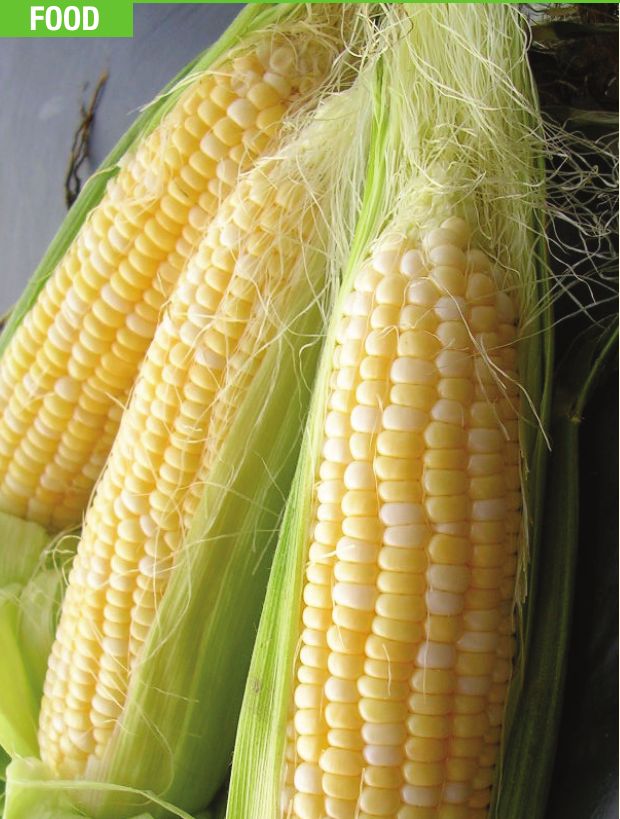
Are there any sights, sounds and smells more evocative of a Midwest summer than those of fresh corn on the cob waiting to be shucked? The leaves are still crisp and green; the aroma’s corny and delicious; the husks squeak when they’re ripped away to reveal the tender kernels.
For anyone who’s ever grown and picked it, sweet corn evokes other sensory sensations as well. The densely planted stalks shut out any possibility of a cooling breeze to counter the blazing sun and thick, humid air. In my youth, the corn rows seemed to claustrophobically enclose me as I trudged down the narrow aisles with an increasingly heavy bushel basket and an increasingly aching back, that green-corn aroma mixing with the smell of the sweat that trickled from my forehead into my eyes and slithered down the back of my neck. The stiff darkgreen corn leaves on the stalks could leave a welter of scratches, so long-sleeved shirts were mandatory, but hands and face were still vulnerable.
Then there was the frustration. Sweet corn was the biggest, most important crop we grew at our produce farm. When the sweet corn was on, folks who normally wouldn’t stop were lured in by the promise of just-picked corn and bought other vegetables as well.
My grandfather planted successive patches of sweet corn so that we’d have it as continuously as possible throughout the summer, but every so often his careful planning would be ruined by his archenemies, the raccoons. “The corn’ll be ready to pick tomorrow,” he’d cheerfully announce at supper. “It looks beautiful. Be sure to put the sign out front.” The next morning he’d walk down to the field, then back up to the house, shoulders slumped dejectedly: “ Those #&$% coons showed up again. Better take the sign down.”
It wouldn’t have been so bad if they’d taken a few dozen ears. In fact, I think my grandfather would gladly have given that much to them. The problem
was that the raccoons – who unerringly waited until the day the corn was
at its prime – would move down the rows and take one bite out of each
ear, ruining an entire field. Anyone who’s ever seen Bill Murray battle
the gopher in the movie Caddyshack will have an idea of the
unending war my grandfather waged against the raccoons. At various times
he tried electric fencing, an army of transistor radios placed
strategically in the fields that blared throughout the night and kept us
all awake, bright lights, and even an occasional nighttime vigil with a
shotgun. Some of his strategies would work for a while, but it never
took long for the clever raccoons to catch on.
Conventional
wisdom used to hold that sweet corn was at its best when it was just
picked and very young, because younger sweet corn had a higher sugar
content and, once an ear is picked, the sugars rapidly converted to
starch. In fact, we used to put the water on to boil before going out to
pick corn for supper so that it would be only minutes from stalk to
pot. Though some people still follow those guidelines, the introduction
of the super sweet varieties first developed by University of Illinois
by botany professor John Laughnan in the 1950s rendered them
unnecessary. Those U. of I. hybrids and their descendants incorporated a
mutant gene that slowed the conversion of sugars to starch, so it’s no
longer necessary to cook corn as soon as it’s picked for maximum
sweetness.
These days
it’s virtually impossible to find any sweet corn that’s not a super
sweet hybrid, either in groceries, farmers markets and farm stands.
There are heirloom varieties such as Country Gentleman (also called shoe
peg because of the irregular arrangement of its kernels on the cob),
Stowell’s Evergreen and Golden Bantam. It’s been years – actually
decades – since I’ve tasted any but super sweet varieties. But this
year, my daughter Ashley has planted some Golden Bantam. It’s not quite
ready, but the difference between it and the super-sweets is already
apparent: The stalks are much shorter. When I was a child, a common
saying was “knee high by the Fourth of July.” It’s something I remember
at the beginning of July because now the stalks of both field and sweet
corn are head high.
I
actually prefer super sweet corn that’s mature; very young ears are
almost too sweet and haven’t yet developed much corn flavor.
Boiling,
steaming or microwaving is probably the most common way to enjoy fresh
corn on the cob, but in my family we’ve become equally fond of preparing
corn on the grill. Grilling sweet corn caramelizes its sugars and
enhances that corny flavor, but if not done properly it can produce
kernels that are tough and dry.
My
grillmeister husband offers these tips for corn that stays tender and
toothsome: Pull out as much of the silk from the top of the unshucked
sweet corn as possible. Soak unshucked corn in cold water for at least
10 minutes. Place the still-unshucked corn over hot coals and grill it
for 10 to 15 minutes, turning so that it’s grilled evenly. The outer
husks will become charred and blackened, but the corn inside will
essentially be steamed. Let the corn cool until you can handle it
easily. You can then either remove the husks and silk completely or pull
the husks back, remove the silk, and tie the husks midway with string
to make a handle to hold while eating the corn. Brush the corn very
lightly with oil or butter and return it to the grill (keeping the husk
handle, if you are using one, away from the hot part of the grill) for a
few minutes, turning frequently, until the kernels just begin to brown
and caramelize.
My
family usually enjoys our first corn on the cob of the season as simply
as possible, perhaps with a little butter and salt or even without any
adornment whatsoever. As the season continues, however, we like to
experiment with new variations or re-create variations we’ve enjoyed in
the past.
Perhaps
someday we’ll find a corn-onthe-cob treatment we enjoy as much as elote
asado, but somehow I doubt it. This traditional specialty can be found
in practically any Mexican town, as well as in Mexican enclaves in
American cities. In the Little Village neighborhood in Chicago, elote
carts can be seen on almost every street corner in the summer. In
Mexico, the pit-roasted ears are field corn, but here in the United
States sweet corn (the older the better) is the norm.
Whether
the corn is boiled, roasted or grilled, the garnishes are the same:
First the cooked ears of corn are slathered with mayonnaise or creme
fraiche (similar to sour cream, an acceptable substitute). Mayonnaise is
most commonly used on the street carts, but I prefer creme fraiche or
sour cream, which is lighter and less oily. Then the coated ears are
rolled in crumbled queso fresco (fresh cheese), queso añejo (aged
cheese) or an equivalent such as Parmesan, feta or farmer cheese and,
finally, sprinkled with chili powder. Admittedly, it’s not a diet dish,
but it is sublime: undoubtedly a food of long-lost Aztec and Mayan gods
and something worth experiencing at least once every Midwestern summer.
Contact Julianne Glatz at [email protected].