Fixing school funding
Illinois’ antiquated school aid formula doesn’t work
SCHOOLS | Lauren P. Duncan
Illinois has seen the price of food, gasoline, shelter and most basic necessities increase. Yet for four years the state hasn’t increased the amount it pays per child in public school. And the formula which determines how much state aid each school gets hasn’t been changed since 1997.
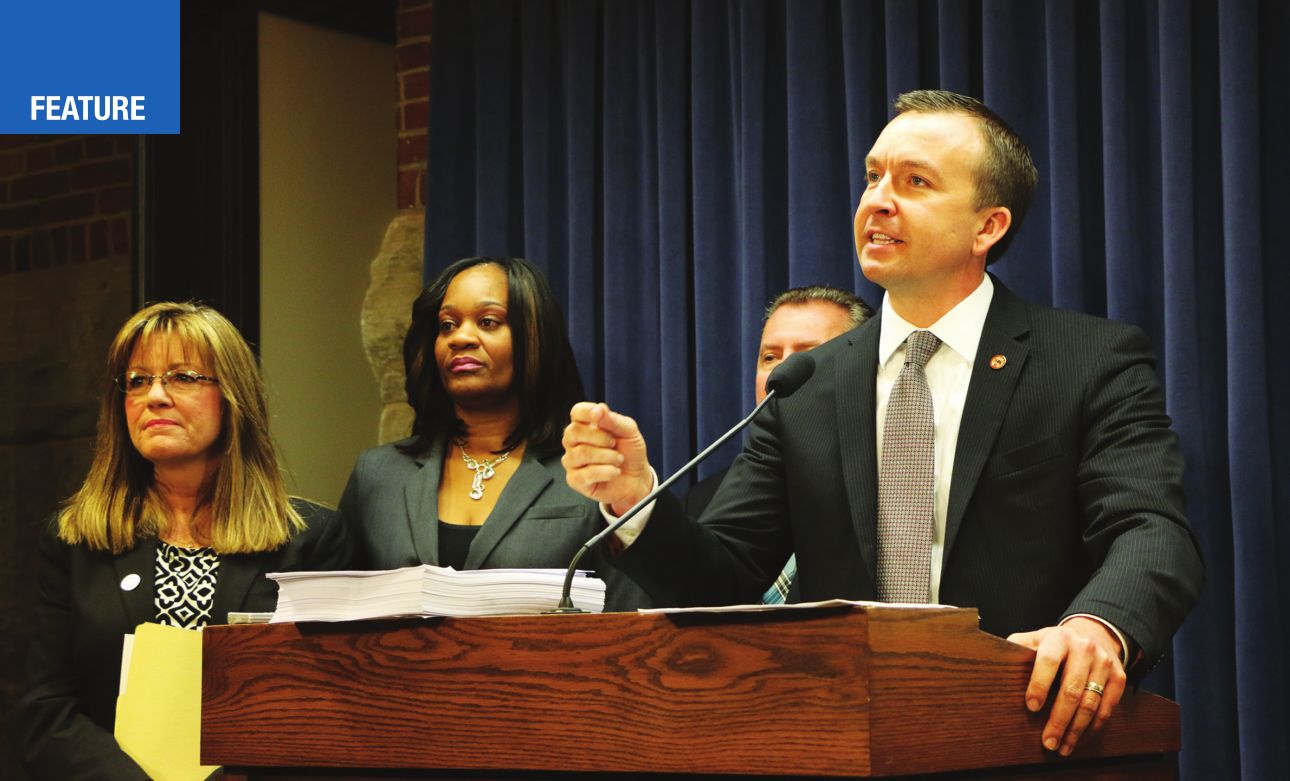
A few members of the General Assembly are trying to take steps to change the state’s antiquated school-funding system. In July, 2013, Sen. Andy Manar, D-Bunker Hill, a freshman lawmaker who had just taken office in January, was named as a co-chair of the Education Funding Advisory Committee (EFAC). Illinois Senate leaders formed the committee to address the state’s education funding disparities, including the fact that, at the time the committee was formed, about 67 percent of Illinois school districts reported deficit spending.
After the committee gathered testimony, on April 1 Manar introduced Amendment 1 to Senate Bill 16, or the Illinois School Funding Reform Act of 2014. It would set
up a formula to distribute education funding based on a local district’s “ability to pay,” which considers a district’s available local resources through property tax revenues. The formula also considers the poverty level of districts by factoring in low-income student populations. The bill aims to give property-poor districts a bigger slice of the state aid pie, and propertyrich districts a smaller piece of the pie. The proposal would also add greater weight to other special funding needs districts face, such as students with disabilities or gifted learners.
Presently, about 44 percent of the $4.3 billion in general state aid for education is distributed to districts based on their ability to pay. Manar’s bill aims to raise that number to about 92 percent so that most of the state’s funds would be distributed based on districts’ needs.
Manar said the proposal is a needed change toward reforming Illinois’ education funding.
“We need a comprehensive fix that deals with good policy and ignores the politics,” Manar said.
Illinois’ school funding formula is complex.
Entire college courses are taught on the funding system. Manar’s bill aims to change the method. The key point, Manar said, is to help address today’s education funding issues.
The state’s education funding problems mean some schools have had to close buildings, hold classes in windowless rooms and use outdated textbooks, Manar said at a press conference April 2 when he unveiled the bill. He said small towns are losing their identity, good teachers are losing their jobs and the achievement gap is rising in poverty-stricken districts.
“Those things are all a direct result of a law that today protects inequity.... We can do better in this state and this bill will get us there,” Manar said.
The problem
Illinois places a greater burden on local school
districts to fund education than most states. Article V of the Illinois Constitution says “the State has the primary responsibility for
financing the system of public education.” Yet the state government hasn’t taken that primary responsibility seriously.
The average state and local share of education cost in the United States is about 44 percent state share, and 44 percent local share, with the remaining cost paid with other grants or federal dollars, according to a report released April 7 by the Center for Tax and Budget Accountability (CTBA). In Illinois, the state carries about 28 percent of the bill, while local districts pay for 61 percent of the costs through property taxes.
The CTBA report states that over-relying on local property taxes to fund education is not good tax policy. Instead, CTBA emphasized that state-based revenue generated from income and sales taxes is a better way to tax people. “Illinois over-relies on property taxes because the state fails to pay its fair share of the cost of public education,” the report states.
Manar’s bill doesn’t change the sources of education funds in Illinois, though. It suggests the state move one step closer toward distributing funds based on districts’ needs with the revenues the state has.
Since
2010, Illinois has not increased the “foundation level,” which is the
amount the state has decided is needed to provide an adequate education
to children. The state share has remained at $6,119 per child. However,
many schools do not receive even that much, due to “proration,” or state
budget cuts. Yet the state’s Education Funding Advisory Board has
recommended that the foundation level be higher. In 2014, it said, the
minimum needed to adequately educate an Illinois student is $8,672.
What
the state pays to educate students may increase if Gov. Quinn’s plan to
increase education funding by $344 million next school year goes
through. However, agreement on a number of looming issues – including
extension of the temporary income tax and proposals for a progressive,
or “fair tax,” structure – stand between the governor’s proposed budget
and the fund increases becoming a reality.
Manar’s
bill aims to ensure that regardless of how much money the state
provides, the districts that need the money most will receive the most.
The
bill would reduce state aid to school districts that have more local
income and increase aid to districts that have lower local property tax
income, by taking into consideration local property wealth.
There
is a vast difference in property values amongst Illinois’ school
districts. Because districts receive most of their dollars from local
property tax revenues, this means propertyrich districts have the
opportunity to collect more money for schools. Wealthier districts tend
to have lower tax rates than poorer districts. For example, New Trier
Township High School District 203, which includes the suburban towns of
Winnetka and Northfield, has more than 10 times the local property
wealth of Springfield, yet Springfield’s tax rate is more than three
times higher. New Trier, however, is one of the state’s 72 “flat grant”
districts, which means
because its resources are so great, it receives a bare minimum of state
funds, $218 per student. Manar’s bill aims to decrease even the $218.
Even some of the wealthiest districts understand there needs to be a change in the funding system, Manar said.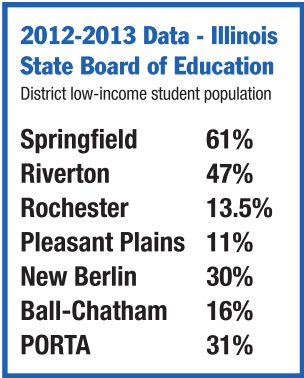
“There’s
a realization that something has to change in our state system,” he
said. “If the state system crumbles, everybody is going to be affected.
Even the most wealthy … whether you spend $20,000 per student or $6,000
per student, the health of the state’s system is at stake here, and
that’s what we’re trying to talk about,” he said.
Manar
wants to make sure property-poor districts can afford to educate their
lowincome and special needs students. In addition to basing funding on a
district’s “ability to pay,” the proposed reform considers the number
of low-income students in the district. Low-income students are those
who are eligible to receive free or reduced-price school lunches.
The
proposed reform would also add extra weight to the funding formula for
other students with greater needs, such as advanced placement students,
alternative schools, gifted pupils, students with disabilities, and
Englishlanguage learners.
Ralph Martire, CTBA executive director, said Manar’s bill is one step toward improving the tax policy in Illinois.
“If
adequately funded, this bill would do a much better job of distributing
resources and it follows best practices. In those countries and/or
states that do a much better job of funding education, they
figure out what it takes to educate your typical kid, and then they say,
all right, not everybody is your typical kid, some have special needs,
some come from poverty, some are English-language learners. All of those
things cost more, to educate a kid with those backgrounds, than to
educate a kid who doesn’t,” Martire said. “This approach to education
factors in those characteristics that increase the cost of educating
children.”
The proposed reform also suggests adding extra weight to gifted students.
“For
the longest time we sort of ignored the fact that it’s more expensive
to provide an education to a really gifted kid than to a typical kid,”
Martire said. “This really changes that.”

Gaining support
While
Manar and the legislation’s cosponsors are working to gain support for
the proposed reform, many school superintendents are worried about
something more immediate. School leaders are simply hoping they don’t
receive any further cuts to their budgets this year.
Springfield
District 186 is facing a more than $4 million shortfall for the next
fiscal year beginning July 1. That’s if state funding is kept at the
same level as last year. While more equity-based funding would likely
help the district, which has about a 60 percent low-income student
population, right now its leaders worry about how much the district will
receive.
District 186
Interim Superintendent Robert Hill pointed out that if state education
funding levels are kept at the same rate, then changing the formula
would take away funds from some districts, though probably not
Springfield.
“When you
have the conversation that we’re having right now and you don’t put any
more money in, then it’s guaranteed, it’s a zero-sum game, there are
winners and there are losers,” he said.
Based on the legislation, Hill said, it looks like Springfield would be a winner.
Though
the debate seems to pit poor downstate schools against wealthier
suburban districts, Hill pointed out that there are some suburban
districts that are hurting just as much as downstate schools.
Thus,
the actual projections showing how districts would be financially
affected are what superintendents are waiting to see. Manar said the
Illinois State Board of Education is expected to release the
calculations in mid-May.
For
PORTA District 202 in Petersburg, the outcome of Senate Bill 16 isn’t
certain. Superintendent Matt Brue said that when he began as
superintendent 10 years ago, the district had about
18 percent low-income students, but now it’s close to more than 30
percent, due to a growing federal housing development.
The
district has higher property values than some nearby districts, but
it’s facing budget shortfalls because the district’s student population
has been declining.
In
addition to waiting on the bill’s numbers, Brue and his district are
waiting to see how much the state approves this year for education
spending. Over recent years, the district has had to cut back on its
spending. Instead of cutting staff to save money, Brue said, the
district has trimmed expenses by not filling positions when staff
members retire. As a result, Brue both serves as the district
superintendent and the cafeteria director. He said the district can’t
afford any deeper cuts in state spending.
In
order for Manar’s proposal to pass, Brue said, wealthier districts that
stand to lose general state aid may ask for “mandate relief.” The state
legislature passes laws, or mandates, every year that serve as
requirements for districts. For example, a bill pending in the Illinois
Senate would require schools to implement screening tests for children
entering kindergarten to look for signs of dyslexia. If a student shows
signs of dyslexia, the bill would require schools to offer a special
program. At PORTA, however, Brue said the district already has more than
30 specialized programs for children with reading disabilities that
ensure students are receiving the attention they need.
Both
Superintendent Hill of Springfield District 186 and Superintendent Brue
of PORTA said most leaders in Illinois would agree that school
districts do not need a long list of mandates in order to know what
students need.
“Parents have expectations,” Brue said.
“There’s
a reason we haven’t cut programs … I guarantee you that if school
districts have mandate relief, they’re not going to stop providing a
good education.”
Brue
said he thinks Manar’s plan is a good idea, and that most of the
property-wealthy districts would accept losing some of their general
state aid, especially if mandate relief is available.
Like school superintendents, legislators also are waiting to see the numbers behind school formula reform.
Convincing
the state’s leaders to agree on major policy changes is rarely a simple
task. Superintendent Hill said even 20 years ago, education funding
reform discussions were often based on something called “printout
politics.”
“They would
print out what the impact was going to be on every school district.
Every member of the General Assembly would get the printouts, look at
the schools that were in their legislative district … and it would
pretty much determine whether they would vote for or against it,” Hill
said.
Manar is hoping
that isn’t the case this time around. EFAC went through seven public
hearings and 45 hours of public testimony before releasing its findings
this year. Manar said all of that work wasn’t done for a “bickering
match.”
“Because if that was the case, I just wasted a lot of time and a lot of people’s time.”
A
number of groups have voiced their support for the bill, including
Advance Illinois, a group that works on education policy, the Chicago
Urban League, Ounce of Prevention Fund, a group that works with children
in poverty, the Illinois State Board of Education, the Illinois
Education Association, Stand for Children, Illinois Action for Children,
and the Illinois Business Roundtable. Additionally, former Gov. Jim
Edgar and Lt. Gov. Sheila Simon support the measure.
Yet
others have voiced concerns or opposition. In both the Senate Executive
committee and Senate Executive subcommittee, both of which approved the
bill, Republican members who were present either voted “nay” or
“present,” while all Democrat committee members voted in favor of the
bill.
Sen. Dale
Righter, R-Mattoon, voted against the legislation in committee. He said
the proposal will increase the funding system’s disparities and more
funds will go to Chicago public schools. A component of the bill is to
eliminate the Chicago Block Grant and filter funds for Chicago District
299 through the same formula as all other Illinois school districts.
Sen.
Righter also criticized the legislation as being drafted “in secret”
without discussion with EFAC’s Republican co-chair, Sen. Dave
Luechtefeld, R-Okawville.
Manar
said he had hoped politics would be kept out of the discussion. Manar
was displeased to hear that Sen. Righter had called in to a radio
station in Manar’s district and disparaged the bill.
“Actions like that, by Senator Righter, are the reason we haven’t been able to get this done in the state,” he said.
Manar’s
plan would phase in changes over four years. In the meantime, districts
are hoping to see no further cuts this upcoming school year. Over the
past two years, Illinois schools have been “prorated” at 89 percent,
meaning schools received 89 percent of the funds that the state says are
needed to provide the foundation level, or $6,119 per student.
Superintendent Hill said some leaders have heard an 83 percent proration
has been considered.
“It would be a doomsday scenario,” Hill said.
Contact Lauren P. Duncan at [email protected].