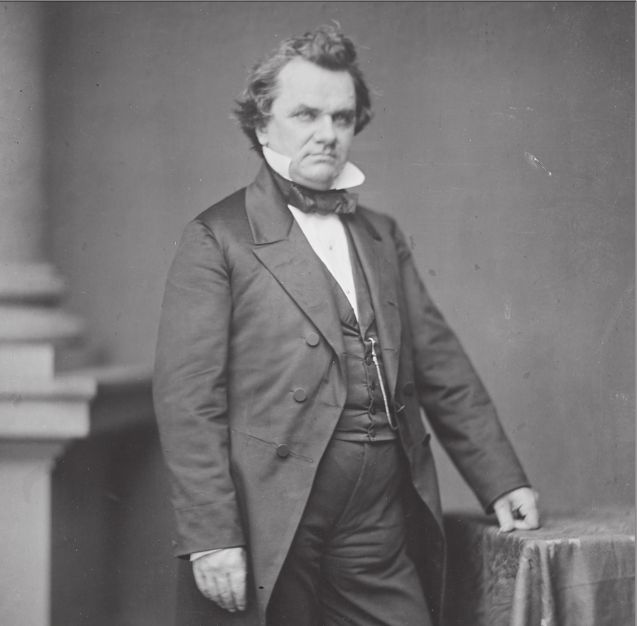
Prince of demagogues
Stephen A. Douglas and Illinois’ populist past
DYSPEPSIANA | James Krohe Jr.
The prospect is in store of two rabble-rousing populists trading insults for the next seven months. Each will try to tap the deep vein of grievance that runs through a middle class convinced that privileged interests (unions or the rich, it hardly matters) have robbed them blind. It’s all too depressing to look forward to, so I have been looking backward at some of the Illinois men who rose to power – or rather, who stooped to it – by cynically exploiting the popular prejudices of their day.
William Jennings Bryan, Salem-born and Jacksonville-educated, was one such mountebank. But Bryan merely wore a coat tailored to fit his predecessor of a previous generation, Stephen A. Douglas. The Little Giant was in fact a giant little man, meaning one whose energy and ambition enabled him to impose on large events the small spirit of our meanest citizens, specifically the Jacksonians who felt (and whose descendants still feel) disenfranchised by modernity.
Douglas’s memory has been ennobled by his long association with Lincoln, but he was anything but the Lincoln of the Democrats of their day. Judge David Davis of Bloomington once called him the prince of demagogues. Douglas was a walking, breathing attack ad. During his famous debates with Lincoln, he resorted to every low rhetorical trick to distort his opponents’ record and blacken Lincoln’s reputation. (Literally; he falsely accused Lincoln of wishing to mongrelize the white race.) Off the platform, he was a virulent white supremacist with a violent temper (he bit John Stuart’s thumb during an argument). As a lawyer he once stole a client’s money and spent it on a campaign, thus anticipating by more than a century our own disreputable system of campaign financing.
One historian exonerated Douglas of being aggressive, reckless, inconsistent and unscrupulous because, in the end, he remained steady in his love for the Union. This resort to patriotism as a defense for excess is always suspect, and more so in Douglas’s case. He has been praised for trying to chart a moderate course for the nation between abolitionists who wanted to destroy slavery even if it meant destroying the Union, and Southerners who wanted to save slavery even if it meant destroying the Union. The effort led one 1959 study of Douglas to describe him as “Defender
of the Union,” but we are entitled to ask whether a union that survives
only by countenancing slavery – Douglas’s union – is worth defending.
(We can also argue whether a union that survives only by military
conquest and repression – Lincoln’s union – is worth keeping.)
Douglas,
remember, helped start the slide to war in 1854, when he authored and
worked to pass the Kansas-Nebraska Act to advance the development of the
West, which set in motion the whole Indiankilling, territory-stealing,
farms-in-deserts madness of the age. He was an admirer of Andrew
Jackson, and like Jackson believed in Manifest Destiny. This, for those
who have forgotten, was the claim by Americans to a unique right to
behave in our continent as it now condemns Vladimir Putin for acting on
his. The land was ours (that is, white people’s) by right conferred by
God (that is, our God) so we could create a new heaven on earth. The
doctrine is odious and laughable in turn (in the end, we created
Scottsdale) but people still believe it. The difference today is that
Americans believe that our manifest destiny (which is somehow manifest
to no one else) applies not merely to the North American continent but
to the globe. Iraq was another Kansas.
Which
also triggered a civil war. To abet that expansion, he pandered to
Southern interests by agreeing to allow residents of new territories to
decide whether to admit slavery there. Southerners flooded into the
territory, and anti-slavery zealots rushed to oppose them, and blood
flowed.
“Let the
people decide” – as Bruce Rauner wishes to let them do about term limits
and as Pat Quinn hoped to do in 1994 – was high-sounding nonsense in
1854. Which people? (Neither slaves nor women got to decide whether and
where to extend slavery.) Granting people in the territories the right
to decide how to conduct their lives in their own local communities – in
effect, empowering exclusion and separatism – remains a seductive
doctrine to those who believe that the North American continent belongs
to the U.S., Indians and Mexican be damned, and that Americans don’t
need government as long as god-fearing white men have their guns. Those
Southern and Western states have been attempting to invoke their own
version of popular sovereignty when they assert a right to not enforce
federal laws on guns, immigration or health care. Were they to succeed,
they would realize that ideal republic envisioned by Old Hickory, and
nearly made real by the likes of Douglas.
Contact James Krohe Jr. at [email protected].


