Established and successful, music education is ready to grow
MUSIC | Tom Irwin
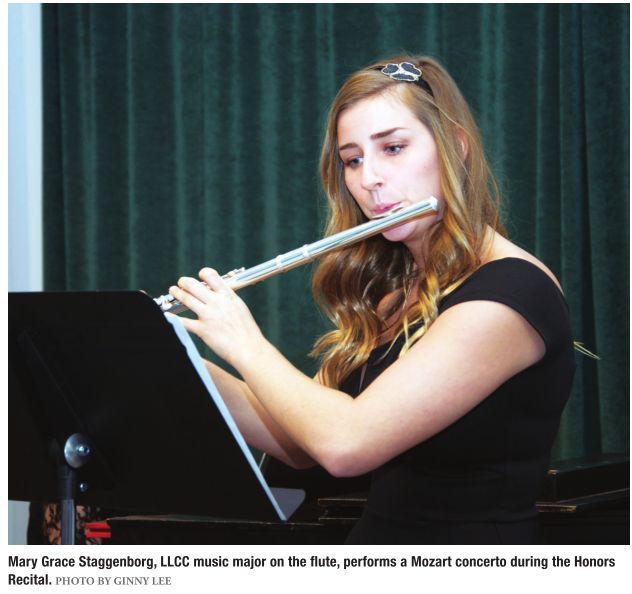
On Wednesday, Dec. 4, outside Room 2250 in Menard Hall on the campus of Lincoln Land Community College, well-dressed young adults pace nervously, awaiting the moment they enter to participate in the LLCC 2013 Honors Recital in progress. Inside the room a black Steinway grand piano dominates the center of the performance space with LLCC music professor Jane Hartman Irwin seated on the bench. Up walks a young woman who flips back her hair, places her music on the stand and begins tuning her flute. With a nod to each other, the two begin performing Mozart’s Concerto in G.
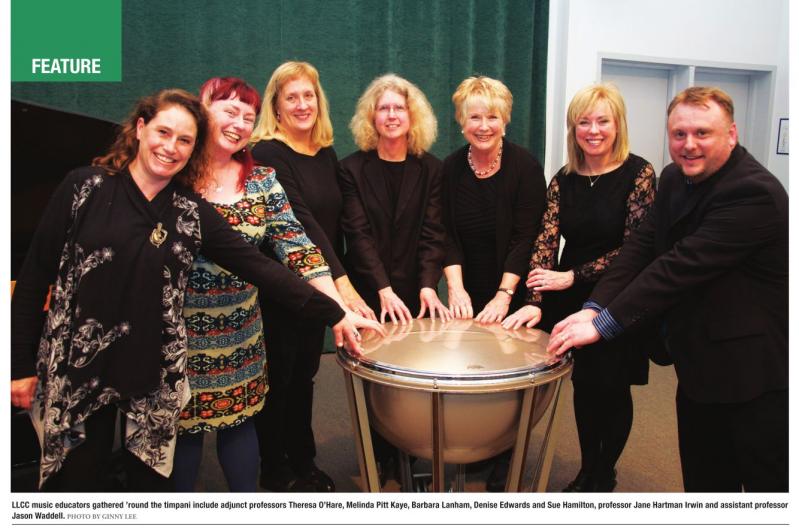
Upon completion of the work, resounding applause from the audience of about 50 family members, friends, students and faculty fills the room. Then up comes the next student to perform. The process continues for several more performances, as guitarists, pianists, vocalists and percussionists demonstrate the musical prowess achieved during time spent in the Lincoln Land music department. Hartman introduces the four adjunct professors present and herself, along with LLCC assistant music professor Jason Waddell as the faculty responsible for the students performing that evening. Now it’s time for cookies and congratulations as the recital comes to a close.
A recital is like the pretty bloom of a flower everyone notices after a long and intense season of growth. Behind that few minutes of performance stands years of dedication, practice and determination to play music from each student. And behind that are many instructors and teachers encouraging and educating these young people toward excellence in music.
At Lincoln Land Community College, Springfield’s undergraduate two-year institution on Shepherd Road south of Springfield, the music department has long been an integral part of the school’s curriculum. The college included a music program under the fine arts and humanities umbrella upon opening in 1968, gradually increasing the department with faculty and space. From department founders, the late Howard Wooters and Robert Vandall (now a successful music composer), to later professors Eugene Haas, Denise Edwards and Barbara Lanham, LLCC built a strong and influential program with the productive work of many dedicated instructors over the ensuing years. The program currently teaches 22 music majors and reaches another nearly 360 individuals with music lessons, courses and performances.
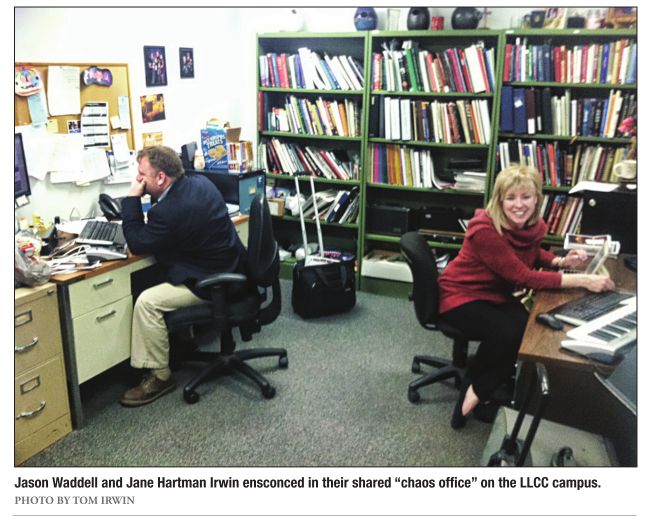
Professor Jane Hartman Irwin and Assistant Professor Jason Waddell – with the full support of David Laubersheimer, dean of Fine Arts and Humanities, and a talented group of adjunct faculty – are set on expanding many areas of the department. These include student and faculty group and individual performances, music technology advances and experiences, increasing music appreciation to both music majors and all students, setting up summer camps for area high school students and tailoring the coursework of music majors to meet exacting requirements of area universities.
“The bottom line is we are looking to grow the music program,” said Dean Laubersheimer, “and we are expanding in multiple directions.”
Every learning center, from early preschool to post-graduate, depends on teachers to convey the basic work of educating. The quality of the faculty makes the Lincoln Land Community College music department shine.
“Along with Jane, and now Jason, as fulltime professors, we have a cadre of excellent adjunct faculty working with us to help build the program,” Laubersheimer said. “I’m really happy about the wonderful group we have here.”
Though she goes by Professor Irwin at school, Jane Hartman is the name familiar to any follower of local music, specifically of vocal and classic piano jazz. She began her popular
Jane Hartman Trio with LLCC members and won the Best Musician category
in our Best of Springfield contest several times. At one time she was
selling more CDs in the Midwest than any other Springfield performer,
especially doing well in the St. Louis area. She still plays out
occasionally and also performs as the “+1” in the local Dixieland band,
Riverboat 5 + 1, but these days her attention is mostly focused on her
growing work at LLCC and time spent with the Grateful Bread Band at
Springfield’s First Christian Church, where her husband, Rick Kent
Irwin, is senior pastor.
An
instructor at Lincoln Land since 1984, she went full time in 2001 when
Gene Haas retired. Her many awards and accomplishments include LLCC
Faculty Woman of the Year for 2005, composer of the Lincoln Land alma
mater “Lincoln Land,” international performances in France, Venice,
Florence, Rome and Ashikaga City, Japan, as well as shows at many venues
closer to home. Her background in classical music, combined with
standard and improvisational jazz, gives her a grounded and classic
approach to the art, steeped in music theory and trained in the
time-honored practice of practice, practice, practice. With real
experience in working performance to back her teaching philosophy, she
not only plays the tune, but knows what it takes to get it done and done
right.
Joining
the faculty in fall of 2012 after the retirement of Barbara Lanham,
Jason Waddell quickly adapted into the other professor position.
According to Dean Laubersheimer, of the many applicants for the job,
Waddell was the ideal fit for the program, but he nearly didn’t apply
for the position. Happily ensconced in a high school band director
position with plenty of satisfying adjunct work at Richland Community
College near Decatur, he wasn’t aware of the opening until he performed
at LLCC’s Trutter Center with one of his band groups and was encouraged
to apply by his Lincoln Land hosts.
Loaded
with high academic credentials and degrees from Millikin University and
Illinois State University, his work history involved writing jingles
with his musician/ composer wife, publishing music educational books,
working directly with music software companies developing programs,
school band directing, teaching a variety of music-related and
humanities college courses and other jobs. His background seemed to
seamlessly fit into the growth concept in place at LLCC.
“When
we first looked at his resume and saw he was a euphonium player, my
husband, who also comes from a low brass background, said ‘that’s the
one!’,” laughed Irwin. “But then, when we discovered he also composed,
knew music technology, played guitar, piano, percussion and other
instruments, we felt he would fit in perfectly here.”
The
one-two combination of “the J team” – as Waddell laughingly refers to
Jane and Jason – seems to be working well. As Irwin concentrates on the
organizational side, music theory and classical performances, Waddell
works to develop his new Music Tech
course, teaches various instruments and encourages the students oriented
to popular music. The energy created through the collaboration of two
individuals dedicated to music education is obvious and effective.
 With
a new piano lab featuring a couple dozen electronic pianos connected to
a large, collective screen that allows for intricate teaching methods,
Hartman happily works in her up-to-date environment, teaching theory and
keyboards. In the same room, Waddell has space reserved for several
computer work stations where students will soon be applying the latest
methods of recording music and sound processing to self-composed works.
They work toward understanding the concepts behind the technique so they
can do it for a living.
With
a new piano lab featuring a couple dozen electronic pianos connected to
a large, collective screen that allows for intricate teaching methods,
Hartman happily works in her up-to-date environment, teaching theory and
keyboards. In the same room, Waddell has space reserved for several
computer work stations where students will soon be applying the latest
methods of recording music and sound processing to self-composed works.
They work toward understanding the concepts behind the technique so they
can do it for a living.
In
a recent example of applying the newly acquired skills with
interdepartmental cooperation, members of the music department recorded,
mastered and produced a soundtrack for the LLCC theater department’s,
now playing production of The Importance of Being Earnest.
“We
not only did the recording and composing, but we set the whole project
up just like the theater group was a client,” explained Waddell. “That
way students got a working idea of how a business scenario could happen
while doing the actual music work.”
According
to Waddell, it worked. The producers of the play turned down the
original offering and the music group had to redo the project to meet
the “client’s” demands, just like a working composer dealing with a
real-world situation would need to do. The retooled music was acceptable
and everyone got what they wanted, plus it was all done “in house.”
Along
with Irwin and Waddell as fulltime faculty, Lincoln Land has an array
of gifted and devoted adjuncts who work per course and per lesson, many
native to the Springfield area. The part-time faculty includes the trio
of Sue Hamilton, Melinda Pitt Kaye and Alice Edwards, along with several
others, including Greg Cohill, Russel Brazzel, Denise Edwards, Barbara
Lanham, Pe-i Wang, Joe Kohlrus and Theresa O’Hare. Several of these
well-educated private instructors have been with the program for years, a
good indicator of how well the department functions.
Lessons
are offered through these private faculty to all members of the
community, not just Lincoln Land students. This idea of including the
community in the community college ensures anyone interested in
continuing to work on music with qualified faculty instructors can do
so, with affordable lessons.
These “hobby students” perform at their own recital and also can join
in some of the music group options offered to students, especially in
the LLCC Big Band. Placing adult players in the same band next to
student musicians fresh out of high school allows experience to meet
enthusiasm, with positive results.
“When
you have the older students passing it along, sitting next to younger
students, showing them how to do things differently... to me that’s
community college at its best,” Hartman said. “This community band and
our quality adjuncts are some of our best strengths.”
According
to the Illinois Community College Board, more than 60 percent of
students enrolled in higher public education in Illinois attend a
community college. As these community colleges more and more become
“feeder” schools for economic and scholastic reasons, programs called
“two-plus-two agreements” are popular between two-year institutions and
four-year universities. Students sometimes discover when transferring
that certain classes from one school don’t meet qualifications at the
new college. The two-plus-two concept allows students to avoid that
issue by directly working with the institution they intend to attend, in
order to clarify transfer issues beforehand. In some cases they can
even commit to the school upon entering LLCC and lock in tuition rates
as if they were actually attending the other college. The program, well
established in other departments, is now becoming a reality within the
music department. Agreements are being pursued with Western Illinois
University in Macomb, Millikin University in Decatur, Eastern Illinois
University in Charleston and with other compatible schools.
As
the established programs of longstanding music traditions and styles
meet the newer concepts of digital technology and popular music, the
Lincoln Land music department is poised to make Springfield a better
place to learn music business and performance. Students seem more
willing than ever to consider and accept what community colleges can
offer, before taking the big step to complete a degree at another
institution. And LLCC is ready and able to fill the bill.
“Lincoln
Land is in essence a transfer institution. Our reputation depends on
the quality of our students,” Dean Laubersheimer stated. “I’m happy to
report we have schools actively pursuing our graduates.”
The
continued growth, along with a dedication to well-rounded education and
thoughtful attention to the needs of students while benefiting the
community as a whole, makes the college a valuable resource to central
Illinois residents. While some students choose to stay and enhance our
local scene, others decide to move on to other adventures. But all take
the quality education offered and delivered by LLCC wherever they use
their talent, given and honed.
When
talking about a certain student in her theory class who “got it,” Irwin
spoke of the musician “just beaming” while working. As Waddell
continued the story, “He came up to me and said, ‘I found my niche, now
I’m hungry for it.’ Wow, now that’s what we like to hear!”
Contact Tom Irwin at [email protected].