Five innovators give their perspectives on the Springfield arts and music scene
ARTS | Scott Faingold

Allison Lacher: ‘We should broaden the scope... and bring the best work we can here.’
As 2013 draws to a close, the arts in Springfi eld are in an exciting place. Local visual artists, theatrical performers and musicians have rarely had so many opportunities to gain exposure, with a growing number of active, adventurous venues and curious, enthusiastic audiences becoming the norm rather than the exception. Simultaneously, established and emerging artists in all fi elds from around the region, the country and even the world are fi nding their way to Springfi eld like never before, creating a sense of vibrancy and connectedness for a scene that in the past has sometimes tended toward isolation.
We asked a select few of the most active and innovative members of the arts community to each give their perspective on where the arts in Springfi eld stand, how we may have gotten here and where things might be headed.
Allison Lacher was an accomplished installation artist when she moved to Springfield from Utah a few years ago to accompany her husband who had been hired as a professor in the business department at UIS. A frustrating period of dormancy followed, but Lacher has since rallied to become an essential conduit for the local fine art scene. Her position as manager of the Visual Arts Gallery at UIS, where she is also an instructor, has provided a link to the local arts establishment and gives her a legitimacy that has been useful in forging connections between Springfield and the wider world of art. In addition to presenting visiting artists at the university gallery, she has been able to facilitate connections between the local grassroots Pharmacy collective and similar groups in other towns. This year she, along with UIS Visual Arts Gallery Director Jeff Robinson, volunteered time to help found and curate the DEMO Project, a sui generis, artist-run gallery located on the campus of the Springfield Art Association. The DEMO Project continually presents work by eminent, contemporary artists from Chicago, New York City and elsewhere.
“There is often a mentality that Springfield should only be showing Springfield artists,” says Lacher. “I am certainly in support of local artists having opportunities but I think it’s incredibly essential for outside artists to be exhibiting here as well.” Living in town and observing the traditional ways the arts have functioned here, she came to the gradual conclusion that reliance on existing venues and attitudes, while often providing an essential foundation, can also lead to irrelevance and stodginess. This resulted in an approach that acknowledges tradition while working to stave off any tendency toward provincialism and airlessness. “I just think we should broaden the scope a little bit and bring the best work we can here, because art and music can be transformative. It can transform a young mind – but if all we are seeing is the same artists again and again, myself included, that limits the potential for that transformation.”
Nearly all of the work Lacher does in the arts community is on a volunteer basis, and much of it is as simple as just picking up the phone, or even sending a Facebook message, to an artist she is interested in working with and forging the necessary connections to set future exhibitions in motion. She also spends her free time traveling to regional art exhibitions in places like Bloomington, Peoria and Decatur, believing strongly in the importance of an Illinois arts scene. A recent conversation with Lyle Salmi, chair of the Millikin University art department, provided some perspective. “He said, ‘Man, Springfield has so much more going on than Decatur,’” Lacher smiles. “That was kind of refreshing to hear.”
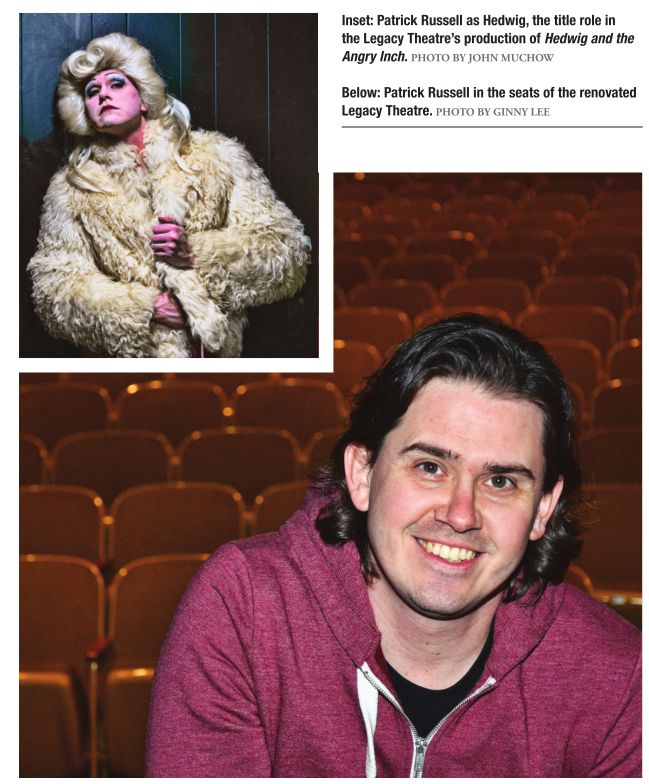
Patrick Russell: ‘Why can’t Springfield have the things other cities have?’
Patrick
Russell is the associate director of the Legacy Theatre and last year
made a splash with his explosive performance as the flamboyant,
androgynous protagonist in a trailblazing production of the glam-rock
musical Hedwig and the Angry Inch. The play tells the story of
its tortured, titular antihero(ine), rendered neuter by a botched
sex-change operation, who uses the freeing avenue of glam and punk music
as a means of finding identity and love. The play is poised for a New
Year’s Eve performance at the Legacy followed by a two-week return run
at the Legacy later in January.
The enthusiastic local response to Hedwig was
not what Russell was expecting, and positive word-of-mouth certainly
worked in the show’s favor. “There were 30 people in the audience on
opening night,” he recounts. “By the last performance we were having to
pull out every chair in the building – we were even pulling them out
from the boiler room – so everyone could have somewhere to sit. I think
we surprised people both in the level of the production – I think it was
as professional a production as you were going to see in this tiny
space – and in the show’s theme.”
Springfield
audiences are more likely than ever to embrace nontraditional, even
risqué, theatrical content. The ADHD company’s rendition of The Rocky Horror Show is
a reliable sellout whenever it plays the Hoogland, and drag shows of
various stripes have been a steady draw at the Legacy, but the
popularity of Hedwig seemed to bring this trend to new levels.
Russell attributes this to a sea change in the cultural conversation
both in Illinois and nationwide, pointing to the recent passage of the
Illinois Religious Freedom and Marriage Fairness Act, allowing same-sex
couples to legally wed in Illinois as a clear indicator. In a culture
where same-sex marriage has become acceptable, the story of Hedwig’s
struggle and redemption manages to be both timely and edgy.
Beyond
the content of the actual shows, Russell has noticed of late more pride
and self-reliance within the local creative community. “There’s more of
a ‘Why not us?’ attitude,” he says. “Why can’t Springfield have the
things other cities have? Why can’t we do it here? Why do we have to
drive an hour and a half, three hours away? We have amazing artists,
amazing performers and amazing musicians in this town. We can do it, and
we can support it.”
 Aaron Phillips: ‘This was a banner year. We did a lot of stuff.’
Local
hip-hop has taken more of a lead role in town lately and nobody works
harder to make this happen than Aaron Phillips, a local promoter,
blogger and artist who MCs under the name “Uncanny.” Until recently,
Phillips was the host of Torch Tuesday at Bar None, which remains the
preeminent outlet for area hip-hop. But lately he has become too busy to
make the show every week, although he does continue to promote and book
music there. Recent endeavors have included hosting nationally known
rapper Chingy’s show at Catch 22 as well as putting together shows at
Frankie’s 49er and Four Seasons Sports Complex. “So many venues have
opened their doors, so many people are trying to be involved just as
fans and as creators of music – it’s going nuts,” he says. Recent Torch
Tuesday concerts have included talent from throughout the region, with
well-received performances from Decatur and Champaign artists as well as
appearances by locals such as Scooby Da Lyricist and Pytch Wyte.
Phillips
is aware that hip-hop music and culture still has something of an image
problem, with many club owners and members of the public continuing to
associate the music with violence and thuggish behavior. “The music
doesn’t incite the problem, it’s just the people,” Phillips observes.
“Frankly hiphop is for a demographic of people who largely aren’t
affluent – it’s for poor people. So you’ve potentially got people who
aren’t spending money at the bar, who are drinking out in the car and
causing a little bit of trouble – a venue doesn’t want to deal with
that. But we’re doing everything we can to try and change that
perception.” As in the past, Torch Tuesday will continue to perform
charitable work such as holiday clothing and food drives in order to
give back to the community.
As
for the overall music scene in town, the one thing Phillips sees
missing is a platform encompassing all local music. “There is no
magazine or paper or website that covers the whole thing regardless of
genre,” he says. “This year was a banner year, we did a lot of stuff.
Local artists making a ton of moves and people from other places are
actually looking for us now.”
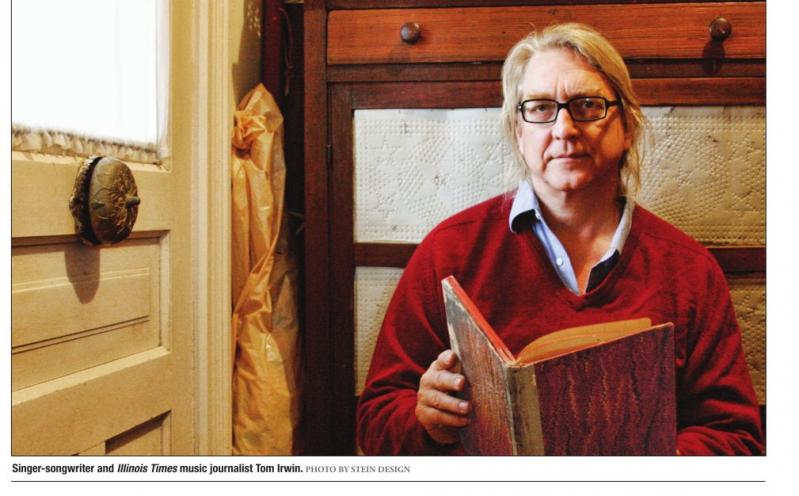
Tom Irwin: ‘Young musicians want to get something going locally and keep it going.’
In his position as a veteran local singersongwriter as well as IT’s venerable
music columnist, Tom Irwin is well-placed to observe changes as they
happen in local music, and lately they are very positive indeed. Between
WUIS’s Route 66 concert series, which continues to bring high-quality
roots music to the Hoogland Center, and an increase in classic rock and
international music onstage at the Sangamon Auditorium, Springfield has
been experiencing a greater number of national and international touring
acts in recent years. Two newer venues have only increased this trend,
bringing in more “big” acts while increasing stage opportunities for
locals, allowing the music scene some of the same cross-pollination
between homegrown and outside acts touted by Allison Lacher in the world
of visual arts.
“Boondocks
and Donnie’s Homespun have both only been open for about a year and
it’s amazing how they’ve changed things,” Irwin says. “Where did we go
before they were here?” Indeed, recent shows by touring acts like Los
Lobos, Ezra Furman, The Wailers and many others have put Donnie’s on the
map as a place for reggae, bluegrass and Grateful Dead-style “jam band”
music, while pop country acts from Nashville have been showing up at
Boondocks with increasing frequency. “By gosh, they have the same person
playing out there that’s playin’ on the radio,” Irwin exclaims dryly.
As
for local music, “the kids are on the move,” Irwin says. “In my
generation, everybody wanted to get big and get out – you were either
gonna move out of town and get on a record label or you were gonna move
back here and be embarrassed and just play in a cover band somewhere.
That isn’t so much the case for young musicians these days. They want to
get something going locally and keep it going.”
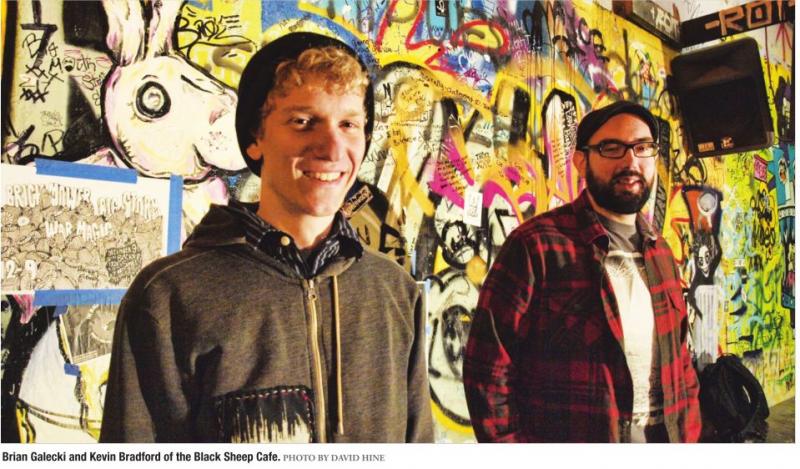
Black Sheep: A stopover for touring bands and an outlet for locals
Punk
and indie rock music, both on the regional and national levels, are
also on the upswing in town, largely thanks to the continuing activities
of all-ages venue Black Sheep Café, which in the past few years has
made the once routinely bypassed Springfield into a regular stopover for
rough-edged independent touring bands, as well as a reliable outlet for
locals. Ninety percent of Black Sheep shows are for touring bands,
providing a place to do shows between St. Louis and Chicago dates.
“Bands sometimes need a place to play on a weekday night and it’s not
always easy to find that,” says Brian Galecki, who helps to book shows
and run sound at Black Sheep. “A lot of great Springfield bands have
been popping up in the past year, year and a half,” he enthuses. “It’s
really awesome to see some of these new bands putting out vinyl.
There have also been a lot of young kids coming out too – a lot of high
school kids in the audience and a lot of high school bands and that’s
helped the scene overall. There have been a lot of fullhouse shows in
general over the past year.”
The
venue, which has been owned and operated by Kevin Bradford for the past
eight years and is located near popular skateboard shop Skank Skates
near the corner of 11 th and South Grand, is already something of a
youth culture center and is poised to take another large step in that
direction with the announcement of Dumb Records, a record store which
Black Sheep will be opening next door in early 2014 in partnership with
Champaign’s Error Records. Galecki envisions the store as a place to
highlight local releases. “I’m sure we’ll have a huge wall just for
Springfield bands,” he says. The Black Sheep has also begun hosting
music festivals over the summer. Last year Black Sheep Fest featured
about 20 local bands and was well attended, while the debut of the even
more ambitious Dumb Fest presented 25 bands from as far away as New York
and Seattle.
“In
a way, it’s like bringing the cultural world I didn’t have here as a
transplant and cultivating it,” Allison Lacher says, describing her
motivation for bringing renowned visual artists from other communities
to Springfield. It seems that a similar desire may be infecting all
areas of the arts in town, perhaps setting the scene for local and
traveling acts to feed on each other symbiotically, creating a hybrid
vigor and vitality in the Springfield arts and music scene that has
barely been hinted at before.
Contact Scott Faingold at [email protected].