It’s time to put down the smartphone and give Instagram break. These next-level digital cameras will take their photography to the next level.
HOLIDAY | Greg Scoblete, CTW Features
There’s an old cliche in photography circles: The best camera is the one you have with you. For many of us, that’s our smartphone.
For everyday use, smartphones are tough to beat. They have full-featured cameras, large, high-resolution displays, and fun apps for editing and sharing photos. In fact, sales of point-and-shoot cameras have been declining for the past five years, dropping off more than 25 percent just from June 2012 to May 2013 alone, according to The NPD Group’s Retail Tracking Service. (A pointand-shoot can’t Instagram your dinner, after all.)
But for all the notable advancements in smartphone photography, they still can’t deliver the image quality and range of features you’ll find in an interchangeable lens camera, sales of which actually increased 5 percent during the same one-year period, according to NPD.
For the photo-addict in your life, one of these advanced-yet-approachable shooters – with features like blurred backgrounds, rapid-fire burst modes and lens options no app can mimic – will help take their photos to the next level.
Canon EOS Rebel SL1
One of the biggest knocks on digital SLRs is that they’re too bulky to conveniently take anywhere. Now, Canon’s EOS Rebel SL1 ($749.99 with 18-55mm lens) won’t slip into a pair of skinny jeans, but it’s the lightest and smallest dSLR on the market (as of mid-September), making it a great starter camera for first-time dSLR owners. This 18-megapixel Rebel can record full 1080p high-def movies and uses a new autofocus system to maintain crisp video and stills no matter how quickly a subject is darting across the lens. Shots will be framed through a three-inch touchscreen display or an optical viewfinder, and the user will enjoy a burst mode of up to four frames per second. Three “special scene modes” – kids, food and candlelight – quickly optimize the SL1’s settings to get the ideal shot.
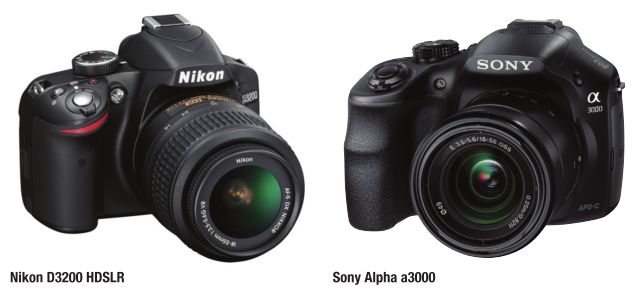
Nikon D3200 HDSLR
With a 24MP sensor and 4fps burst mode, Nikon’s D3200 ($699 with 18-55mm lens) is a suburban soccer mom’s (or dad’s) sideline companion. The camera includes a Guide Mode that offers on-screen advice and sample images to walk the user through the ins-and-outs of the D3200’s feature set. In addition to the standard manual controls, six scene modes help optimize images in a range of environments. The D3200 offers a threeinch display and 1080p HD video recording, including an option to record 720p video at 60fps to better capture fast-moving subjects, such as that budding superstar athlete.
Sony Alpha a3000
Sony’s
Alpha a3000 has an eye-catching price – just $399.99 for both the
camera and an 18-55mm lens. It features a 20MP CMOS sensor and is
capable of bursting at 4fps for an unlimited number of images. It can
record 1080p HD video in the AVCHD format at 24 or 60fps. Shooters get a
three-inch display, 15 picture-effect modes and an Auto Object Framing
mode that will automatically save two versions of an image: one original
and one a tight crop focused more closely on the subject, allowing the
user to choose their favorite.
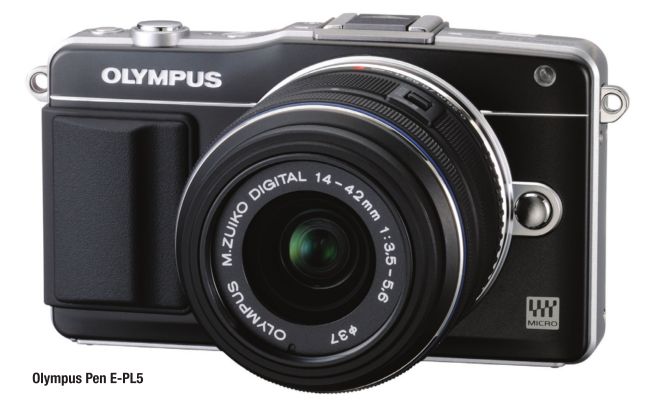
Olympus Pen E-PL5
The Pen ($599.99 with a 14-42mm lens) is the most customizable
interchangeable-lens camera of the bunch. Users can slide off the front
grip for a sleeker look, in addition to customizing the “My Set” button
on the top mode dial for instant access to their favorite shooting
settings. The 16MP E-PL5 boasts a three-inch tilting touchscreen LCD,
1080i HD video and six bracketing modes that capture multiple images
with subtle changes to settings like exposure, ISO and white balance, so
shooters can compare effects and select the image they like best. There
also are 23 scene modes to choose from. The E-PL5 comes in black, white
or silver.
Samsung NX2000 SMART
Camera Just because they’re stepping up from smartphone photography
doesn’t mean they have to ditch wireless connectivity. Samsung’s 20MP
NX2000 ($649.99 for the body, 20- 50mm lens and external flash) offers
builtin Wi-Fi with an autoshare function that automatically sends images
from the camera to their phone for emailing or posting to social
networks. Users also can upload photos to social networks and cloud
storage services and email them directly from the camera when you’re
connected to a Wi-Fi network. Further, installing the free Samsung Smart
Camera app on their phone (Android and iOS) can turn it into a remote
control for the camera. Other features include a 3.7-inch touchscreen
display, 1080p HD video recording and a burst mode of 8fps. The NX2000
comes in white, pink or black.
The Nokia Lumia 1020: The camera with a phone complex
Not all smartphone cameras are created equal. Nokia’s Lumia 1020 is
equal parts phone and camera, with a 41-megapixel image sensor – that’s
right, 41 megapixels, higher than any of those advanced cameras we’ve
just mentioned – and optical image stabilization. It’s loaded with
camera-friendly features, including a real mechanical shutter and Xenon
flash. The 1020 can use its high-res sensor in helpful ways, including a
dual-record function that captures two images at once: It snaps a
high-resolution photo for your archives and printing needs, plus a
low-res version that’s easier to email and post to social networks. The
Lumia 1020 is an outlier in another way: In a world of iPhones and
Android devices, it runs on the Windows Phone 8 operating system. Price:
$299 with two-year contract from AT&T. ©CTW Features