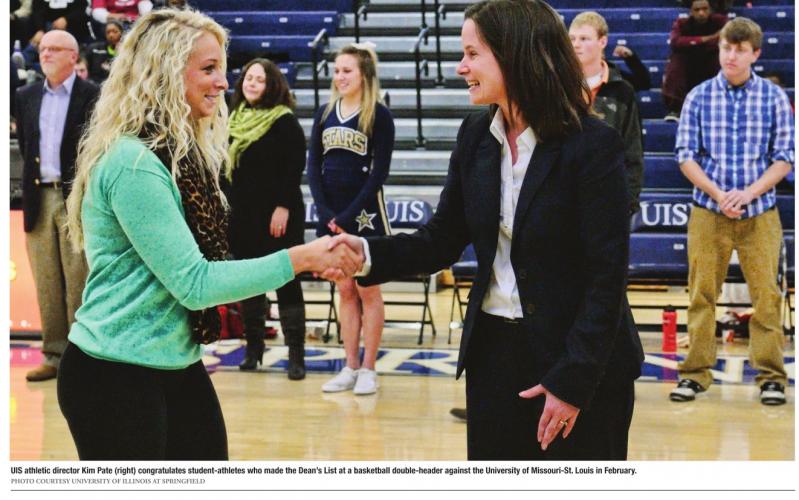
UIS athletic director Kim Pate keeps her eye on the ball
SPORTS | Patrick Yeagle
Three years ago, the athletic department at the University of Illinois Springfield faced criticism from several angles. Scandals large and small hinted at lax standards and a lack of accountability for both coaches and athletes.
But those scandals faded after the new athletic director, Kim Pate, took the helm of the athletic department in June 2011. Pate and her team have improved participation, strengthened ties with the community, and set high expectations for themselves and their athletes. While Pate is quick to share the credit for the department’s improvement, her leadership seems to have been the catalyst for change, and she seems to have alleviated the concerns of even the department’s most vocal critic.
As Springfield’s largest institution of higher learning, UIS produces numerous graduates each year who stay in Springfield after college to live and work. Countless UIS graduates work in state government, health care, insurance and other industries that are vital to the capital city, so the success of UIS is tied to that of Springfield. A strong university athletic program is always a boon to the growth and prosperity of its host city, and Pate says college athletics is as much about learning life skills as it is about playing a sport.
“It’s an incredible opportunity for us to provide a comprehensive learning experience for students, where they get the classroom piece, but they get to learn beyond that,” she said. “They’re learning discipline and balance. We want them to go and do things beyond college and be leaders in the community.”
Kim Pate grew up in the Canadian province of Saskatchewan until her mother moved the family to Brevard, N.C., when Pate was in high school. After high school, Pate got married and then attended Brevard College, where she played softball and started all four years at second base. By sophomore year, Pate was team captain. That experience is what started her on her current career path.
“It was just a life-changing experience for me, personally,” Pate said. “I was kind of shy. I was always dedicated to my sport and worked hard, but it allowed me to develop as a leader. It was profound for me and how I developed as a person.”
After graduating with her business degree, Pate started as an assistant coach at her alma mater and became athletic director at the school in 2008. While at Brevard, Pate helped the school’s athletic program transition from being governed by the National Association of Intercollegiate Athletics to the larger and more prestigious NCAA Division II, which UIS joined shortly before Pate arrived here.
Juan Mascaro, the current athletic director at Brevard College, worked as Pate’s associate athletic director during her tenure there. Mascaro calls Pate “driven, goal-oriented and a hard worker.” He says he enjoyed working with her.
“It was great because you always knew where you were standing with her,” Mascaro said. “She’s very black-and-white in that sense. She knows what she wants, and she tells you exactly what she wants. That’s good. I would rather have that than not knowing where you stand or where things are going.”
 Pate
left Brevard in 2011 to become athletic director at UIS. When she
started in July 2011, the athletic department at UIS was dealing with a
bevy of scandals under then-director Rodger Jehlicka.
Pate
left Brevard in 2011 to become athletic director at UIS. When she
started in July 2011, the athletic department at UIS was dealing with a
bevy of scandals under then-director Rodger Jehlicka.
In
2009, UIS paid a $200,000 settlement to a member of the women’s
softball team who alleged sexual impropriety against a coach. The coach
and an assistant coach resigned shortly after the allegations became
public.
Later
the same year, three members of the UIS men’s soccer team were arrested
for an alleged hate crime. The three players were alleged to have
attacked another group of men and called them homophobic slurs. Although
the hate crime charges were eventually dropped, two players did plead
guilty to other charges, and the incident cast the school and the
athletic department in a negative light.
In
2010, six members of the women’s basketball team were informed their
student-athlete scholarships wouldn’t be renewed. The players weren’t
given a reason for the move, and Dr. Barbara Hayler, a professor
emeritus of criminal justice and outspoken critic of the athletic
department, filed a Title IX gender discrimination complaint with the
U.S. Department of Education against UIS. Hayler’s complaint raised
questions of whether discipline was meted out evenly between male and
female athletes, among other issues.
Hayler
filed another Title IX complaint in January 2011, after UIS announced
it would add a men’s baseball team. The additional sport for men without
a corresponding increase in women’s sports created a significant
imbalance between the two, Hayler alleged. The addition of the men’s
baseball team put the total number of male athletes at 84 in the
2010-2011 school year with only 68 female athletes, according to
Hayler’s complaint.
While
Hayler no longer lives in Springfield, she has kept tabs on the
athletic department. She says the department appears to have improved
under Pate, based partly on the fact that she no longer gets calls from
angry students, parents or staff wishing to vent about the athletic
department. Hayler says she isn’t sure whether that’s because of
institutional changes, Pate’s leadership or both. She cautions that any
improvements made to the department should be codified to prevent
backsliding if Pate leaves.
Hayler
isn’t certain whether the university has fully addressed the issues she
raised, although UIS has added more opportunities for female athletic
involvement. There are currently 87 female athletes and 75 male
athletes. The school has
six sports for females and five for males. In response to Hayler’s
first complaint, the university agreed to revamp its process for
handling complaints and demonstrate compliance with the law, though it
denied that anything was wrong in the first place.
Hayler says Pate appears to have been the right choice for athletic director.
“She
impressed me as someone who was committed to athletics and also
interested in the well-being of athletes,” Hayler said of Pate. “I think
things actually are running in a more responsible way. I think people
are focused on developing winning teams but also a positive student
experience.”
Pate
has invested a significant portion of her time at UIS helping the
department address the circumstances that led to past problems. She and
other university staff have spent the past two years revamping the
department’s compliance manual and student-athlete handbook, which set
standards and boundaries for coaches, students and others involved in
sports at the university.
“It’s
been an all-around commitment from the university and our staff to do
things the right way, to build a model program,” she said. “That’s been
our focus since I got here. We want to make sure we have a solid
foundation and sound protocols in place.”
Though the problems of the past diminished morale in the athletic department, Pate says that seems to have turned around.
“I
would say it’s night and day from when I got here,” she said. “The
morale and energy are strong. Everybody there is excited to be there.
We’re focused on the process and on building. That’s not to say that we
don’t still get frustrated if we don’t make the strides people think we
should be making, but generally, we’ve got great people, great attitudes
and great energy.”
Pate
says she likes her job because of the opportunity to influence young
people. To that end, Pate requires that every athlete perform at least
eight hours of community service. She says the current crop of athletes
have performed more than 2,000 hours cumulatively, which is about 700
hours more than the 162 athletes were required to perform.
“It’s pretty awesome to see these young people change and grow and go on to do some great things,” she said.
Despite the improved conditions in the department, Pate talks candidly about the challenges that remain.
“I
don’t think we’ve got exactly what we need to compete in the GLVC,”
Pate says, referring to the Great Lakes Valley Conference, which
includes NCAA Division II schools in Illinois, Kentucky, Missouri,
Indiana and one in Wisconsin. “It’s a very tough league, and (the teams
are) funded very well. But we’ve made big strides and we’re headed in
the right direction as far as funding.”
Pate
says the university has received strong backing from Springfield
businesses through the school’s corporate booster club. This year,
proceeds from the club have almost reached last year’s total, and that’s
with more than a month to go.
“I feel really good about the support we’re
getting from the community and from the university,” she said. “But
we’ve still got some work to do in that area, and it will take us some
time.”
 Paul
O’Shea, who serves on the UIS Athletic Advisory Council, helps organize
events for the Stars Club, the booster club for UIS. He says organizing
the booster club was mostly Pate’s doing, and with the help of
associate athletic director Travis Whipple, the club now has more than
170 corporate and individual members who donate to the athletic
department.
Paul
O’Shea, who serves on the UIS Athletic Advisory Council, helps organize
events for the Stars Club, the booster club for UIS. He says organizing
the booster club was mostly Pate’s doing, and with the help of
associate athletic director Travis Whipple, the club now has more than
170 corporate and individual members who donate to the athletic
department.
“It’s
amazing the way she’s bringing enthusiasm to the program,” O’Shea said.
“It has always been good, but she’s taking it to a different level with
her energy. She seems to work well with people, bringing together
coaches, players and lots of other people. She has an infectious
energy.”
Pate
points out that she hasn’t been working alone. She gives a large share
of the credit to her administrative staff and coaches, and she thanks
UIS Chancellor Susan Koch for giving her the opportunity and support to
make adjustments as needed.
“It has really been a collective contribution of passion and energy,” she said.
Koch
praises Pate’s leadership, saying Pate sets high expectations for
herself, her staff and her athletes, while creating a positive
environment.
“I
have found her to be a consultative person, very much a team player,”
Koch said, adding that Pate has sought out coaches who have the best
interests of the athletes at heart. “I think that’s been something
that’s working very well in our environment.”
Still,
the individual teams at UIS continue to struggle. The women’s softball
team was the only UIS team with a winning record for the 2012-2013
season, and all of the teams combined won only about 35 percent of their
games. The 2013-2014 season is showing similar results, with the men’s
soccer, women’s soccer and women’s volleyball teams each finishing their
schedule this academic year with losing records.
The
men’s soccer team did improve considerably over last year, however. The
2012 season saw three wins and 10 losses, while the 2013 season, which
ended in October, saw eight wins and 10 losses.
The
lack of wins likely contributes to the sporadic attendance at games,
where the bleachers are sometimes less than a quarter full.
Pate
says she hopes to build the UIS athletic department into a “model
program” that is nationally known, while bringing in more local
student-athletes.
“We’re
getting a great community response, but we need to grow that,” she
said. “It’s a great start, but we want to pack the stands and make the
community proud.”
Contact Patrick Yeagle at [email protected].


