Renewable resources for your residence
Straight talk about solar, wind and geothermal
HOME | Scott Faingold
“A lot of people tell me they’d like to get off the grid,” says Bob Croteau, renewable program coordinator for City Water, Light and Power. “That’s really one of the worst decisions you could make because it is extremely expensive to do so and it leaves you having to make serious lifestyle changes.”
There are practical, affordable options available to homeowners who want to become more energy-efficient and costeffective, but there are many pitfalls to be avoided along the way. When it comes to going green, haste can make waste.
“A lot of people will call up and say, ‘My bills are too high, I want solar,’” says Croteau. “They think that will be the magic bullet that’s going to solve their problems.” Before moving ahead with such a change, there are several steps residents need to walk themselves through. According to Croteau, simply doing a good job of weatherizing and installing high-efficiency heating and cooling equipment will often be more costeffective than taking a headlong leap into solar power. “Solar is expensive and it’s a premium product so you want to make sure that you’re using it for what you need it for,” he says.
Before even considering making the switch to solar, it is important for your home to be as airtight as possible. Attics and walls should be well-insulated, and although installing all new windows can be prohibitively expensive, at the very least all windows should be freshly weatherstripped and caulked. “If you have gas in the house you should have a 95 percent efficient gas furnace,” says Croteau. It is also advisable to have a new air conditioner with a SEER (Seasonal Energy Efficiency Ratio) value of at least 15 and a high-efficiency washer and dryer. “Don’t have a garage
refrigerator,” Croteau adds with a certain fervor. “Just figured I’d
throw that in there. Once you get the basic stuff like that down, now
you’re ready to be looking at solar.” Other considerations when
equipping a home for solar power include having a reasonably clear
horizon. “You don’t have to have it clear to the ground but the clearer
it is to the south of you, the better.”
Alternative energy systems might save you money, “but other things might save you a lot more first.”
Geothermal
heating and cooling can be a good option, but also should not be
entered upon without a good deal of preparation. Large homes, in the
4,000-5,000-square-foot range, might benefit from this method, but
smaller ones not so much.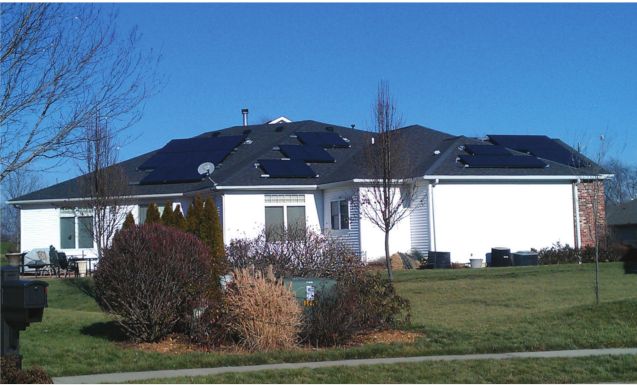
Croteau
explains how geothermal systems work. “Basically it’s a heat pump that
is using the ground as a heat-sink as opposed to a regular heat pump
that’s using the air,” he says. “That can be much more consistent and
much more moderate than the outside winter air.” These systems utilize
wells at depths of 150 feet, where the earth is consistently 50 to 55
degrees. “It’s a premium product too,” he cautions, “but once your house
gets to be that efficient, now the extra cost for the geothermal might
not be as significant as if you had a very large, very wasteful house.”
Wind
power is a popular concept at the moment, but Croteau is blunt about
the limitations of its applicability, which largely depends on where you
live. “I will draw a difference between urban and rural areas here,
because wind is very difficult to use in an urban area,” says Croteau.
“You can try, but it just won’t do much.” This is because to operate
properly a wind-powered generator needs to be at least 30 feet above the
treetops or any obstructions within 500 feet of the dwelling. “That
gets to be pretty hard when you’re surrounded by 80-foot oak trees. I
get calls regularly from people wanting to mount a small wind turbine
that will stick up about five feet over the house – that is just totally
not going to work. It’s basically an expensive lawn ornament. If you
are in an urban environment then solar is probably your most viable
option there.”
Once
appropriate preparation has been done and initial expenses are out of
the way, several longer-term financial advantages are available. Net
metering is a system that allows the meter to run backward when a home
is producing more power than it is using. “It’s a special meter that we
install that is allowed to work in reverse,” says Croteau. “When you go
to work, your refrigerator shuts off and you’re not using anything in
the house, so the meter is going backward during the daytime. Then, when
your air conditioner kicks on or you start using power, it’s capturing
back that energy that it stored up.” Other financial advantages include a
30 percent tax credit, as well as various rebate options. “CWLP offers a
rebate of $1,500 per kilowatt and most residential systems are between
two and five kilowatts,” says Croteau, “but if you make a system too big
you might generate too much electricity and it may not really be worth
it for you.” It is also important to bear in mind that rebates for
solar-powered homes require pre-qualification. “You don’t want to be
jumping in and buying a system and then calling in for a rebate. That
won’t get it for you,” he chuckles.
“These
kinds of systems might really save you a lot of money but a lot of
other things might have saved you a lot more first,” says Croteau. “It’s
kind of a tossup.”
Scott
Faingold is a contributor and blogger for IT as well as an active
member of the Springfield music scene himself. He can be reached via sfaingold@ illinoistimes.com.