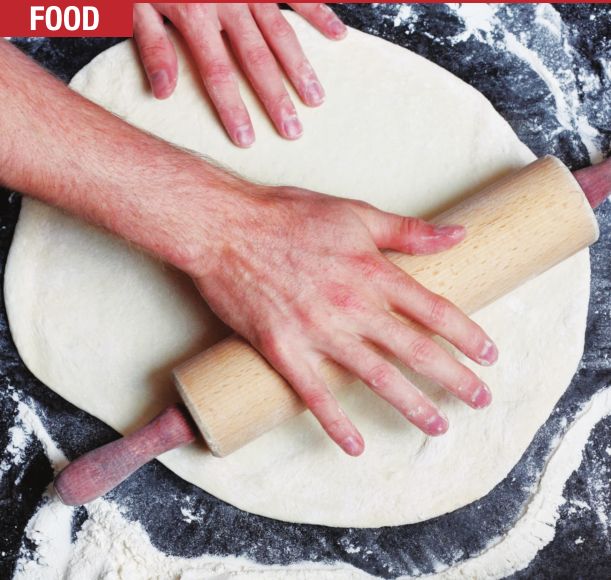
How kids can make their own dough
FOOD | Julianne Glatz
I’ve written about make-your-own-pizza nights before. They were a Glatz tradition: Family nights that often ended with us all watching a video, and on really special occasions, make-your-own-sundaes. Initially they were just for our immediate family, but soon they expanded into almost de rigueur fare for sleepovers and slumber parties. When our kids were young, lots of close adult supervision was also de rigueur, but as they and their friends moved into their middle school years they’d become competent enough that I sometimes found myself delivering a mini-tutorial about the science involved in making pizza dough rather than having to make sure they didn’t do themselves bodily harm. During their high school years, my husband’s and my supervision took on a different form.
After our youngest graduated from high school in 2003, make-your-own-pizza nights became mostly a pleasantly nostalgic memory, although we did manage a few on the rare occasions when everyone was home. When I started teaching cooking classes, my first for children was about making pizza, for which I expanded and wrote down my offthe-cuff bread-making tutorial. But I taught that class over a decade ago.
The Glatz make-your-own-pizza tradition came back to life last week when my daughter and grandson came to visit. Robbie will be 3 in November, and is fully into being a “terrible two.” But watching his excitement during MYOPN was worth the mess, even though it pretty much took two adults to monitor him.
It’ll be several more years before Robbie is ready for my bread tutorial, expanded or otherwise. Still, last week reminded me how much fun – and educational – making their own pizzas can be for kids; and what a great interactive family activity it is.
What follows was written for approximately middle-school-aged children. But re-reading it made me remember some interesting bread-making facts I’d forgotten; hopefully it will be interesting to adults who aren’t obsessive bread makers. And it just might make a good starting point for a school science project.
How bread happens There are thousands of kinds of different yeast breads, but all must have just three things: wheat flour, water and yeast. Other things are often added for flavor or texture, but they aren’t essential. In France, it’s even a law that traditional French bread, most often formed into long thin loaves called baguettes, can only be made with wheat flour, water, yeast and salt.
There is another category of breads, known as flatbreads. Flatbreads were the earliest bread. Food
anthropologists (scientists who study the history of foods and how
they’ve evolved over time) believe that the first flatbreads may have
been made as long ago as 30,000 years ago, although they don’t know
exactly when. Flatbreads are just what they sound like – flat, made with
various sorts of ground grain and cereals, flavoring and liquid,
usually water. We still eat them today: Things such as tortillas,
tortilla chips and crackers are flatbreads. Pizza dough is not
technically considered a flatbread, even though it is often kind of
flat. But it contains yeast, and because the dough rises slightly (thin
crust) or a lot (thick crust), it’s not a true flatbread. But for now
we’re going to focus on yeast breads.
Yeasts
are living organisms, tiny plants with 3200 billion cells to a pound.
They feed on carbohydrates – especially sugars. When they are feeding
they produce gasses (the same way people do when they breathe out),
especially carbon dioxide and ethanol. People used yeast to make bread
for thousands of years, but it wasn’t until 1857 when Louis Pasteur – a
French scientist most famous for inventing pasteurization – proved that
they are living plants. Yeasts are part of the huge Fungi family of
plants, as are mushrooms.
There are many different strains of yeasts.
Wild
yeasts are everywhere in the air. If a mixture of flour and water is
left out in the open and the right kinds of yeasts are around, they will
start to feed on the flour/water mixture and eventually produce
sourdough “starter,” a thick gooey substance filled with bubbles. If you
watch it, you’ll actually see the bubbles come to the top and pop.
Sourdough
starter must be fed regularly to keep it fresh and strong enough to
make bread. Sourdough bread bakers save part of their sourdough starter
whenever they make bread. They feed flour and water to the sourdough
starter until they are ready to make bread again.
For
thousands of years, using wild yeast was the only way to make risen
bread. In fact sourdough bread making was recorded in ancient Egypt over
4000 years ago and may be lots older than that.
In
early America, the pioneers in wagon trains headed west, slept with
their jar of sourdough starter so it wouldn’t get too cold and be
ruined. It was the only way they could be sure of having bread – not
just on their journey, but also when they reached their destination.
Today
we use sourdough because of its wonderfully delicious tangy flavor and
the special kinds of bread that can be made with it. My own sourdough
starter is over 15 years old. (More about it can be found in my Oct. 6,
2011 column at the IT website.) But most
bread these days – whether homemade or store bought contains commercial
yeast, usually in the form of dried granules. These strains of yeast
are easy to work with and allow people to make bread much more easily,
reliably and quickly. In America, the first commercial yeast was
introduced by Charles and Max Fleishmann at Philadelphia’s Centennial
Exhibition in 1876. The company they founded is still in business; it’s
the brand I use.
Wheat flour is also an important part of making bread. There are two basic kinds of wheat – hard and soft.
Hard
wheat grows in colder climates – from the Midwest up to the Northern
states and into Canada. All flour is composed mainly of two things –
carbohydrates and protein. The proteins in wheat flour are called
glutens, and they act in a special way. When mixed with water, they form
stretchy sheets. When yeast (either wild sourdough yeast or commercial
yeast) is added to the flour and water mix, the yeast feed on the
carbohydrates and produce gasses – especially carbon dioxide and
ethanol. These gas bubbles get trapped in between the sheets of gluten:
that’s what causes the dough to rise. When the bread goes into a hot
oven, if the baker has done a good job, the yeasts give off a last blast
of gas bubbles that make the bread rise even more as it bakes.
Soft
wheat grows in warm climates. It’s not as good for making yeast breads
because it is low in gluten (protein). That is why in Southern states,
their most traditional breads aren’t yeast breads, but what are called
quick breads – things such as biscuits, cornbread and muffins that are
made with chemical rising agents like baking powder and baking soda.
Southerners
did make yeast breads, but before modern transportation methods, hard
wheat flour was much more expensive because it had to be imported from
up north. Only well-to-do families could regularly afford yeast breads.
Likewise,
flour made from grains such as rye, rice or corn contains little or no
gluten. Only wheat flour has enough gluten to make yeast breads. Yeast
breads made with rye or other flours always also contain high gluten
wheat flour so that the bread can rise.
Combining
basic wheat flour, water and yeast is essentially a simple process. But
the variety of breads that people make from that simple process is
incredible – from sandwich bread to sweet rolls, coffee cakes, to
sandwich bread to rolls – hundreds of different tastes and textures.
Contact Julianne Glatz at [email protected].


