The Nightingale of Andover
Take a day trip to the Jenny Lind Chapel near Galesburg
EXCURSIONS | William Furry
 Though her name is more associated with nursery furniture today, Jenny Lind was without a doubt the most remarkable singer of her day, a celebrity of celebrities whose admirers included Queen Victoria of England, Harvard’s Edward Everett,
poet Henry Wadsworth Longfellow, orators Daniel Webster and Henry Clay,
and German composer Felix Mendelssohn, who called Jenny the greatest
artist he had ever met.
Though her name is more associated with nursery furniture today, Jenny Lind was without a doubt the most remarkable singer of her day, a celebrity of celebrities whose admirers included Queen Victoria of England, Harvard’s Edward Everett,
poet Henry Wadsworth Longfellow, orators Daniel Webster and Henry Clay,
and German composer Felix Mendelssohn, who called Jenny the greatest
artist he had ever met.
Born
Johanna Maria Lind in Stockholm, Sweden, on Oct. 6, 1820, Jenny was the
illegitimate child of unfit parents, who at the very first opportunity
sent their infant to live with strangers in the countryside. Although
circumstances returned Jenny to her mother at the age of three, their
true relationship was unknown to the future opera star until she was
nine, when she was heard singing to her cat in a window box and offered
an audition with the Swedish National Theatre. Even at that young age,
Jenny’s voice turned heads and she was offered a working scholarship to
the theater, at which time her parents had to reveal their daughter’s
paternity. Soon afterward, Jenny’s parents married, but only after
discovering their daughter’s potential for a steady income. Over the
next eight years Jenny appeared in nearly 300 plays, operas, and other
performances staged by the National Theatre. But her meteoric rise was
just beginning.
After
her 18 th birthday Jenny was invited to sing in Germany, where her
reputation grew year after year. She sang in countless operas of the day
by Mozart, Verdi and Donizetti, and was received in the Swedish and
English court. Everywhere she went, Jenny Lind was loved for her voice,
but also for her generosity. Seldom did she sing without giving away a
substantial portion of her receipts to local charities and personal
appeals. Stories abound about her benevolence, modesty and Christian
virtue. After studying for a year with perhaps the greatest vocal
teacher of the 19 th century, Manuel Garcia in France, Jenny was invited
to perform all over Europe, eventually in England, where, in 1849, she
was approached by representatives of P. T. “Humbug” Barnum, the infamous
impresario more noted for his sideshow hucksterism than for his
operatic ear.
But
Barnum was shrewd. He knew that culture-starved Americans would pay a
pretty price to see a pretty face deliver the real goods, especially if
you brought her to their doorsteps. Barnum paid Lind $187,000 in cash up
front – more than $1 million in today’s money – to embark on an
18-month American tour between 1850 and 1852. Lind was contracted to
sing more than 100 concerts in New York, Boston, Philadelphia,
Baltimore, Charleston, Havana (Cuba), New Orleans, Memphis, Lexington,
St. Louis, Louisville, Cincinnati, Pittsburgh and other sites along the
way before returning to Europe.
The
Swedish Nightingale and her entourage arrived in America on Sept. 1,
1850. Barnum’s promotion and Jenny’s reputation brought an estimated
30,000 people to greet her at the New York pier. Individual tickets were
auctioned off, the first selling for more than $200 – that’s 1850
money. In Boston the “first-seat” auction raised more than $600,
although the average ticket price was between $3 and $6. Nevertheless,
ticket sales were vigorous and nearly all seats were sold in advance.
Not only did Lind receive a large commission to tour America, she
received a portion of the ticket sales, which allowed her to invest
money at home and to give away a portion of her earnings. In New York
alone, she donated more than $10,000 to various charities after her
first concert. The donations were itemized and printed in the New York
papers, which only encouraged others to ask her for money.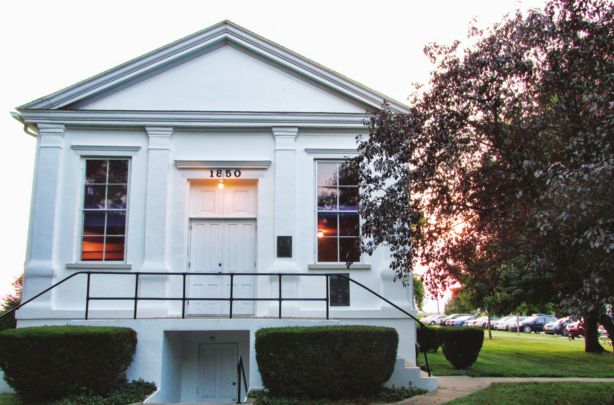
When
Jenny sang in Boston in June of 1851, she received a visit from
Reverend Lars Paul Esbjörn, pastor of a flock of Swedish immigrants who
had settled in the small Henry County, Ill., town of Andover, north of
Galesburg. According to Rev. Esbjörn’s diary, he met with Lind for more
than an hour on June 26. When he left he had a personal check for $1,500
from Lind to build a new brick church for his congregation. Most of
Lind’s money paid for the church’s construction, interrupted only by a
cholera epidemic in Andover between 1851 and 1853. Some of the lumber
her money purchased was used to build coffins for the victims, estimated
at more than 100, who were buried in a common grave in the cemetery at
Andover, which fronts what is now called the “Jenny Lind Chapel.”
Although
her travels took her up the Mississippi and Ohio rivers, Jenny Lind
never actually set foot in Illinois. She gave at least five concerts in a
mudhole city called St. Louis, and saw the city of Cairo from the Ohio
River (a fellow traveler called it “a filthier and more woebegone place”
than its namesake in Egypt, a “lamentable spectacle of dilapidation and
the rot”), but she never made it as far as Andover. Nor did she make it
to Chicago, yet she gave at least $1,000 to help build a Protestant
Episcopal Church for a Swedish congregation in that city, and purchased a
silver communion service, valued at $1,500 in its day, for another
Chicago congregation that had been swindled out of its money.
Lind
never made it to Minneapolis, Minn., either, although, an elementary
school there is named for her, as are towns in western Arkansas (near
Fort Smith) and Jenny Lind, Calif., which has a high school name for
her. Lind never returned to the United States after her first tour. She
married her pianist, Otto Goldschmidt, who was nine years her junior,
retired from the stage and settled down to raise a family in England.
She died of cancer at age 67 in 1887.
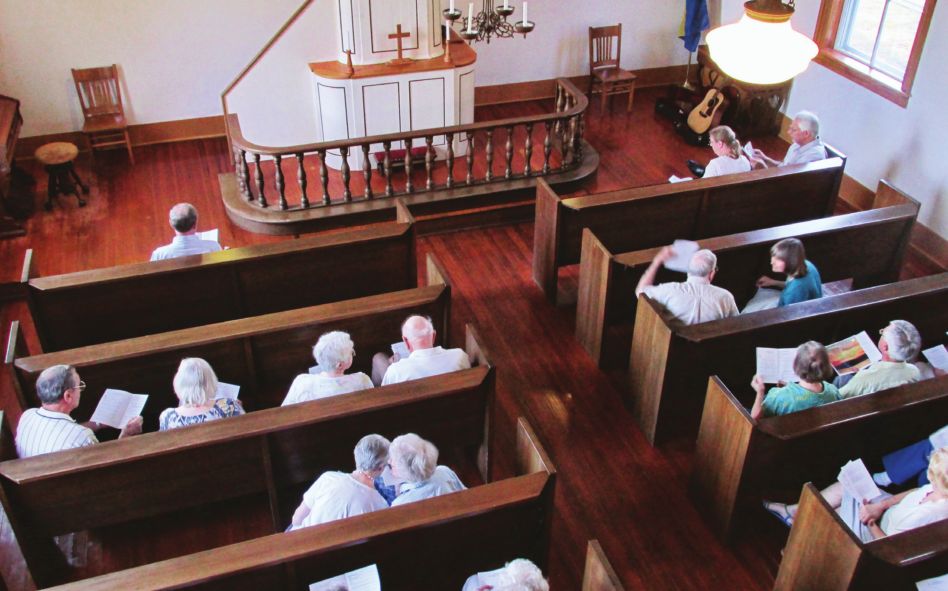
Andover,
Ill., however, is unique in that the Jenny Lind Chapel not only
memorializes its benefactor, it honors her with special concerts, vesper
services in the summer and community events tied to Swedish holidays,
such as the annual Hogmassa (last Sunday in September). The
chapel also houses a small Jenny Lind museum in the basement where
paintings of the Swedish Nightingale, lithographs, copies of her
programs, letters and other memorabilia can be seen.
“She
was truly a rock star of her generation,” says Ron Peterson, a member
of the Jenny Lind Chapel Foundation, which maintains the building and
grounds, and protects its small endowment from the quirky economy. If
you’re ever in Henry County, Peterson would be pleased to show you
around Andover and to tell you the history of this town transformed by a
Nightingale’s song.
William Furry is the executive director of the Illinois State Historical Society and a former editor and staff writer for Illinois Times. In his spare time he plays with Thistle n’ Thyme, a Celtic music trio that performs the “Jenny Lind Polka” upon special request.


