Not tomatoes; tomatillos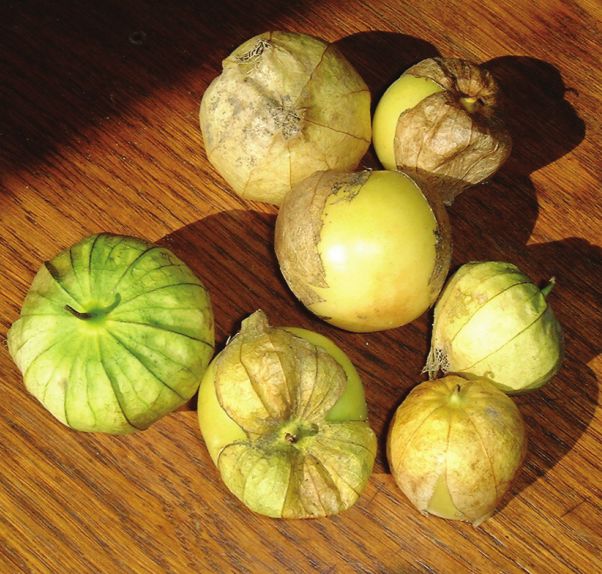
FOOD | Julianne Glatz
They look like green tomatoes, at least once their husks have been removed. When cut and the chambers of tiny seeds exposed, they still look a bit as if they could be tomatoes; although possibly, as a saying in my family goes, “like a bastard at a family reunion.” Eaten raw, their taste and texture is also somewhat like green tomatoes, albeit exceptionally crunchy and tart ones.
But tomatillos are not tomatoes, although they both belong to the Solanaceae family of plants. Members of Solanaceae can be found all over the globe, and include diverse edibles such as eggplants, potatoes and bell peppers. Tobacco is also a part of the Solanaceae family, as well as other plants that are toxic. Tomatillos, native to the American West, Mexico and Central and South America, are most closely related to ground cherries, which grow wild and are delicious, and decorative bright orange Chinese lanterns. Though it may seem an odd grouping, the different Solanaceae species’ flowers reveal their relationship, at least any I’ve ever seen: similar small, star-like petals surrounding a pointed center. I’ve seen a lot of those blooms up close and personal, bending down to pick the fruits of seemingly endless rows of eggplants, peppers and tomatoes, or pulling away mounded soil to harvest potatoes during my childhood and young adulthood at my family’s organic produce farm.
We didn’t grow tomatillos back then; in fact we wouldn’t have even known what they were. But they’re an integral part of my husband’s and my relatively miniscule garden, not that it’s taken any effort on our part. We planted tomatillos almost two decades ago, but they’ve been self-seeding and flourishing ever since.
Like their closest cousins ground cherries and Chinese lanterns, tomatillo fruits are enclosed in a papery outer shell. They are ripe and ready to use when the fruit has grown to the point that it completely fills the shell, or even has burst it open a bit. After peeling away the papery shell, you’ll find that tomatillos’ surface has a sticky coating. It’s not harmful, but should be rinsed off before using.
While some recipes call for completely raw tomatillos, most (and the most traditional) usually cook them at least partially. This can be done by simmering them gently in water to cover, or (again, most traditionally) by placing the husked tomatillos on a hot griddle, turning frequently until blackened in some spots and slightly softened, or roasting in a hot (450 F) oven, turning as needed. The roasting and griddling methods concentrate tomatillos’ flavor.
Every year at about this time, I have a bumper crop of tomatillos, and use them to make large batches of the following recipes for the freezer. The mole is wonderful by itself or combined with a
little sour cream or yogurt as a dip for tortilla chips or crudités (raw
vegetables). It can be used to top salmon or other fish or as an
accompanying sauce to countless Mexican preparations.
The
pork and tomatillo “chili” isn’t technically a chili; it contains
neither dried or fresh peppers. But it seems “chili-esque.” The tartness
of the tomatillos, tomatoes and sweet/tart orange juice give it a
brightness that makes it a real crowd-pleaser, and one or my family’s
favorites.
These days
you don’t have to grow your own to enjoy tomatillos. They can often be
found at farmers markets, and are usually available in local groceries’
produce sections. Unhydrogenated lard can be purchased at the Triple S
Farm stand at the Old State Capitol Wednesday market, or at Humphrey’s
Grocery.
Mole verde
• 1 lb. fresh tomatillos, washed and husked
• 4 large garlic cloves, unpeeled, or more to taste
• 1 poblano chile
• 1 medium white onion, coarsely chopped
• 1 handful each flat-leafed parsley and cilantro, or use all cilantro
• 1/2 c. water
• 1 T. masa harina, (corn flour used to make tortillas and tamales), or
a handful of tortilla chips, excess salt brushed off and crumbled
• 2 T. non-hydrogenated lard (preferred), bacon fat or vegetable oil
•
Salt and sugar to taste Heat a griddle or heavy skillet over moderately
high heat. Add the tomatillos and garlic cloves to the skillet. Sear,
turning frequently, until both the tomatillos and garlic cloves are
blackened in spots and somewhat soft, about 10 minutes.
Let
the tomatillos and garlic cool to room temperature, then peel the
garlic and put both the tomatillos and garlic in the container of an
electric blender or food processor. Set aside.
Roast
the poblano over an open flame by holding it by its stem with tongs or
laying it on a rack. This can also be done over a hot fire on a barbecue
grill. Turn frequently until the skin of the chile is completely
blackened.
Put the
chile in a small paper bag and roll up the top. Let the chile steam for
about 5 minutes or until the skin has loosened from the flesh. Wipe off
the blackened skin with a paper towel, then open the poblano and remove
the seeds and stem. It’s OK if there are still blackened bits clinging
to the poblano’s flesh.
Add
the poblano to the blender or food processor along with the onion,
parsley, cilantro, water and masa harina. (If you are using tortilla
chips instead of the masa, crumble them, mix with the water, and let
stand for about 15 minutes before proceeding.) Purée until smooth.
Heat
the lard or other fat in a large heavy saucepan or skillet over high
heat. Add the purée and bring to a boil. Reduce the heat to low and
simmer the mole, uncovered for about 10 minutes (if you’re making
multiple batches it will take longer). The sauce should thicken to the
consistency of a fine textured salsa. Season to taste with salt and
sugar. Mole verde freezes well. Makes about 4 cups.
Pork, tomatillo and black bean chili
• 1/4 c. bacon fat, preferred, nonhydrogenated lard or vegetable oil
•
2 lb. pork, from butt or shoulder, trimmed of all visible fat and cut
into 1/2 cubes OR boneless skinless chicken or turkey, preferably dark
meat
• 2 c. chopped onions, not super sweet
• 8 cloves garlic, thinly sliced
• 1 12 oz. bottle dark beer, preferably Mexican such as Negro Modelo
• 1 1/2 c. orange juice
• 1 lb. tomatillos, husked, washed and quartered
• 2 c. peeled chopped tomatoes, fresh or canned
• 1 bunch cilantro, stems finely chopped and leaves chopped separately and reserved
• 1 30 oz. can black beans
• Kosher or sea salt and freshly ground pepper to taste
For garnish, optional
• Cooked rice
• 1 c. sour cream mixed with the juice of 1 lime In a heavy bottomed
large pot, heat the oil over medium-high heat. Add the meat and brown.
You will probably need to do this in batches so as to not overcrowd.
Remove the meat as it is browned and reserve.
Pour
off the excess fat and add the onions and garlic to the pan. Sauté
until softened and golden brown, about 10 minutes. Add the beer, orange
juice, tomatillos, chopped tomatoes, the liquid from the black beans,
and the cilantro stems and bring to a boil and add the pork. Reduce the
heat and simmer, uncovered for about 30 minutes, or until the mixture
has reduced and thickened somewhat.
Add
the meat, beans and half the remaining cilantro and simmer an
additional 15 minutes. Let stand for about 15 minutes before serving.
Place a 1/4 to 1/3 cup cooked rice in the middle of a soup bowl, and
ladle the “chili” over it. Sprinkle some of the remaining cilantro
leaves over the top as a garnish. Pass the sour cream/lime juice at the
table as a topping.
Vegetarian version: substitute an additional 30 oz. can of black beans for the meat. Use vegetable oil instead of bacon fat or lard.
Contact Julianne Glatz at [email protected].


