42 is a fitting tribute to Jackie Robinson
FILM | Chuck Koplinski
A solid film biography of Jackie Robinson is long overdue. Though it was made with the best of intentions and features the man himself, the 1950s The Jackie Robinson Story, isn’t a film that’s aged well. Noble in intent but awkwardly executed, it gets bogged down in sentiment and melodrama and is hard to watch with a straight face today, many of the unintentional laughs coming from Robinson’s wooden performance. Thankfully he had the whole baseball thing to fall back on. Acting gave him more fits than a late-breaking curve.
Brian Helgeland’s 42 is the biography Robinson deserves. However, that’s not to say that it’s a complete success. The director seems far more interested in presenting post-World War II America as we imagine it rather that how it really was and trips up when it occasionally goes out of its way to enhance the myth surrounding its subject rather than deal with the man himself. Still, there’s no denying that Helgeland has constructed a solid and occasionally inspiring work that gets by on its good intentions, rousing performances from its two leads and the turns from various supporting actors as well.
Ostensibly covering 1947, the year in which Robinson broke the color barrier to become the first black player in major league baseball, the movie proves to be an efficient storytelling machine. Helgeland keeps things moving from one key event to the next, faithfully recreating some, condensing others and fabricating a few. It’s a compliment to the director that while the film is two hours long it rarely feels like it, gradually building a full head of narrative steam, that mirrors Robinson’s ascension in the big leagues.
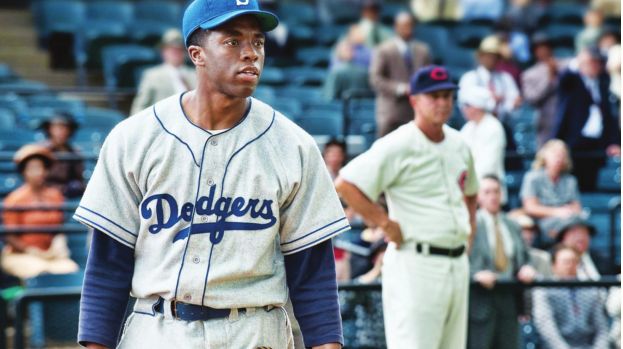
Perhaps the smartest thing Helgeland does is that. While some scenes play out with an ample serving of corn, he doesn’t set out to portray Robinson as a saint, but merely a man who finds himself at the crossroads of history, searching for the fortitude to navigate the uncharted social waters he’s set to embark on. Boseman is quite good in this regard. He convincingly shows how the ballplayer’s attitude developed over the course of the season. A bit arrogant at first, he comes to realize he’s in over his head as things progress, especially after an ugly incident involving Philadelphia Phillies’ manager Ben Chapman (Alan Tudyk) who mercilessly heckles him. Yet ultimately, he’s able to come to terms with the situation and endure. In underplaying the role, Boseman takes us inside the man, showing us his doubts and strength in equal measure, underscoring Robinson’s humanity from which his heroism grew.
On the other end of the spectrum is Harrison Ford who delivers one juicy piece of ham as Brooklyn Dodgers General Manager Branch Rickey. Mercilessly chewing on a battered stogie, gruffly delivering his lines in a muffled baritone, the actor is fun to watch as he blusters about, cajoling, chastising and at turns inspiring those who oppose this grand experiment. Ford has presence to spare but his most effective moment comes when he counsels and consoles Robinson after a particularly bad day, a fabricated moment from Helgeland’s pen that both the actors run with. Maybe this inspirational event didn’t happen per se, but Ford and Boseman know this is the turning point of the film and deliver such an emotional scene that you can’t help but wish it were true.
Myth and history collide throughout and create more than a few dissonant notes, the harshest of them being the short shrift accorded to Robinson’s wife Rachel who was the rock behind the man. This is to be expected from films of this sort, but in the end what matters is that the spirit of the movie stays true to its subject. That 42 is noble in intent and a reflection of true courage is as apt a reflection of its subject that one can ever hope for.
Contact Chuck Koplinski at [email protected].


