
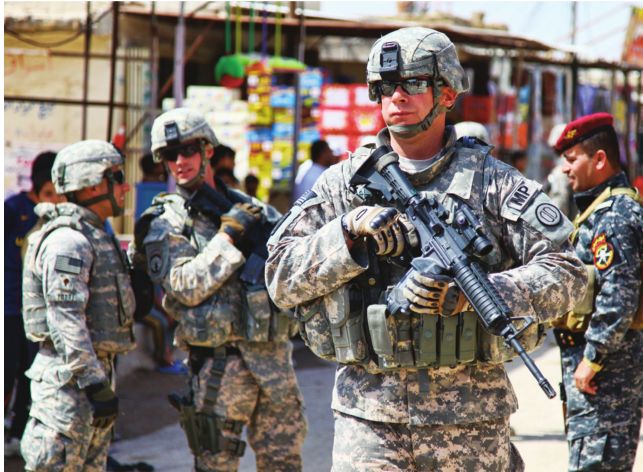
Iraq and America’s never-ending battle against truth
DYSPEPSIANA | James Krohe Jr.
We fought, we were told, to avenge an act of terrorism against our nation that was made up, after a campaign whipped up by the U.S. media. In fact, the real powers in America wanted the war to protect their own economic interests in the region. An initial victory led to stalemate in a faraway place that left the U.S. tangled up for years in an ugly civil war/ resistance movement that earned our nation an international reputation as a bully-boy.
That will sound familiar to any citizen who was alive and sentient during the administration of Bush the Lesser, when the U.S., or rather the White House, invaded Iraq. It would have sounded familiar to their great-grandparents too, for it describes the Spanish-American War of 1898.
Wars would seem to be hard things to forget, but they happen, in spite of monuments meant to prevent forgetting. There is a memorial to the Spanish-American War Memorial in Springfield, on Monroe Street outside the Armory. It was erected
in 1948, a half-century after the events it commemorates. Its base is engraved with the names of major battles from that conflict, in places that are as mysterious to most of today’s passersby as Jupiter’s moons.
Already the names of the key battles of the Iraq war – Najah, Mosul, Basra, Kabala – are fading from popular memory, if indeed they ever were there in the first place. It’s been 10 years now and, even a decade later, much of the nation has yet to make up its mind about it. I did, before it started. The White House invaded to protect us against weapons of mass destruction that did not exist, indeed were known not to exist, and to protect the U.S. against terrorists that were not in that country until we opened it to them.
If defeating Hussein was not a war that needed to be fought, it was one we could win, and that was enough for the lesser Bush, who had a score to settle, and for his henchmen at Bechtel, Halliburton and Fluor, who had profits to make. Not since the Spanish-
American War has the U.S. so shamed itself in the eyes of the world.
I know people who will recoil from the suggestion that an American president would condemn so many helpless people to violent death, exile and upheaval out of such base motives. They mistake their presidents. Think back again to Vietnam. A recent report from the BBC strongly suggests that in 1968, candidate Richard Nixon used back-channel contacts to sabotage peace talks between the Johnson administration and Hanoi then nearing an end. Recently declassified recordings from the LBJ White House prove that the president knew about the interference and kept quiet about it – perhaps because to expose Nixon’s lie would have risked exposing Johnson’s, he having fabricated the Gulf of Tonkin incident he used to justify the initial escalation.
Nixon of course won the election that fall, in part by blaming the Democrats for having failed to get the Vietnamese to the table. The war in Vietnam dragged on for five more years at a cost of an additional 22,000 American lives and who knows how many Vietnamese and Laotian lives.
The vast majority of U.S. households were untouched by that war, and Iraq touched far fewer still. These days we have paid help to do our killing for us, like we have paid help with the lawn. Americans judged the war as if it were a TV show, and when it ceased to engage them they moved on to other entertainments. Perhaps this casual interest in the killing explains why, according to a Gallup poll released in March, 42 percent of American adults still believe that invading Iraq wasn’t a mistake.
There are other possible explanations, beyond simple ignorance of the facts. Forty years ago I believed that if more Americans had a kid at risk from the fighting in Vietnam, they would react to it like parents, with the result that public opinion would swing against it. Only people who were watching other parents’ kids die, I thought, could react to the war like patriots. I had it backwards. Knowing your kid is at risk seems to turn a lot of parents into patriots, perhaps because to face that your kid might die or be maimed to protect a president from Glenn Beck or to bolster Halliburton’s stock price is too horrible to contemplate.
Protecting ourselves from ugly truths for even perfectly human reasons leaves the public vulnerable to future hysteria of the sort it fell prey to in 2003. I know of no way to prevent another of what Matt Steinglass recently called a catastrophic mass delusion, no way that might work in a republic such as this one in which neither the truth nor the law matters to power.
Contact James Krohe Jr. at [email protected].