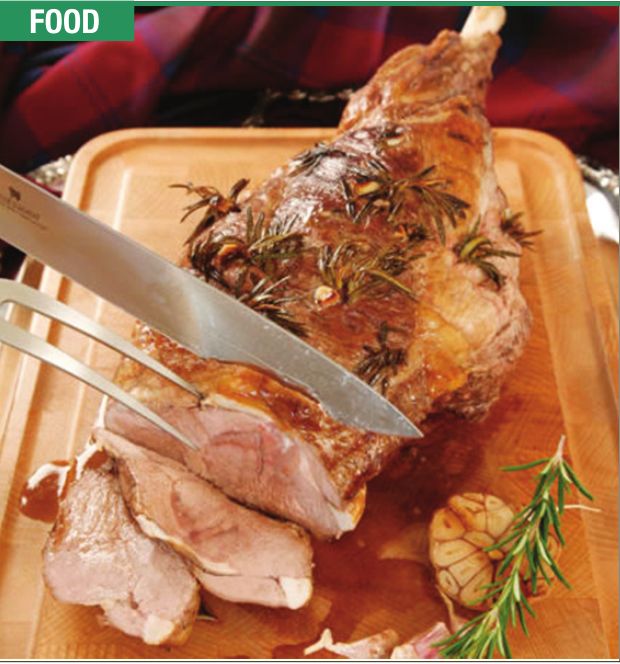
For many Americans, ham is the traditional centerpiece of their Easter dinner. In other homes – ours included – it’s roast leg of lamb. Lamb’s natural association with spring makes it a favorite this time of year with people of many beliefs and cultures. Sadly, many folks have only experienced roast lamb that’s overdone and dry. But following the instructions below will guarantee an Easter roast that’s perfumed with garlic and fresh herbs and gravy that’s so delicious some of my family swear it’s the best thing about roasting lamb. For ham fans, I’ve included a recipe for my favorite baked ham glaze. And last, my grandmother’s recipe for asparagus on toast. It’s as old school as it gets – asparagus comfort food.
Roast leg of lamb with pan gravy
For the lamb:
• 1 leg of lamb, either bone in or boneless, rolled and tied
• Kosher salt
• Vegetable oil
• Garlic cloves, peeled
• Fresh rosemary
• Fresh thyme, optional
• Freshly ground pepper
For the gravy:
• 1/4 c. all-purpose flour
• 6 c. hot water, or low-sodium meat or vegetable stock/broth
The night before you plan to serve the lamb, remove it from any packaging, rinse it, and pat it dry with paper towels. Sprinkle it all over with Kosher salt – approximately 2 tablespoons, or a bit more or less, depending on its size, place it on a rack, and put it, uncovered, in the refrigerator.
The next day, remove the lamb from the refrigerator and let it stand for 2-4 hours to come to room temperature.
Cut the garlic cloves into thin slivers and de-stem the herb leaves.
Preheat the oven to 300 F. Place a roasting pan over medium-high heat; brush bottom lightly with oil. When it’s hot but not smoking, put the lamb in the pan and sear until it’s well browned all over. Turn as needed, holding it with forks to brown areas where it won’t balance itself.
Remove the pan from the heat and remove the lamb. With the tip of a thin knife, make slits all over the meat’s surface; stuff each with a garlic sliver and a couple herb leaves. It’s OK if they stick out slightly. Sprinkle the meat with pepper, put it back in the pan, then in the oven.
Roast, uncovered, until desired degree of doneness. Test with a meat thermometer inserted halfway through the roast, but not touching bone:
Rare 135 F Medium-rare 140 F – 150 F
Medium 155 F Medium-well
160 F – 165 F Roasting will take anywhere from 25- 40 minutes per pound
depending on the degree of doneness and your individual oven; begin
checking after 20 minutes/pound for rare roast; after 30 minutes for
beyond that. Boneless roasts will finish more quickly.
After
roasting, remove the meat to a platter or carving board. Put the pan on
the stove over medium heat and sprinkle on the flour. Cook, stirring
constantly to scrape up the flavorful bits (called fond) on the
bottom and lightly brown the flour. When it’s bubbling, add the hot
water or broth, whisking and stirring until there are no flour lumps and
the fond is fully incorporated into the gravy. Simmer the gravy until
it’s thickened and reduced slightly, and season with salt and pepper.
Makes 4-5 cups.
Bourbon, mustard and brown sugar glazed ham
Makes enough glaze for an 8-10 pound ham
• 2 c. chopped onions, not super-sweet
• 1/2 c. Dijon or whole-grain mustard – do not use ballpark type mustard
• 3/4 c. dark brown sugar
• 1/3 c. bourbon, or substitute apple, orange or pineapple juice
• 1 tsp. freshly ground pepper, or to taste Remove the ham from the
refrigerator 3 to 4 hours before baking to come to room temperature.
Preheat the oven to 300 F.
Mix
all the above ingredients. On a large sheet of heavy-duty foil, spread a
couple spoonfuls of the glaze in a rough circle or oval and set the ham
on top of it. Spoon the rest of the glaze over the ham, bring up the
edges and crimp the foil to seal completely. Put the foil-wrapped ham in
a heavy baking dish or roasting pan, preferably nonstick, and place in
the oven.
Bake about 2
hours or until the ham is completely heated through – it should
register 100-115 F on an instant-read meat thermometer. Unwrap the ham
and place it on a platter. Scrape the glaze off the foil with a rubber
spatula into a bowl. Put the ham back onto the foil (or new foil if the
original has torn), then coat it liberally with the glaze.
Return
the ham, uncovered, to the oven. If there’s additional glaze, baste the
ham with it after 15 minutes. Continue baking until the glaze has
caramelized, another 30-45 minutes.
Let stand for about 15 minutes before carving.
Variation: Top
the glaze with seedless orange slices, both beneath and on top of the
ham, securing with toothpicks if necessary. Discard the orange slices
after unwrapping the ham. Reduce the glaze/pan juices in a saucepan to
syrupiness before brushing for the final baking/glazing. Use bourbon or
substitute an orange-flavored liqueur such as Cointreau.
Asparagus on toast
• 2 slices homemade-type bread, toasted
• 1 1/2 lb. asparagus, washed
• 2 c. water
• Salt
• 2 T. unsalted butter
• 2 T. flour
• Freshly ground pepper Leave the bread crusts on or trim them off.
Cut the toast into 1 inch squares and spread in the bottom of your asparagus serving dish. Set aside in a warm spot.
Holding
the bottom of an asparagus spear with one hand, grasp the top just
under the tip with the other hand. Gently bend the stalk until the top
breaks off, usually about 1/3-1/4 from the bottom, though it can be more
or less. That will be spot between its tender top and tough bottom.
Cut
the tender parts into bite-sized pieces, either straight across or at
an angle. For a fancy presentation, use the Chinese roll-cut method:
Place an asparagus stalk on a cutting surface and cut below the tip at
an angle. Roll the stalk over and make the next cut with your knife at
the same angle. Leaving a space between cuts produces trapezoidal
pieces; leave no space and
they’ll be triangular. Continue to the stalk’s end; repeat with the rest. It’s easy and quick once you get the hang of it.
Bring
the 2 cups of water to a boil over high heat in a saucepan, adding a
half teaspoon of salt. Have a large bowl ready – not the serving bowl.
Add the asparagus and simmer until just tender: easily pierced with a
sharp knife tip but still bright green. This takes as little as 1 minute
or as many as 5, depending on the asparagus’ thickness.
Immediately
strain the asparagus in a colander over the bowl, reserving the cooking
water. Quickly put the colander under cold running water, tossing the
pieces until they cool to room temperature. Set aside to drain.
Melt
the butter in the pan over mediumhigh heat. When it turns nutty brown,
add the flour and whisk to combine. Cook for a minute or two, then whisk
in the reserved cooking water. Simmer until the sauce is thickened and
smooth, about 2 minutes. Stir in the asparagus and cook just until it’s
heated through. Season to taste with additional salt and freshly ground
pepper.
Using a
slotted spoon, place the asparagus on top of the toasts, then pour the
remaining sauce over them. Let stand a minute or 2 before serving so the
toasts will soak up the flavorful sauce. Serves 4 or more.
Contact Julianne Glatz at [email protected].


