Nearly a mile below the surface of southern Illinois, a vast reserve of oil and natural gas sits locked in thick shale rock. While Illinois has a long history of tapping into its enormous fossil fuel resources, unlocking the shale reserve takes a new approach that could bring both economic windfall and potential for environmental disasters.
That new approach is called hydraulic fracturing – “fracking” for short – and it requires a whole lot of water, sand and toxic chemicals. Fracking is legal in Illinois, but state lawmakers are considering a measure to regulate it, while some environmental groups call for an outright ban. Some states like Texas – which made more than $1.5 billion in revenue from fracking in its 2012 fiscal year – are wide open for fracking, but the practice is almost nonexistent in Illinois because oil and gas companies fear the lack of a regulatory structure that provides predictability. While the legislation on fracking in Illinois contains precautionary measures to guard against pollution, some opponents say the bill doesn’t go far enough. Once you frack, they say, you can’t go back.
The past and the future
The moist, warm breeze blows softly across the splashing waves as a 20-foot-long squid-like animal with a conical shell snatches trilobites from the shallow sea floor. It’s a typical day in Illinois about 350 million years ago, during a time known as the Mississippian Period. Most of the United States was covered by a shallow inland sea at the time, and Illinois sat just south of the equator.
In the eons that followed, the earth’s tectonic plates shifted, the inland sea receded and the abundant marine life in what is now Illinois died out. Buried in sand and mud that eventually became compacted into shale rock, the dead plants and animals were “cooked” into a rich stew of organic matter permeating the shale. The U.S. Geological Survey estimates that the organic matter in the area known as the Illinois Basin – which covers most of Illinois and parts of Indiana, Kentucky and Tennessee – comprises an estimated 8.9 billion gallons of oil, 4.6 trillion cubic feet of natural gas and more than a billion gallons of other petroleum products like butane.
Illinoisans first started tapping into the state’s petroleum resources in the 1860s. During the peak production years spanning 1955 through 1963, Illinois’ oil wells produced as many as 80 million barrels of oil per year. A barrel is 42 gallons. Illinois has never been a major player in natural gas, however, with most gas being recovered as a byproduct of oil drilling.
The days of easy access to Illinois’ petroleum resources are mostly in the past, with the majority of wells either dried up or now operating as marginal wells producing fewer than 70 gallons of oil per day. Total oil production in Illinois is about 10 to12 million barrels per year, according to the Illinois Department of Natural Resources.
Instead of simply sticking a “straw” – industry slang for a well pipe – into the ground and tapping a single continuous pocket of oil or gas, drilling companies began using hydraulic fracturing at least as early as the 1950s. Hydraulic fracturing involves pumping water, sand and chemicals underground to create cracks in shale rocks to free up smaller pockets of oil and gas. That fracking was what’s known as “vertical” fracking because the well pipe is vertical and only reaches the deposits directly below it.
Modern fracking operates on the same principles, but with a much larger reach and on a much larger scale. It starts with an oil or gas company drilling a normal vertical well, which generally takes about two weeks and reaches several thousand feet below the surface. During the drilling process, the drill bit is gradually angled to turn the well pipe horizontal for as far as a mile. Next, the drillers set up a series of industrial pumps that push between 2 million and 5 million gallons of water into the well, along with a certain type of sand and several thousand gallons of acids, anti-bacterial agents and other chemicals. The pressure from the
water cracks the shale, while the sand flows into the cracks and holds them open. As the water flows back out of the well, oil and gas come up, too, along with whatever other substances happen to be buried there. Once the fracking operation is done, the well typically operates as normal, though a well can be refracked multiple times to keep production up.
Brad Richards, executive director of the Illinois Oil and Gas Association, says fracking is a way to free up oil or gas that previously either weren’t economical or weren’t deemed reachable. Richards, who has a master’s degree in geology, says modern hydraulic fracturing is a “paradigm shift” in petroleum production that has allowed the U.S. to overtake Russia in gas production, and he expects the U.S. to surpass Saudi Arabia in the near future. While Richards and others say it’s impossible to know how many wells may be fracked in Illinois or how much the activity might raise in state revenues, he said fracking may even allow the U.S. to avoid purchasing energy from outside North America.
“It’s absolutely a transformation,” Richards said.
Risk and reward
Despite the economic promise of fracking, it comes with a cost. While drilling companies and industry advocates
insist fracking can be done safely and with minimal risk to the
environment, fracking accidents elsewhere illustrate what happens when
something goes wrong.
 Although
fracking takes place well below the depth of most aquifers, it has been
alleged to cause groundwater contamination. In 2010, the U.S. EPA
advised residents living near a fracking site in Pavillion, Wyo., not to
drink water from their private wells after tests showed the wells
contained high levels of methane gas, benzene and other petroleum
compounds. While the EPA didn’t announce a cause of the contamination,
the same scenario has played out in Pennsylvania, Colorado, Texas and
other states, with petroleum compounds showing up in private wells near
fracking sites.
Although
fracking takes place well below the depth of most aquifers, it has been
alleged to cause groundwater contamination. In 2010, the U.S. EPA
advised residents living near a fracking site in Pavillion, Wyo., not to
drink water from their private wells after tests showed the wells
contained high levels of methane gas, benzene and other petroleum
compounds. While the EPA didn’t announce a cause of the contamination,
the same scenario has played out in Pennsylvania, Colorado, Texas and
other states, with petroleum compounds showing up in private wells near
fracking sites.
Potential
groundwater contamination is just one of the environmental risks
associated with fracking. Much of the water and chemicals – many of
which are known carcinogens – used during the fracking process return to
the surface as “flowback” water, carrying additional contaminants from
deep underground, including radioactive radon, barium, strontium,
benzene and toluene. Flowback water can be reused in fracking, but it’s
often stored in tanks or retention ponds, injected underground into
disposal wells or sent to sewage treatment plants.
The
disposal options each have their problems. Storage tanks and ponds can
leak, like the one found to be leaking near two schools in the Canadian
town of Kennetcook, Nova Scotia, in February. Injection of flowback into
disposal wells has been linked to earthquake activity by the U.S.
Geological Survey, though none of the earthquakes recorded so far have
been of a magnitude great enough to cause damage. And researchers in
Pennsylvania found that sewage treatment plants attempting to process
fracking wastewater end up releasing significant amounts of pollutants
into the water supply.
Kyle
Ferrar is a doctoral graduate student in environmental and occupational
health at the University of Pittsburgh. Ferrar and his fellow
researchers examined the treated water coming out of three sewage
treatment plants that accepted fracking wastewater in 2011 and found
that the plants released barium, strontium and bromides into the water
supply because conventional sewage treatment doesn’t mitigate those
substances.
After the
Pennsylvania Environmental Protection Agency requested that sewage
treatment plants stop accepting fracking wastewater, Ferrar said another
round of tests showed that the levels of those pollutants decreased
significantly. He added that bromides can interfere with disinfectants
used to sanitize water. Illinois’ proposed regulations would ban
fracking wastewater from being dumped in any surface water or sent to a
sewage treatment plant.
While
Ferrar doesn’t draw a positive or negative conclusion about fracking
from his research, he says more research is needed to ensure fracking is
done safely.
“This
development has happened at such a fast rate that when we needed to deal
with the primary wastewater stream, we didn’t have the infrastructure
to deal with it, and we didn’t have the research in place to identify
effective safeguards,” Ferrar said. “This natural gas is not going
anywhere; it’s going to be under Pennsylvania, so there’s no need to
have this type of rushed development with disregard to best practices.”
Even the sand used in fracking could create problems for Illinois, says Dr. Sandra Steingraber, author of Living Downstream, a
book about her struggle with cancer and the disease’s links to
environmental contamination. A biologist by trade, Steingraber is
originally from Pekin, Ill., and she now lives in New York state. She
says fracking in Illinois will likely use silica sand mined from near
Starved Rock State Park on the Illinois River. Mining the sand produces
fine dust that hangs in the air “like fog,” Steingraber says, and it can
cause lung cancer and heavy lung scarring known as silicosis, according
to the federal Occupational Safety and Health Administration (OSHA).
Additionally, Steingraber expects the mining process to leave the
landscape around Starved Rock heavily scarred.
“The economic pressure to turn the Illinois River Valley inside-out to mine for sand will be unstoppable,”
Steingraber said. “It’s such a destructive force. There is no reclaiming
land once you turn it inside out and blast away the sandstone.”
Fracking
can even cause air pollution, Steingraber says. She says air quality
tests three quarters of a mile from a state-of-the art fracking site in
Colorado showed dangerously high levels of the carcinogen benzene, and
an upcoming study of children in Texas showed an abnormally high
incidence of asthma around fracking sites.
In
addition to the potential direct effects of fracking on the
environment, Steingraber says fracking needlessly prolongs dependence on
fossil fuels.
“It
makes no sense to further entrench the fossil fuel industry at this
point,” she said. “The biggest disincentive to rolling out renewable
energy sources is cheap natural gas, but it’s only delaying the day that
we invest in renewables. It’s not a bridge to the future; it’s a plank
we walk at the point of a sword, and the pirates are not our friends.”
In the Statehouse 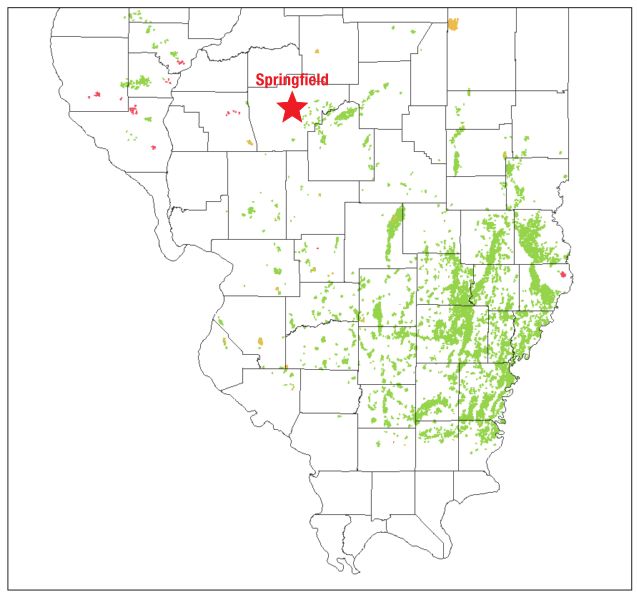
About
a dozen oil and gas companies have invested between $200 million and
$250 million buying up drilling leases on about a half million acres of
private land in southern Illinois for potential fracking sites, says
Brad Richards, the executive director of the Illinois Oil and Gas
Association. He says the industry is pushing for a state fracking law to
provide some regulatory certainty to oil and gas companies, which don’t
appear to be fracking yet, despite the current lack of a ban or
moratorium. Without regulations, an oil or gas company that fracks its
wells may attract the attention of government agencies which have no
clear guidelines on how to oversee fracking. That could lead to
protracted legal battles and eventual fines. In short, asking for
permission is financially safer than asking for forgiveness.
However,
the issue is becoming more urgent for the oil and gas companies because
many of their existing land leases are nearing expiration, Richards
says. While the companies usually have the option to renew their leases,
they would have to pay the landowners a second time, he says.
Richards
calls the bill to regulate fracking in Illinois, House Bill 2615, the
most comprehensive regulatory proposal in the U.S. Indeed, the bill does
contain several restrictions on fracking that attempt to address
problems which have arisen in other states. Before fracking even begins
under the proposed law, companies must run public notices of intent to
frack a well, and any person who has “an interest that is or may be
adversely affected” by fracking can request a public hearing beforehand.
It’s unclear whether that includes only people who own property nearby
or any nearby resident who is concerned about the effects on the
environment.
Fracking
couldn’t occur within 500 feet of a residence, water well, school or
church under HB2615, and municipal governments would have the final say
about whether to allow fracking within their borders. The bill does not
appear to give county governments the ability to opt out.
The bill requires testing of private wells before and after fracking occurs, requires disclosure of what chemicals are used in fracking and even requires
companies to return land to its pre-fracking state once the process is
finished. It allows a landowner to request an investigation by the
Illinois Department of Natural Resources and the Illinois Environmental
Protection Agency if the landowner believes his or her water source has
been polluted by fracking, and companies must restore or replace the
water source if the investigation shows it has been polluted by
fracking.
Fracking
wastewater could only be disposed of using injection wells below the
depth of drinking water supplies, and companies would have to file a
comprehensive plan for transporting and handling wastewater.

Companies
that frack wells would face hefty fines and criminal charges for
violating regulations, and they would still have to abide by other state
and federal pollution regulations already in place. The proposed
$13,500 permit fee under the bill would fund regulatory activity by the
Illinois Department of Natural Resources, and companies would pay a
“severance” tax to the state for extracting the resources from the
ground.
The tax would
be on a sliding scale which depends on the production level of each
well. For the first two years, each well would pay a tax of 3 percent of
the value of the gas or oil. After that, oil wells would pay somewhere
between 3 percent for wells producing fewer than 25 barrels per day and 6
percent for wells producing 100 or more barrels per day. Oil wells that
produce fewer than 15 barrels per day would be exempt from the tax.
After the first two years, gas wells would pay 6 percent of the value of
the gas extracted.
Richards
says the bill is the result of long negotiations between industry and
environmental groups, and the oil and gas companies were willing to
accept what they see as a very high tax in exchange for getting the
legislation passed.
“We
want to make sure the permit money goes toward a robust regulatory
structure,” he said. “We agreed to this bill because we understand
politics and, quite frankly, want a resolution of this issue.”
Despite
the environmental and landowner protections negotiated into the bill,
not everyone is happy with it. As industry groups and a coalition of
environmental groups like the Illinois Chapter of the Sierra Club, the
Natural Resources Defense Council and the Illinois Environmental Council
announced the compromise, other environmental groups which hadn’t been
part of the negotiations reacted with anger at the idea that their
brethren had consented to fracking in any form, regardless of the
protections in the bill.
Clare
Butterfield, executive director of the Chicago-based environmental
group Faith in Place, explained that her group agreed not to oppose
HB2615 in exchange for the protections in the bill, which she said
“moves the needle on what good regulations are.” Still, she received a
large volume of angry correspondence from fellow environmental advocates
regarding the group’s decision.
“We
came to this position thoughtfully, carefully and with great
deliberation,” Butterfield said. “We agreed to the compromise on
the premise that this process (fracking) won’t be stopped, so we need
to get the strongest regulations we can get. Nothing constrains this
process from going forward now. Companies already own easements and have
legal rights to go ahead.”
Butterfield says her group didn’t feel that an outright ban on fracking would receive enough votes to pass the legislature.
“For many folks in southern Illinois, land leases and this process have been welcomed,” Butterfield explains.
Indeed, after a previous Illinois Times article on fracking, one reader even asked for help finding an oil or gas company to lease her family’s land in southern Illinois.
 “That’s
why we came to the conclusion that this process is very likely to come,
so we needed to get what we want,” Butterfield said.
“That’s
why we came to the conclusion that this process is very likely to come,
so we needed to get what we want,” Butterfield said.
But
for one newly organized environmental group in southern Illinois,
compromise on fracking means defeat. Rich Whitney, a former Green Party
gubernatorial candidate and member of Southern Illinoisans Against
Fracturing Our Environment, or SAFE, traveled to Springfield last week
from his home in Carbondale to speak at a legislative hearing in favor
of a bill which would create a two-year statewide moratorium on
fracking. Whitney says SAFE isn’t even truly an environmental group;
it’s simply a group of citizens concerned about the effects fracking
could have on their community. While SAFE wasn’t part of the
negotiations on the fracking bill, Whitney says approaching negotiations
with the attitude that a fracking ban wouldn’t pass became a
selffulfilling prophecy.
“They made this prediction right off the bat before mobilizing in favor of the complete ban,” Whitney said.
Despite the rush of land leases in southern Illinois, not all residents are on board, Whitney says.
“The
assumption of many legislators seems to be that the people of southern
Illinois are so hungry for jobs that we need to just grab for this
carrot, even if, in grabbing for the carrot, we fall over the cliff,” he
said. “We’re the supposed beneficiaries? No. We’re looking at it and
seeing a serious potential of our local economy and environment being
ransacked and ruined.”
The
backlash from environmental groups which weren’t at the negotiating
table led those groups which were there to clarify that they still
support a moratorium on fracking, even though they do not oppose the
negotiated fracking regulation bill. The separate bill to create a
moratorium on fracking was delayed in a Senate committee last week and
is likely dead because of a legislative deadline for getting bills out
of committee.
But the
main fracking bill in the House is also delayed, thanks to an amendment
added by sponsor Rep. John Bradley, D-Marion. The amendment requires a
licensed well contractor for any fracking activity, which Bradley said
is an attempt to spur local job growth. However, opponents in the oil
and gas industry say the well contractor licensing is meant for water
wells, not oil wells, and the added requirement will raise costs.
For
opponents of fracking, any delay is welcome. Sandra Steingraber, the
biologist and author originally from Pekin, says lawmakers should wait
for the results of scientific studies which are currently under way in
other states.
“We
don’t need to run this experiment by letting industry do it and then
measure the results,” Steingraber said. “We can do controlled
experiments first. It’s like designing a new car: you don’t test it by
putting real people in it and crashing it.”
Contact Patrick Yeagle at [email protected].


