Group pressing school board candidates on CCPA closure
Upcoming election could see swing in board’s vote on popular middle school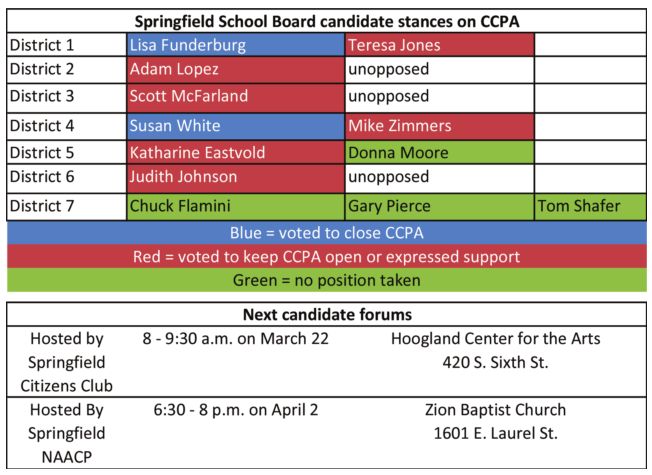
EDUCATION | Patrick Yeagle
A group of Springfield parents and educators is hoping to prevent the closure of a popular middle school, despite two unfavorable votes by the Springfield School Board. Their main tactic? Elect a different school board.
Shelley Tulipana of Springfield spearheads the effort to keep Capital College Preparatory Academy open. Tulipana leads a group of about 20 parents and teachers, called “Save CCPA,” in advocating for the school.
“I believe in what this school is doing,” Tulipana said, explaining why she decided to get involved. She has a son in seventh grade at CCPA and another child whom she hoped would attend CCPA. Tulipana and others in the group hope the upcoming election on April 9 shifts the school board’s majority in favor of keeping CCPA open.
The board voted Feb. 4 to close CCPA, citing cost concerns because of the school district’s ongoing budget problems. CCPA is an alternative school for sixth, seventh and eighthgrade students from around the city. The school has a high proportion of non-white students and students from low-income households. Closing CCPA was originally estimated to save $1.7 million, but later revisions lowered the estimated savings to about $1.1 million.
In total, the school board has approved $6.6 million in cuts that include eliminating 104 staff positions, foregoing new textbooks, and consolidating Wanless and Pleasant Hill elementary schools into Feitshans Academy.
Save CCPA is concentrating its efforts on lobbying the candidates who will comprise the new school board. With the school’s closure scheduled to happen at the end of the current school year, after the April 9 school board election, Save CCPA sees an opportunity for the next school board to reverse the closure decision. The group has been attending candidate forums and asking each candidate to publicly say whether they would close CCPA. They have also asked members to canvas their neighborhoods in support of candidates who would vote to save the school.
It’s possible that the April 9 election could produce a school board which favors keeping CCPA open. Two of the four board members who previously voted to close CCPA are not running for another term in office, and most of the new candidates favor keeping the school open.
Scott McFarland and Judith Johnson, the board members representing Subdistrict 3 and Subdistrict 6, respectively, previously voted to keep CCPA open and are running unopposed in the election.
In Subdistrict 5, candidate Katharine Eastvold has expressed support for keeping CCPA open, while candidate Donna Moore told Illinois Times that although she hasn’t
taken a position on CCPA, she would like to examine ways to keep the
school open. Either Eastvold or Moore will replace outgoing board member
Candace Mueller, who previously voted to close CCPA.
In
Subdistrict 1, current board member Lisa Funderburg faces challenger
Teresa Jones. While Funderburg has twice voted to close CCPA, Jones says
she would keep the school open. The same situation appears in
Subdistrict 4, where current board president Susan White faces
challenger Mike Zimmers. White voted twice to close CCPA, but Zimmers
says he would like to see it remain open or become a “school within a
school” – a concept in which CCPA would retain most of its
characteristics but take up residence in another Springfield middle
school.
Candidate Adam
Lopez is running unopposed in Subdistrict 2, and he says that he will
propose a resolution on May 6 to vote again on CCPA. He says many of the
school’s “scholars” come from his subdistrict, so he would vote to keep
it open. Lopez also plans to propose a 10 percent pay cut for all
administrators in the school district, which he says would save about $5
million. Lopez will replace outgoing board member Nick Stoutamyer, who
previously voted to close CCPA.
The
race for the open seat in Subdistrict 7 has three candidates. While
candidate Gary Pierce says he can’t take a position on CCPA until he
sees a “cost-benefit analysis” for the school, he says he would support
keeping it open if the analysis favors doing so. Candidate Tom Shafer
said he would not speculate on any
past
board actions or any other candidates, and he refused to say how he
would vote on CCPA if elected. Candidate Charles Flamini said he hasn’t
taken a position yet, but he would like to see objective criteria in
place for evaluating programs like CCPA.
In
total, three school board races will likely result in votes to keep
CCPA open, and two contested races could produce votes either way. The
remaining two races are wild cards, both featuring at least one
candidate who hasn’t publicly taken a position on CCPA.
Bob
Ogden, a member of Save CCPA with a daughter in eighth grade at the
school, says he got involved in the effort to prevent the school’s
closure because he feels the district doesn’t have a different plan to
close the “achievement gap” – a disparity in test scores based on
gender, race and socioeconomic status.
“It’s
kind of frustrating when you find something that is actually working
and doing what it’s supposed to do, and for whatever reason, it never
got the support it needed,” Ogden said.
Ogden
says he is frustrated to see some of the district’s budget savings come
at the expense of a school that parents and students believe to be
working.
“We are too
smart to be this dumb about education,” Ogden said. “Our biggest
resource is our children. They are our future, and their knowledge and
education is the greatest thing we can impart to them, because that’s
something no one can take away from them.”
Contact Patrick Yeagle at [email protected].


