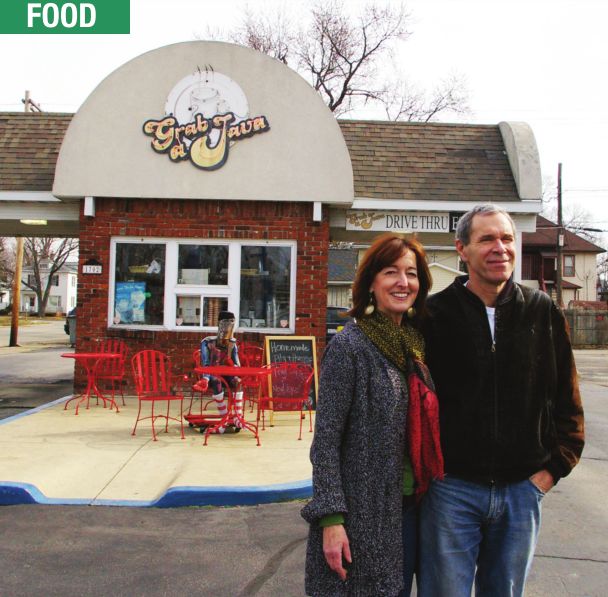
Quality brews at Grab-a-Java
FOOD | Julianne Glatz
There’s coffee and then there’s coffee. It ranges from gas station black swill you buy at 1 a.m. solely to push through the last hour of an extended road trip to fragrant ambrosia made from carefully selected and roasted beans that are freshly ground before being turned into brews prepared by trained baristas.
For 16 years, Grab-A-Java has been providing Springfield with the latter, most often known as “specialty coffee.” While some may think the term refers to what have become myriad coffee-based concoctions, many of which are highly sweetened and include additional flavorings, to the Specialty Coffee Association of America it’s all about the quality of coffee beans and the standards used to create them. As Ric Rhinehart put it in a June 2009 article published by the SCAA: “In the final analysis specialty coffee [is] defined by the quality of the product, whether green bean, roasted bean or prepared beverage and by the quality of life that coffee can deliver to all of those involved in its cultivation, preparation and degustation. A coffee that delivers satisfaction on all counts and adds value to the lives and livelihoods of all involved is truly a specialty coffee.”
Grab-A-Java owners Meg and Pete Lazare have had a love affair with outstanding coffee since the earliest days of their own love story. “Coffee has always been a big part of our lives,” says Meg. “We met in St. Paul, Minn. back in the early 1970s. I was living with Peter’s ex-girlfriend upstairs in a twoflat; Pete lived downstairs. His ex-girlfriend was a great cook and really into coffee.” When the Lazares left St. Paul, they brought along the love of coffee that Meg’s flatmate/ Pete’s old girlfriend had instilled in them.
By the mid-1990s, the specialty coffee craze that had begun on the West Coast was taking America by storm. But it hadn’t yet really hit Springfield; Meg, a registered nurse, thought the time was right to bring the brewing storm to Illinois’ capitol city – with Pete’s help, of course. And they decided to do it by building a drive-through.
A drive-through? It might not have taken a trends expert to realize Springfield had potential as a specialty coffee market, but drive-throughs had barely begun appearing in the Pacific Northwest. The Lazares had seen a couple on travels there and read about the concept in a magazine. It would be several years before specialty coffee’s 800-pound gorilla, Starbucks, started building them; outside the west coast, specialty coffee drive-throughs were totally unknown.
“We’d drive along Sixth Street and see long lines at the McDonald’s and Hardee’s drive-throughs opposite each other,” they told me. “And we thought it’d work for coffee, too.” Not everyone agreed. Meg got start-up capital
through a Women and Minorities Loan program, but their builder was
incredulous that money could be made from drive-through coffee. “Of
course, when you start a business, you think everybody will want your
product,” says Pete. “If you’re a chain restaurant, it’s a mob scene on
the first day; if you’re an independent, it takes awhile for people to
find you.”
But people
eventually did find them, though it took three years for the business to
turn a profit. Grab-A Java has an everincreasing base of regular
customers, some almost fanatically so. “We have really loyal people that
come day after day, and year after year,” says Meg. “And we form
relationships with them, which is kind of surprising in a drive-through.
Some are second generation: small kids who came with their parents are
coming in as grown-ups. ” There was the woman who drove through to pick
up a coffee on the way to her wedding – behind the wheel, in her wedding
dress. Another stopped by on the way home from the hospital with her
newborn in car. Some come after funerals. “We even had one great
customer who died of cancer and mentioned Grab-A-Java in her obituary,”
the Lazares told me.
What effect has specialty coffee’s 800 lb.
gorilla
had on Grab-A-Java? When Starbucks opened their first Springfield
drive-through in Parkway Pointe shortly after Lazares built their second
Grab-A-Java on Hedley across from Lowe’s, I worried that the
competition from the famous national chain would hurt their business.
Lazares had concerns, too. But they also saw it as an opportunity to
make the quality of their coffee “shine through.” They credit Starbucks
with helping popularize coffee drinks, and say the competition helps
keep them on their toes to “make ours the better product.”
But
the Lazares didn’t need outside motivation to make fantastic coffee.
Grab-A- Java offers a wide selection of coffee drinks of varying
strengths as well as flavored and/ or sweetened options (teas and
smoothies are also available). From the beginning they’ve gone to great
lengths to educate themselves about coffee-making, taking courses on
everything from how to brew a perfect cup of coffee, make espresso, and
properly foam milk for cream to the chemistry of coffee. “There’s so
much that goes into making a good cup of coffee – so many steps,” they
say. Their coffee beans are purchased from a micro-roaster in Oregon.
“It’s almost all organic,” Meg says. Their roaster has personal
relationships with the farmers who supply the beans, ensuring that the
source is ethical – i.e., the farmers and their workers are paid a
living wage. “That’s important to us,” she says. “The beans are roasted
the day we order them. We get them three days later and use them within a
week and a half. And we grind the beans for each order as it comes in.”
Water quality is also a high priority; the water for coffee is
monitored and adjusted to have enough minerals to improve taste, but not
so much that it interferes with the flavor. Different water standards
are used for tea.
Education
hasn’t just been for Grab-A- Java’s owners. The Lazares periodically
fly that Oregon micro-roaster to Springfield for barista training
sessions; just one of the reasons many of their baristas are long-time
employees. “We’re lucky to have such good people working for us,” they
say.
Although
Grab-A-Java has always been a joint effort for the Lazares, initially it
was primarily Meg’s business. Since Pete’s recent retirement from the
Illinois Commerce Commission, he’s taken on a bigger role. But from the
beginning, Pete has made Grab-A-Java’s whimsical – and occasionally
controversial – banners. One of England’s Queen Elizabeth II saying,
“Shag me some coffee, baby” caused a woman to threaten staging a
protest. A rendition of Edvard Munch’s painting, The Scream, was
misinterpreted as denigrating the Holocaust. The legend, “Mocha Gone
Wild” prompted a complaint that the banners were always about sex. One
banner even received national attention: a depiction of Abraham Lincoln
eating a muffin that declared “Finger- Lincoln Good,” on display during
the presidential library/museum opening, made an appearance on C-SPAN.
The
Lazares continue their quest to improve Grab-A-Java. They attend coffee
conventions to “get a feel for what’s new,” trying samples of espresso
from leading providers. They search for innovative equipment that can
“provide the most advanced technology that still allows the barista to
be in control.” To that end, they’ve converted to the espresso-maker
used for the World Barista Championship Competition. They’re expanding
the flavor ranges (darker and lighter roasts) of coffees on offer as
well as food items including non-sweet “snacky things” such as ham and
cheese tarts and house-made hummus. A recent innovation that is gaining
popularity nationally and that Meg says has “really exploded” at
Grab-A-Java is cold-brewing coffee, a 12-hour process of soaking and
then slow extraction.
It’s
a quest that ensures Grab-A-Java’s coffee-drinks – as well as its other
offerings – will continue to meet the SCAA’s definition of specialty
coffee, delivering “satisfaction on all counts and add[ing] value to the
lives and livelihoods of all involved.”
Contact Julianne Glatz at [email protected].


