Star Bucks
Bambi thrives in Illinois
OUTDOORS | Bruce Rushton
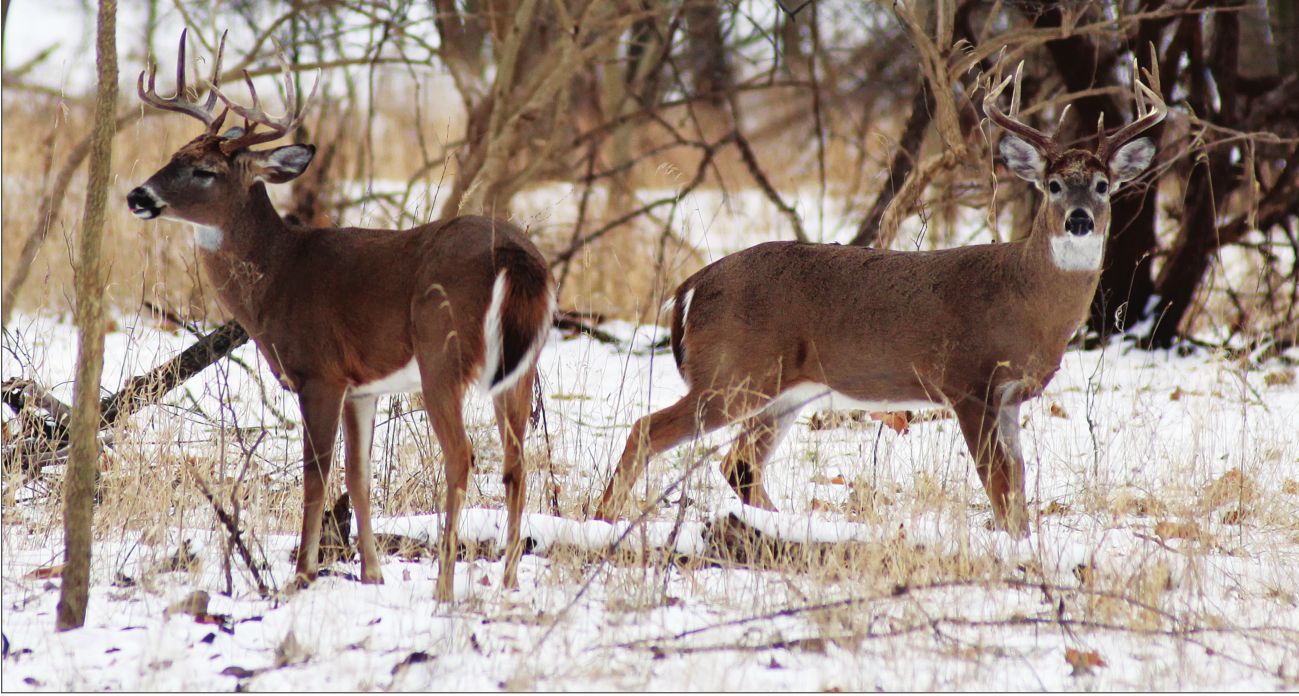
Driving his pickup up a gravel road toward a built-in-a-weekend cabin on a 160-acre piece of land he calls a farm, Jack Robertson spots a pair of does munching on wheat that, along with oats and clover, is the only crop this place produces. That’s by design. He has tried soybeans and corn, but neither has taken in this hilly Pike County terrain that would give a combine fits. None of it is for human consumption.
The does bound off as Robertson approaches.
Deer are what Robertson raises, or tries to raise, here. Since 1988, he has owned this place called Bucktrail Farm along with two partners, but the landowners remain more interlopers than residents. The cabin has neither indoor plumbing nor electricity, which is by choice in an area 70 miles west of Springfield where lodges with Jacuzzis beckon professional athletes, businessmen of all stripes and, of course, Ted Nugent.
At 4 p.m., Robertson, who owns a lawn-care business in Springfield, settles into a ground-level blind a short drive from the cabin, hangs his bow on a nearby hook and makes himself comfortable on a cheap plastic chair that affords a full view of an oat field bordered on either side by woods.
A half-century ago, anyone who bagged a deer in Illinois was either incredibly lucky or Daniel Boone reincarnated.
Throughout the nation, deer had been hunted to near extinction by the turn of the 20th century. In Illinois, conservation efforts began in 1853, when the General Assembly banned deer hunting between January and July in 16 counties, including Sangamon. Twenty years later, the ban expanded to include all counties in the state. But it wasn’t enough to save a species that had long been treated as disposable.
“Immense numbers of deer are killed every year by the hunters, who take them for the hams and skins alone, throwing away the rest of the carcase,” wrote A.D. Jones in an 1838 treatise on life on the frontier that was then Illinois.
Considered a delicacy, venison was sold on the open market during the 19th century, and no Victorian cookbook was complete without recipes for deer meat.
“What is termed a venison fry consists of the muzzle, the heart, liver, skirts, melt and – what I must here designate the delicacies; it forms altogether a dish which I, for one, should never have a desire to partake of; but as most people’s taste in this case seems to differ from mine, I must give rules how to cook it,” wrote Charles Elme Francatelli in The Cook’s Guide and Housekeeper’s & Butler’s Assistant published in 1857, who goes on to describe a dish that also includes a deer’s “etceteras” that should be sliced before frying. “Currant jelly may be served separately.”
With recipes like that to inspire them, America’s cooks kept hunters in business, and what conservation laws did exist were easily circumvented by crossing borders into states with less-restrictive rules. By the time Theodore Roosevelt, one of America’s most avid hunters, moved into the White House, fewer than 500,000 deer remained in the United States, according to the best estimates. That’s considerably smaller than the herd in Illinois today.
The feds took action in 1900 by approving the Lacey Act, still in effect, which prohibits the interstate trafficking of poached wildlife, including deer. The following year, Illinois banned deer hunting entirely, says Paul Shelton, forest wildlife program manager for the Illinois Department of Natural Resources. The moratorium was supposed to last five years.
“I think they thought that deer are so prolific, if we just protect them for a brief period of time, the numbers will jump back up and everything will be cool,” Shelton says.
But the deer population didn’t bounce back. By the 1930s, the United States Forest Service and the Illinois Department of Conservation, precursor
to the state Department of Natural Resources, were releasing deer into
the wilds of southern Illinois from game farms, including one in
Michigan. By the 1940s, the repopulation effort was in full swing, with a
state game preserve on an island in Horseshoe Lake near St. Louis
serving as a main source.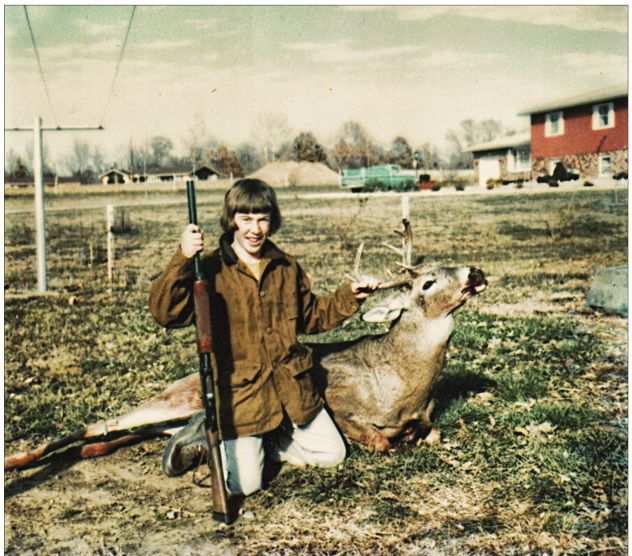
Although
deer were scarce in most of Illinois, that wasn’t true at Horseshoe
Lake or an area near the Rock River in northern Illinois, where
biologists suspected that captive deer had either escaped or been set
loose from pens owned by two men, one a judge. No one knows where the
judge got his deer, according to a 1954 paper on deer populations
published by the state. The other man started raising deer in the late
19th century after purchasing a doe fawn from a hotel keeper in
Wisconsin, then obtaining a buck from the judge. His deer scattered in
1903, when trees felled by a tornado destroyed pens, according to the
state report.
Despite
their rarity, problems with deer were becoming apparent by the late
1940s. Between 1948 and 1951, 178 deer in Illinois managed to get
themselves killed by crossing roads at the wrong time. Prompted by
complaints from farmers whose crops were getting eaten, the state in
1942 started trapping nuisance deer in areas where they had gained a
toehold. Trapping didn’t dent herds at Rock River or Horseshoe Island,
where the food supply was decimated despite 439 head that were trapped
during the 1940s and 1950s. In 1950, eight dead deer were found on the
island. Six of the carcasses were too decomposed to reach conclusions,
but one had died of malnutrition and the other of old age.
Trapping,
the state concluded, was both costly and ineffective in areas where the
deer population had recovered. Repellent sprayed on crops did no good.
“It
would seem that, after the population reaches a certain point, a wise
use policy… would involve some kind of deer cropping system,” wrote
Lysle R. Pietsch in the 1954 state report, who avoided the word “kill”
and suggested that bows and shotguns be allowed but not rifles out of
concern for safety.
Three
years later, in 1957, deer hunting resumed in 33 Illinois counties,
with 1,955 deer, including 220 felled by bow-and-arrow, were killed.
More than a half-century later, as many as 200,000 deer are killed in
Illinois each year.
A buffet table for deer
Robertson has barely settled into position when a pair of does appear, perhaps 250 yards distant and dead ahead.
“What,
we’re here for five minutes, maybe, and the deer are out,” he whispers.
“Pike County, baby!” Blissfully unaware – and completely safe, given
that Robertson’s range with a bow is 30 yards – the does graze, pulling
up tufts of oats and looking up every minute or two to survey their
surroundings, just in case. After 15 minutes, a yearling buck joins
them. They all look beautiful. Tasty. And stupid. Sundown, when hunting
by law must end, is still more than two hours away.
“Believe me, he’s not the only buck in these woods,” Robertson says. “By six o’clock, this should be really good.”
Five years ago, after a half-century of legal deer hunting in Illinois, the Illinois GeneralAssembly did what politicians are prone to do when confronted with a potentially controversial issue: It set up a task force.
 “Deer
overpopulation is rampant in some counties in Illinois, causing
accidents on our highways, increasing crop damage for Illinois farmers,
and making it easier for disease and starvation to afflict our deer
populations,” read a whereas at the top of the resolution that described
all sorts of other havoc and passed both chambers unanimously.
“Deer
overpopulation is rampant in some counties in Illinois, causing
accidents on our highways, increasing crop damage for Illinois farmers,
and making it easier for disease and starvation to afflict our deer
populations,” read a whereas at the top of the resolution that described
all sorts of other havoc and passed both chambers unanimously.
Even
a deer, which has a brain the size of a walnut, could predict where
this was headed. Sure enough, the state Joint Task Force On Deer
Population Control, which included members of the agricultural
committees of both chambers, a representative from the Illinois
Insurance Association, someone from the Illinois Farm Bureau and a
member of United Bowhunters of Illinois, recommended longer hunting
seasons and over-the-counter sale of deer tags, which had been
distributed via lottery. The recommendations were implemented, and the
number of deer killed each year in Illinois now number nearly 200,000.
The measure of success, the task force decreed, would be the number of
deer versus vehicle accidents, which had peaked in 2003 at 241 per
billion miles driven. The number of accidents, which had risen to more than
25,000 a year in 2003, fell to 18,039 last year, and the number of
accidents per vehicle mile traveled has dipped to levels not seen since
the 1990s, Shelton says.
“We
pretty much reached our goal,” says Shelton, who figures the deer
population has fallen by nearly 100,000 from its peak around eight years
ago and now stands at approximately 700,000, which works out to one
deer for every 18 people in the state.
Brad
Zara, owner of Zara Collision Center in Springfield, is seeing a
difference. His auto body repair shop has been taking in one
carversus-deer case a day. Zara says that’s low for a shop that usually
sees at least 50 such cases a year, with an average repair bill of about
$5,000. He guesses that the drought might have caused deer to go
looking for water instead of running across roads, but that’s just a
guess.
“Each year, we
always wonder what gets them moving and try to figure out their way of
thinking,” Zara says. “I don’t know if there’s any sound reasoning
behind things.”
When it comes to deer, Shelton says, specifics aren’t always important.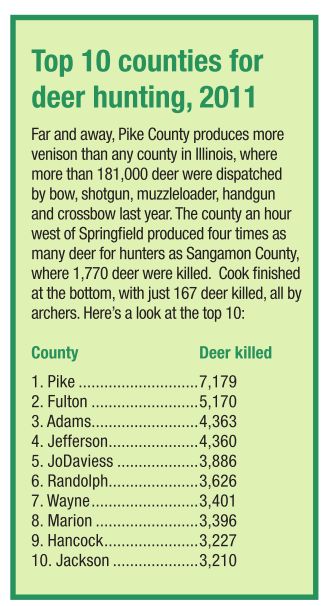
“The
fact of the matter is, we don’t have to know how many deer there are,”
Shelton says. “In many cases, we’re better off not even trying to
estimate an exact number. There’s no way of proving it. All we need to
know to manage deer here in Illinois is whether the herd is increasing,
decreasing or stable. All we have to know is, are people satisfied with
the existing level of deer? If people have their fill of deer and it’s
still increasing, you’re in trouble.”
Biologists
agree there are likely more deer in the Land of Lincoln today than when
the Pilgrims landed. Deer, Shelton explains, are creatures of the edge
that thrive in places where forest meets field, and farmers have created
a lot of edges in Illinois.
“Things
have never been better for our deer population,” Shelton says.
“Illinois is like a buffet table for deer. Quite frankly, Illinois will
support more deer than anybody in their right mind is going to accept.”
No
two people are likely to agree on how many deer is the right number,
and so deer management is as much about politics as biology. Hunters
will nearly always want more deer, farmers and motorists who just had a
buck fly through the windshield usually want fewer and the rest of us
are somewhere in between. Shelton, who has worked for the Department of
Natural Resources for two decades, easily recalls the ying and yang:
During the early 1990s, the General Assembly thought something should be
done about the rising deer population, but hunters protested when the
state allowed a larger harvest, and so the state backed off, which led
to more deer, which led to the General Assembly creating the
deer-population task force five years ago.
Hunters
can take just two antlered bucks per season, and deer are also rationed
during the firearms hunting season that lasts seven days, with another
seven days in 56 counties, including Sangamon, for deer without antlers –
the shooting will start on Nov. 18. But the bottom line is, there is no
real limit onthe number of deer Illinois hunters can kill. Archery season, which
began Oct. 1, doesn’t end until Jan. 20, and archers can take as many
does as they like during the season that lasts more than three months.
The best place to hunt
By
ones and twos, more deer show up in the oat field as the shadows
lengthen. Eventually, eight deer, including two bucks, are grazing,
still out of range, but perhaps not for long. While an eight-pointer
holds back, the yearling buck leads the way, meandering to within a football field of Robertson’s blind.
“They’re all kind of moving this way,” Robertson notes. “And we’ve still got a half-hour to go.”
The
number of hunters is dwindling in most states, but not in Illinois,
where about 270,000 licenses for hunting by bow and firearm were issued
last year.
“For the
past two years, it’s been stable,” Shelton says. “The long-term trend is
increasing. You have to look at the opportunity: Illinois is the land
of plenty when it comes to deer.”
Jack
Campbell, undersheriff at the Sangamon County sheriff’s office, is part
of the trend. He shot his first deer as a 12-yearold boy in 1976 by
trudging down to the Sangamon River, sitting on an upside-down bucket
next to a tree and just waiting. He did even better the following year
when he bagged a 10-point buck using the same technique. He saw nothing
at all for the next four years and gave up hunting, figuring that just
sitting around was boring. No longer.
“I’ve
sat from sunup to sundown in my deer stand,” Campbell says. “It’s kind
of a soothing effect. I like watching the squirrels and raccoons. It
just helps me de-stress for awhile. I think about work. I think about my
family.”
And, of
course, he thinks about deer. It has gotten to the point where Campbell
now owns a trail cam to photograph deer that pass through an infrared
beam, triggering the shutter.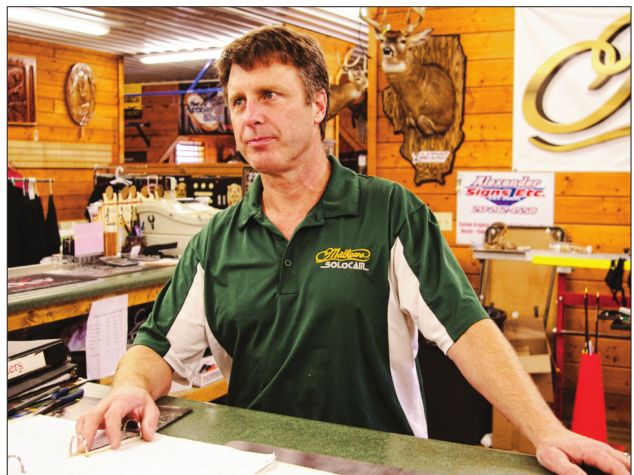
“It’s
like Christmas morning when you go get your memory card out of your
trail camera,” says Campbell, who does just fine hunting in Sangamon
County.
While deer hunting is better than ever in Illinois,
big bucks have grown difficult to bag with a shotgun, Campbell says,
because the monsters go into hiding with the advent of bow-hunting
season, which starts more than a month before firearms are allowed. And
so Campbell recently took up bow hunting. He bagged a buck in late
October, but isn’t finished for the year.
“I went out and got another tag,” Campbell says.
Campbell
tends to give away his venison and he’s not alone. In Pike County, Tom
Magro, whose family owns an Auburn meat-processing plant, collects
carcasses from hunters who either have all the venison they need or
don’t care for deer meat and distributes the donated venison to food
pantries. Last year, seven tons of Bambi burger fed the hungry through
the state program called Sportsmen Against Hunger, Magro says. To keep
things fair, all the venison, including tenderloins and steaks, are
ground up and distributed in the same counties – Pike, Sangamon and
Brown – where the deer were killed.
In
Pike County, deer hunting has turned into big business, with farmers
leasing land to out-of-staters willing to pay thousands of dollars for
exclusive hunting privileges. And that has caused some hard feelings
among locals who once hunted for free but can no longer expect to be
welcomed when they ask if it’s OK to set up a deer stand.
“Everybody’s
putting hunters up in their basements and spare rooms,” says Scott
Andress, owner of Pike County Archery, a 5,000-square-foot shop in
Pittsfield that’s been open for a dozen years. “Everybody’s figured out
how to make a dime out of it. The days of free hunting are over.”
While
deer afford a living for Andress, he says he thinks that his profits
would be bigger if Pike County hadn’t become internationally famous –
and exclusive – through stories in hunting magazines and features on
hunting television programs.
“I’d be making more money,” he says.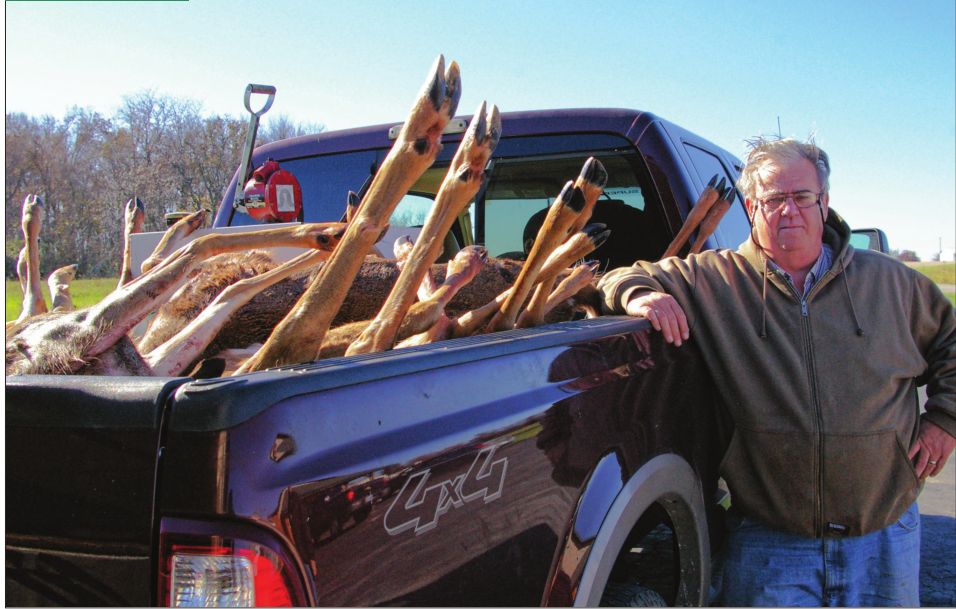
“There’d
be more people hunting, more people buying bows. There’s a tremendous
number of local guys who can’t hunt around here because they can’t
afford it.”
Despite
more than a decade in the international hunting spotlight, Pike County
still leads the state in the number of deer killed each year. Andress
doesn’t think there are as many big bucks as there once were, but two-
and three-year-old bucks are still common and big, he says.
“This is probably the only place in the United States that can produce this level of deer,” Andress says.
Shelton chuckles at the notion that there are no big bucks left in Pike County.
“They
have said that since 1957,” Shelton says. “If you look at the age
structure of our harvest – how many of the deer we’re taking are young –
the age structure that is coming out of those counties over there is as
good as it ever was. The best season we’ve ever seen was always in the
past – that’s human nature.”
Someone
has to deal with all the venison and Magro is that person. He started
out in a garage in 1989, when he processed 14 deer. He processed 30 the
next year. Now, the family’s meat-processing plant goes full-tilt deer
each autumn, ceasing the production of beef and pork when the rut
begins. Last year, the plant, which employs about a dozen people, made
1,100 deer ready to eat. It’s a six-figure business, considering basic
processing costs $129 for a buck, $119 for a doe and $89 for a fawn,
with sausage costing extra.
“When the trigger gets pulled or the arrow flies, that’s when the fun’s over,” Magro says.
The
buck is in the killing zone. With minutes of daylight left, the
eightpointer has sauntered the length of the oat field and now stands
within 50 feet of Robertson, who has passed up shots on the yearling
buck and two does who preceded this beast, wandering down the field to
the blind.
The
other deer were dumb, ambling past while the wind blew north, carrying
Robertson’s scent right to them. This buck, however, halts as he nears
the blind. Something is different than it was when he last came through
here, and he doesn’t stick around to find out what it is. He reaches the
treeline in a blink and a few bounds. Today was not his day, and that
was the choice of Robertson, who never reached for his bow.
“He was just a little too small,” the archer says.
Contact Bruce Rushton at [email protected].


