
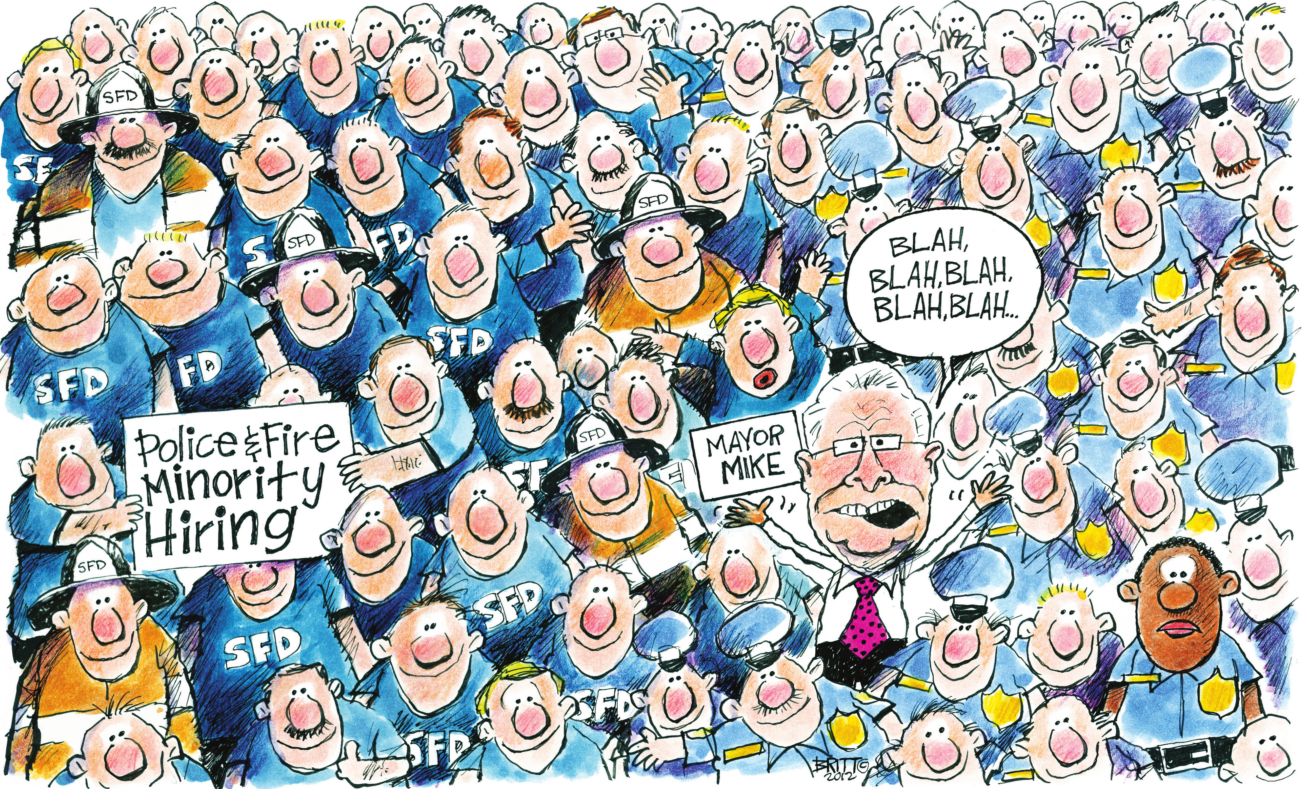
Diversity in city police and fire departments all show, no dough
GOVERNMENT | Bruce Rushton
For years, Springfield politicians have talked the talk: We need more minorities in the police and fire departments.
The numbers are undeniably dismal. More than 96 percent of firefighters are white; fewer than 8 percent of police officers are racial minorities in a city where more than 20 percent of the population is a color other than white.
Walking the walk, well, that never seems to happen. Efforts to increase minority hiring have ranged from nonexistent to laughable.
A dozen years ago, then Mayor Karen Hasara announced a goal of hiring minorities until 15 percent of police and firefighters were people of color by 2005. The city didn’t come close. Former police chief Ralph Caldwell told the city council in 2007 that the way the city ranks job candidates based on test scores will never result in adequate minority representation on the police force, but the city still grades candidates the same way five years later.
Former mayor Tim Davlin, Caldwell’s boss, retained a consultant to recruit minority job candidates for the police and fire departments even though the hired gun lived in Milwaukee, nearly 300 miles from the capital city. Chris
Miller, the minority recruiter hired by Davlin, achieved success by declaring it.
“The infrastructure that we have in place is great,” Miller told the State Journal-Register in 2009. “It’s hard to argue with the success of the efforts.”
Forgive us for quibbling. Three years after Miller said it’s difficult to argue with success, the percentage of police officers who are African-American stands at 5 percent, less than a half-percent higher than in 2009. Less than 2 percent of the city’s firefighters are black. Despite the alleged success of Miller’s recruiting efforts, the city no longer employs a minority recruiter for the police and fire departments.
Mayor Mike Houston is the city’s latest-andgreatest talker. During his campaign, he visited east side churches and made a big deal about diversity. But he didn’t mention minorities during his April 18 “state of the city” address, when he took stock of his first year in office, talking about city finances and grocery stores and building-code enforcement and schemes to combine the city’s vehicle fleet into a single garage.
“It’s almost like it’s the rhetoric of a politi cian on the campaign trail – I’ll say what I need to get elected and after I get elected, the hell with you,” says Ward 2 Ald. Gail Simpson. “That’s harsh. But that’s how I feel.”
The mayor gives a testy response. “You’re talking about someone who’s been on the city council for five years,” Houston says. “What concrete suggestions does she have to increase the minority numbers in the police and fire department? It is easy to criticize. The question is, what is the solution? I’m not hearing the solution.”
Good luck getting a solution, or even a proposal, from Houston.
“We certainly are trying,” Houston said.
“One of the things I think we’ll have to do is change some civil-service rules.”
Just what rules would be changed and how, Houston can’t, or won’t, say, although he hints that he can do it on his own.
“I’m not sure this is something that would have to go to the city council,” the mayor says.
He won’t say what “this” is. “We haven’t fleshed this out yet,” Houston says.
Why not?
“There are a number of things that are important to me in the course of this term,” says Houston, who said during the campaign that he planned to be a one-term mayor. “They are not going to happen overnight.”
That’s for sure.
Talk, talk and more talkLast August, without using the “q” word itself, Houston, who was mayor from 1979 to 1987 before winning a third term last year, called for quotas in announcing a round of hiring for the police department.
“My goal is to have both a police and fire department that is reflective of the community,” Houston told Illinois Times four months after the election. “In my mind, the way you’re going to make that happen is 25 percent of our hires should be minorities until we have a representation that reflects the community.”
Four months later, the city hired 21 firefighters. Nineteen were white, one was black and a Hispanic who was hired along with the others has already left the department.
The city hires largely on the basis of how job candidates perform in written and oral examinations. Applicants are grouped together based on test scores, and the city must exhaust the top-finishing group before moving down to the group that finished second best.
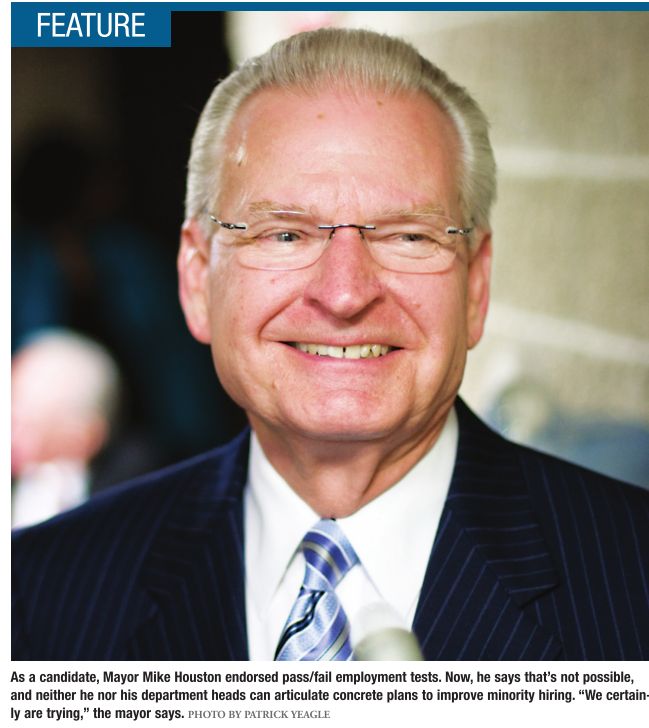
It’s analogous to assigning letter grades to applicants, with A students getting first crack at jobs before B students can be considered. As a candidate, Houston said that hiring tests should be pass/fail, which would increase the size of the eligibility pool and the number of minorities within it. But tests are still graded more than a year after Houston took office, and the mayor now says the city can’t use pass/fail exams.
“What I’ve been told by our corporation counsel is, we cannot do that,” said Houston, who couldn’t provide any further details. “I can’t give you a specific reason, other than they found no authorization in the statutes to be able to do that.”
Corporation counsel Mark Cullen said that a law that passed during the most recent legislative session doesn’t allow pass/fail tests when hiring firefighters.
“I don’t think that they (municipalities) can at this point,” Cullen said. “It (the new law) mandates a whole different type of process in establishing eligibility lists.”
Not true, according to the bill’s sponsor, the president of the Associated Firefighters of Illinois and an attorney for the Illinois Fire Chiefs Association who helped draft the bill that’s now awaiting Gov. Pat Quinn’s signature to become law.
State Rep. Lisa Dugan, D-Kankakee, said that she was only codifying what was already required by the state when she sponsored bills last year and this year that established minimum standards for hiring firefighters. Under the law that passed last year, candidates for firefighting positions must achieve at least the average test score, plus 10 percent, to be hired. That requirement was replaced this past legislative session when the General Assembly unanimously passed a bill that says applicants for firefighting positions must rank above the median score to be hired.
“Half of the people would qualify and move on and half would not pass,” says Pat Devaney, president of the Associated Firefighters of Illinois, which pushed for uniform minimum standards to replace inconsistent ones contained in three different statutes.
Karl Ottosen, attorney for the Illinois Fire Chiefs Association, allows that it sounds like pass/fail, exactly what Cullen and Houston say the state has banned.
“But that’s not what it’s called,” says lackluster minority hiring records, including several that have higher percentages of minorities than departments in Springfield.
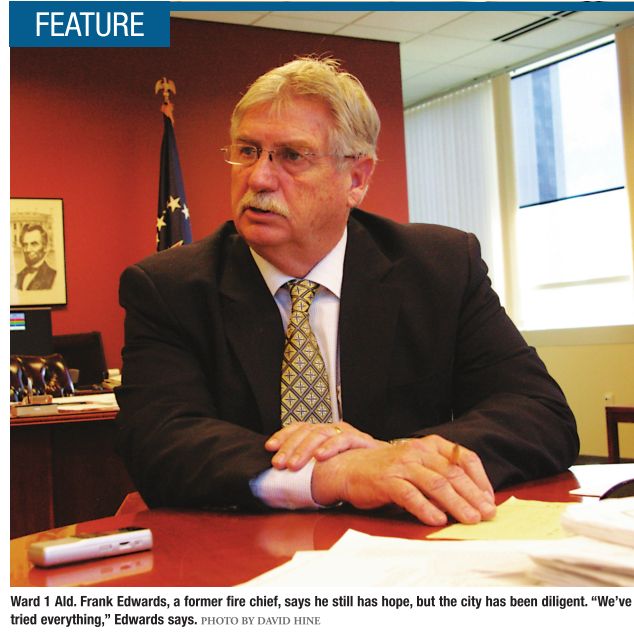
In New York, the federal government in 2009 won a lawsuit filed against the city because 3 percent of the Big Apple’s firefighters were black, 4.5 percent were Hispanic and written tests given to job applicants resulted in few minority hires. In Maryland, the Department of Justice earlier this year began investigating the Baltimore County police and fire departments, which is often a prelude to litigation, to determine why 11 percent of police officers were black and 15.6 percent of firefighters were African-American in a county with a black workforce of 26 percent.
In Springfield, the local U.S. attorney isn’t ready to sue.
“If people want to resolve it without litigation, they surely can,” says U.S. attorney James Lewis, who was arrested three times in Mississippi during the 1960s, twice while he was picketing government buildings to demand voting rights for blacks and a third time when he joined blacks to go swimming in a state park. “Like any other citizen, I am concerned. If people in the community want to sit down around the table and discuss the measures that have been taken, what’s worked, what hasn‘t worked and what needs to be done, I would be happy to sit at that table with them and participate in that discussion.”
Litigation got results during the 1980s, when blacks sued Springfield under the feder al Voting Rights Act and the city was forced to install an aldermanic form of government to replace a commissioner system that had never seen a black person elected to city office. But a lawsuit against the city filed a dozen years ago by the National Association for the Advancement of Colored People, which argued that hiring exams for police officers and firefighters were biased against blacks, hasn’t helped.
In 2001, the year after the NAACP sued the city, four of the top 10 candidates on the hiring list for new police officers were black. The parties settled the case later that year, with the city agreeing to work toward increasing minority employment and the NAACP agreeing to help recruit job candidates. The 2001 decree expired last year with minority employment in the police and fire departments substantially the same as a decade ago.
Frank McNeil, former alderman and a plaintiff in the voting-rights lawsuit that changed Springfield’s form of government, said that he contacted the Department of Justice several years ago about minority employment in the city’s police department but never heard back. In any case, he said he doesn’t believe the answer lies in litigation. The mayor, he says, needs to turn rhetoric into action, and part of that is moving to pass/fail exams. There would be some outcry, McNeil said, but he noted that Houston while a candidate said that he would serve just one term.
“If he’s going to be a one-termer, he shouldn’t care,” McNeil said. “There’s more than talk that’s necessary now. There’s a need for some assertiveness on the part of the mayor.
“We need to change the situation in Springfield.”
Contact Bruce Rushton at [email protected]