FOOD | Julianne Glatz
I start anticipating them each year as winter melts into spring: Springfield’s farmers markets. It’s not just because of the local produce and products I can buy, although that’s a big part of it. It’s also about getting reacquainted with longtime vendors. And it always gladdens my heart to see new farmers and vendors who’ve decided to invest the considerable time, planning and lots of extremely hard work that it takes to become part of our local food system.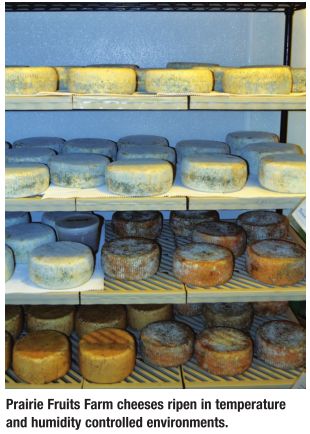
This year my anticipation of Springfield’s farmers markets has been in especially high gear. On May 26 there’ll be a new vendor to the Old State Capitol Farmers Market, one I’ve wished would come to Springfield for years: Prairie Fruits Farm in Urbana.
As the name suggests, Prairie Fruits Farm grows fruit. Owners (and former soil science professors) Leslie Cooperband and Wes Jarrell bought their farm in 2003 and planted more than 350 fruit trees and 600 berry plants in 2004. But fruit trees take years to come to fruition, and even berry bushes don’t produce immediately. These days PFF does sell some fruits, but what they’re best known for are the products of something else Jarrell and Cooperband started in 2004 – the three Nubian does and one buck that became the foundation of their dairy goat herd.
When I say that PFF’s artisanal cheeses are well known, I don’t mean to just a few central Illinois cheese-heads. PFF’s cheeses have been touted in top food magazines. They’re on the menus at some of America’s most renowned restaurants, especially in Chicago. They’re available in some of America’s best cheese shops; most recently including Murray’s in Manhattan, arguably the best – and certainly the most universally known – in the U.S.
I’ve been fortunate to have visited PFF, gotten to know Cooperband and Jarrell, and tasted their wonderful cheeses almost from the beginning.
When
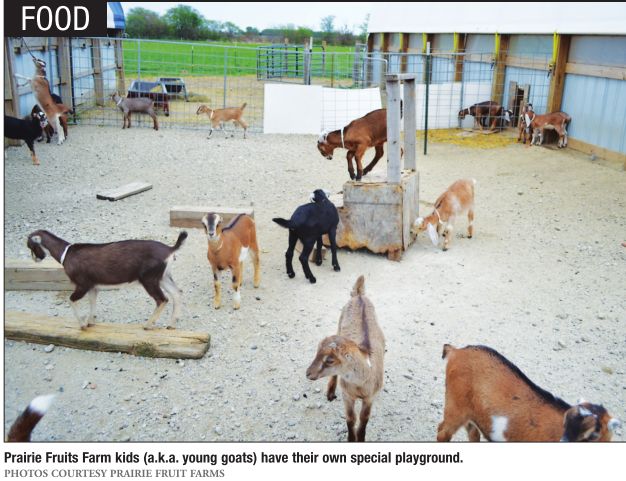
I first came to PFF in 2006, a multitude of baby goats rushed to a
fence as I stepped out of my car, their faces squashed together, bodies
almost obscure, in an impossible-to-resist pleading of “love me, pet me,
love me.” There was a barn, a pristine milking room, an even more
pristine room where the cheeses were made, and a temperature- and
humidity-controlled room for aging the cheeses.
Since
then, I’ve been back to PFF several times a year, mostly for
“Breakfasts on the Farm” and “Dinners on the Farm” events – both highly
recommended, although reservations for the dinners sell out faster than
tickets for rock reunion concerts. (For more information, visit PFF website, www.prairiefruits.com/ or my 3/25/10 column.)
Most
recently, I visited PFF to see how their operation had grown and
changed, and to talk to Cooperband, Jarrell and others involved in
making such extraordinary cheeses in such an extraordinarily special
place.
Calling PFF an operation seems clinical.
But there’s nothing clinical about PFF except the cleanliness in every aspect of their dairy/creamery.
PFF’s
goat herd now numbers 70. There are four curing rooms with different
humidity levels and temperatures to provide the perfect environment for
curing and/or aging the individual types of cheeses.
During
my recent visit, as the goats filed into the milking room, it was clear
they were completely content to be there, taking little notice as
Jarrell dipped their teats into a sterilizing solution, then hooked them
up to an apparatus that takes the milk directly into a stainless steel
holding vat. (The actual milking takes about 15 minutes.)
Each
goat is named, and the names aren’t perfunctory. Even facing just the
goats’ backsides and full udders, Jarrell and Cooperband knew them
individually, knew which give the most milk, and those with quirky
personalities.
Initially
Cooperband was solely responsible for crafting the cheeses, but as PFF
has grown, she’s enlisted help. These days Alison Olewnik and Nat
Bjerke-Harvey are in charge of the day-to-day cheese-making. Goats
produce milk (especially the best and most milk) only seasonally, and
that prime season is now, so the couple is working extraordinarily long
days, with only Sundays off. At PFF the milk is never more than two days
old before it begins its transformation into cheese; most begin the
process within four to eight hours.
A
few years ago, PFF began adding sheep’s milk cheeses to their
repertoire. A hundred gallons of sheep’s milk comes from an Amish farmer
twice a week. One of the reasons that goat’s milk and goat cheeses are
not as common as those from cows is that the yield is so much less.
Sheep yield even less milk per animal, but so many sheep and goat milk
cheeses are so exceptional, they’re worth the extra effort and cost.
Bjerke-Harvey
and Olewnik met while working at Pastoral, Chicago’s premier cheese
shop. “Eventually we became interested in how [cheeses] are made as
opposed to selling them,” Bjerke-Harvey says. The two attended an
intensive course at the Vermont Institute for Artisan Cheese before
moving to Champaign/Urbana and beginning their work at PFF.
“Alison
and Nat are some of the most intelligent people I’ve ever met, and I
would trust no other couple more to take on the responsibility of
crafting the delicious art that is PFF’s cheese,” says cheese expert and
Springfield native Patrick Knox. Knox was also working at Pastoral when
he met the couple. His primary job as the head buyer’s assistant
particularly emphasized domestic cheeses.
After
traveling throughout America in search of outstanding cheeses, Knox is
back in Springfield, working at the Sangamo Club and at my daughter’s
catering
company. I’ll let him describe some of the PFF cheeses that will be
available at the OSC Farmers Market every other Saturday, beginning May
26:
“Prairie Fruits
cheeses are particularly interesting. Every spring when the animals go
to pasture, I anticipate experiencing the flavor spectrum these cheeses
offer. The most versatile and recognizable cheese is their chèvre.
Available spring through fall, it’s notable for its fresh, grassy, and
occasional lemony flavors with a texture that reminds me of homemade ice
cream – firm enough to form into heavenly little spheres to enjoy on a
cheese plate, crumble into salads or use in an endless number of ways.”
“But man cannot survive on chèvre alone!
PFF
offers several bloomy rind goat and sheep’s milk cheeses (think Brie)
including two of my favorites. One is Angel Food – an unctuous white
disc that’s delicate as the name suggests. The interior should be
slightly runny like classic French Brie, but with more intense flavors.
Angel Food has an elegance that makes it a perfect introduction to goat
cheeses and for topping fresh country bread. Then there’s Little Bloom
on the Prairie. It has a similar style, but with more intense flavors.
Both pair well with fresh fruit, candied nuts, and a glass of something
sparkling, or a refreshing wheat beer.
“Then
there are PFF’s sheep’s milk cheeses, including Ewe’s Bloom and Black
Sheep – the latter being a bloomy rind ash-coated cheese, coated with
flavors reminiscent of fresh butter. For bigger and bolder flavors, try
one of PFF’s aged cheeses like Kaskaskia or Caprino Romano. Their
texture and sharp finish make them perfect to grate over pastas, salads
or even something as simple as scrambled eggs that will showcase their
rustic flavors.
“Try
your favorite cheeses throughout the season, and you’ll notice subtle
changes in flavor. Keeping an open mind will open up a larger world of
food and flavor!”
Contact Julianne Glatz at [email protected].
A
complete list and description of PFF cheeses is available on their
website (see above). Olewnik will be bringing PFF cheeses to the OSC
Farmers Market, and will be happy to answer questions about the cheeses,
how they’re made, and how best to enjoy them. Prairie Fruits Farm
Cheeses available on May 26 should include the following:
• Fresh Chèvre
• Sheep’s Milk Feta
• Several bloomy rind cheeses including Angel Food, Little Bloom on the Prairie, Ewe Bloom, Black Sheep and perhaps Black Goat
• Huckleberry Blue
• Roxanne
• Caprino Romano (a year-aged romano-style grating cheese made with raw goat’s milk)


