
To deal with this “psychological problem,” as Reynolds puts it, she urges making the downtown more bike-friendly and walkable while reducing the speed and volume of traffic. This includes “rolling out the carpet” for bicyclists by adding more bike racks and bike lanes, and making it easier for pedestrians to find their way around.
Reynolds advocates putting downtown streets on a “road diet,” which means eliminating lanes in busy streets and using the former lanes as angled parking spaces, turn lanes or other uses. This further encourages a change in perspective toward walking and biking, while also reducing traffic speeds.
“The speeds of your streets downtown are going to kill your retail,” Reynolds says. “If you cannot slow those streets down, it’s going to be incredibly difficult to thrive. … When people are busy trying to game the lights downtown, they’re not going to stop and shop.”
Shifting toward walking and cycling would also help attract young professionals, who statistically would prefer not to bother with car ownership, Reynolds says.
“When they’re given the choice between buying a car and buying a smartphone, they pick the smartphone,” Reynolds says. “They really do value a walkable, bike-able lifestyle.”
Reynolds also floated the idea of converting high-traffic streets like Fifth Street and Sixth Street from one-way to two-way, though Mayor Mike Houston expressed reservations about the idea, saying it may present a challenge for access to the underground parking garage beneath the Old State Capitol.
To deal with the crumbling asphalt on many city streets, Reynolds advocated pursuing more state and federal grants – especially those earmarked for public safety projects.
“The public space in between the curbs is failing at the moment,” Reynolds said. “I really would encourage you to think about your roads as public space the same way you think about your parks or your plazas or anywhere else. Those places have the power to activate your community, or they can be incredible barriers to all of your goals.”
Houston said the city already seeks several grants each year, and many require a substantial amount of matching funds from the city.
Jason Claunch, a market analyst from Dallas, Texas, said the uncertainty surrounding Springfield’s rail consolidation efforts is keeping some developers from moving forward.
“You have to address the uncertainty and manage around those uncertanties,” Claunch said. “You can’t put these opportunities on hold. You’ve got to find ways to manage around the uncertainties of the rail.”
Public spaces
Several of the SDAT members praised Springfield’s trees, benches, historical landmarks and other aspects of downtown’s public spaces.
 But Matt Raimi, an urban planner and founder of Raimi and Associates in Berkeley, Calif., said the public spaces in and around downtown need further development. He focused on increasing the opportunities for physical activities with more public spaces like parks, community gardens, an ice skating rink and bike or pedestrian paths within downtown.
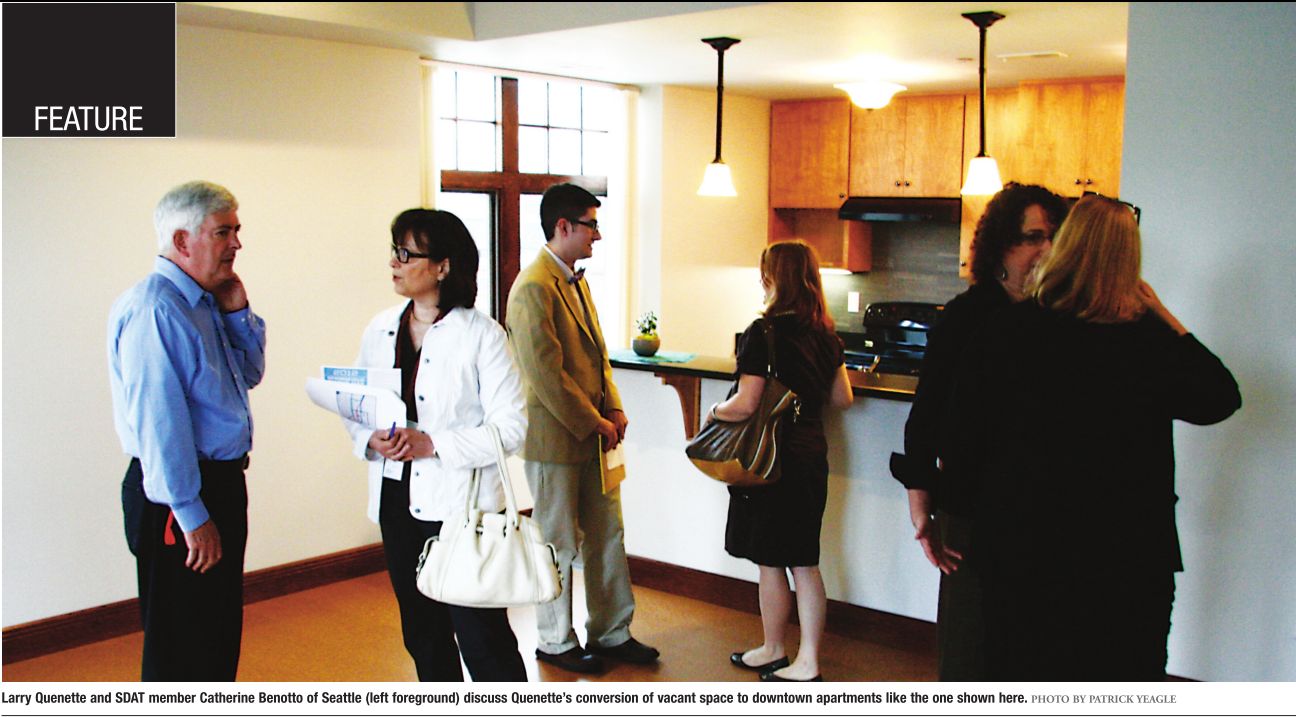
Catherine Benotto, an architect and member of the City of Seattle Planning Commission, says the benches that line Springfield’s downtown streets are a good start, but she advocates even more places to sit. One example is taking down the iron fence that surrounds the Old State Capitol to allow sitting along the raised stone ledge.
Benotto also said public spaces should be dressed up with art and even a bit of “whimsy” to add a cultural and fun touch to the downtown. She said no building facades should be blank, a situation she called “a total killer to the streetscape.” Empty lots downtown could be turned into “pocket parks” or repurposed by restaurants or street vendors as outdoor serving spaces, Benotto said.
John Shields, an architect and member of the board of directors of the Bostonian Society in Boston, called for a “Springfield Heritage Trail” to tie together the city’s downtown landmarks and said such a trail should include a tree canopy to provide shade.
Shields also called for a dedicated welcome center downtown to orient out-oftown visitors who arrive via Clear Lake Avenue from Interstate 55 or Interstate 72.
“This just makes sense, with Clear Lake being our entry and gateway into the city,” Shields said. “You can slip right into the welcome center and you can begin your journey to Springfield from that point.”
Springfield does have a welcome center at the Union Station Visitors Center & Park between Fifth and Sixth streets, but it borders Madison Avenue, a busy one-way street leading away from downtown.
Shields advocated making Clear Lake and other entry points to the city more attractive with more trees and landscape standards for businesses lining those streets.
“You really need to think about those entry points as where you’re setting your first impressions,” Shields said. “It is your front yard. You come down through miles and miles and miles of beautiful Illinois farmland, and then suddenly you turn off the highway and ‘My God….’ ”