
The district’s Instructional Leadership Team, composed of teachers from various schools, determines which skills are most needed at which schools, providing customized professional development district-wide. That includes topics like cultural awareness to help teachers related to students who may have different backgrounds.

“Any school district that is effective at all has very strong professional learning for teachers,” Crum says. “Basically, what we have to do is constantly adapt what we’re doing to meet the changing needs of the kids.”
The district’s efforts to improve education in Springfield extend into the physical realm, as well. Sherman says $90 million in building upgrades are in the works.
The changes will provide several existing schools with energyefficient
central heating and air, new lighting and other improvements, he says.
Two new schools will also be built to replace the current
Matheny-Withrow and Enos elementary schools.
Help for Lanphier In addition to the district-wide efforts, one of the district’s three high schools is undergoing intense, targeted changes through a $6 million federal grant aimed at getting the under-performing school back on track. Lanphier High School in Springfield’s north end performed well below the rest of the district and the state on standardized tests in 2011, with only 25 percent of students meeting or exceeding expectations on the PSAE last year. By comparison, 40 percent of students in the whole district passed the test, while 51 percent of students passed statewide.
The Lanphier
Transformational Plan, started in June 2011, allows the district to hire three new staff, including an administrator to oversee the plan, an analyst to make sense of student data, and a strategist to train teachers and update curriculum. The grant also pays for professional development courses and provides more pay for existing teachers who take on extra instructional roles in their departments.
Meanwhile, Lanphier students gain an additional hour and 15 minutes of teaching during the school day, more tutoring and an early-warning screening system to identify students needing extra help. The plan establishes a summer leadership academy for Lanphier staff, provides 215 new laptops for students and creates a series of online learning tools to bring struggling students up to speed.
“The main idea is just changing the culture behind the school,” says Hannah Jones, secretary to Lanphier’s transformational officer. “We’re shifting away from ‘This is the way it is and the way it’s going to be,’ to ‘We can do this. We can improve.’ We need to give these kids better opportunities than they currently have.”
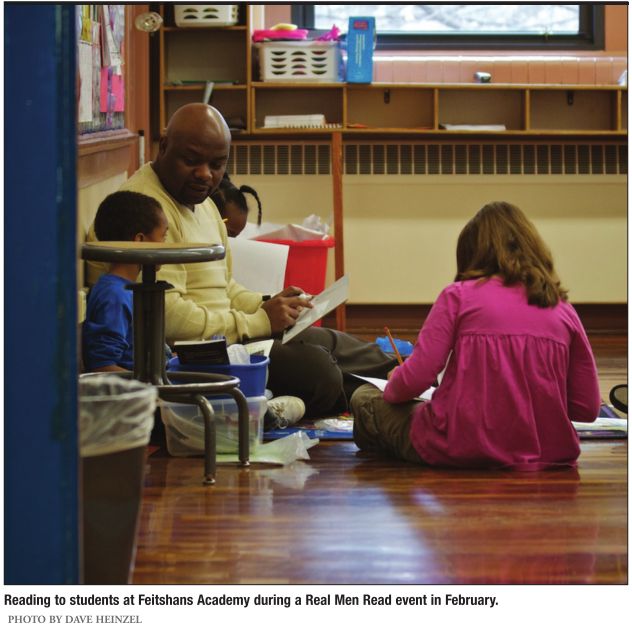
Lanphier also has a program that encourages community involvement in students’ academic lives. The school’s “Making the Grade” program invites volunteers to meet with students to review their report cards and encourage them.
Volunteer Barbara Collins of Springfield jokes that she first got involved at Lanphier because she had already raised her two kids and “harassing teenagers about their grades is something I know how to do.” Collins works as a mediator in child custody cases, and says she often sees children not doing well in school because of their life circumstances.
“Perfectly wonderful, intelligent teenagers can get lost at school because of other pressures in their lives,” Collins says. “They don’t necessarily know they can approach their teacher or another adult for help.”
Jones says several of the volunteers have taken the extra step of becoming mentors for Lanphier students.
“A lot of the students are saying they didn’t realize someone cared enough about them to come in and talk to them,” Jones says. “The question we get the most from students is ‘Are they coming back?’” And they are coming back. Volunteer Robin Daniels of Springfield says he plans to spend all day on March 22 at Lanphier talk ing with students. Daniels says he is involved in a similar program in Decatur, and this will be his third time at Lanphier.
“Maybe I can have an effect on one, two, maybe three kids, if not the whole group,” he says. “Maybe they would change and do something different with their lives. So many of these kids are growing up in households without their fathers, and they don’t have someone telling them what it means to be a man, to take care of your responsibilities like school and paying your bills.”
Answering the call When the 2008 report from the city’s
Education Liaison was published four years ago, it asked some pointed questions: “Do Springfield residents believe that excellent public education is critical to supporting a high quality of life for the entire community? Will Springfield expect more for its children, or is it satisfied with mediocre, unequal results?” The school district and the community at large seem to have answered those questions, accepting the challenge to improve the educational environment and experience for all students. While it remains to be seen how effective these changes will be over the long term, there is certainly no shortage of effort.
“We’re definitely making progress,” Milton says. “I’m very confident that we’re positioned to make more progress. With that said, we still have things we have to work on, to improve not only the achievement gap but the opportunity gap. … If we can invest in our young people now, we can reap the profit of them being successful in the future.”
Contact Patrick Yeagle at [email protected].