FOOD | Julianne Glatz
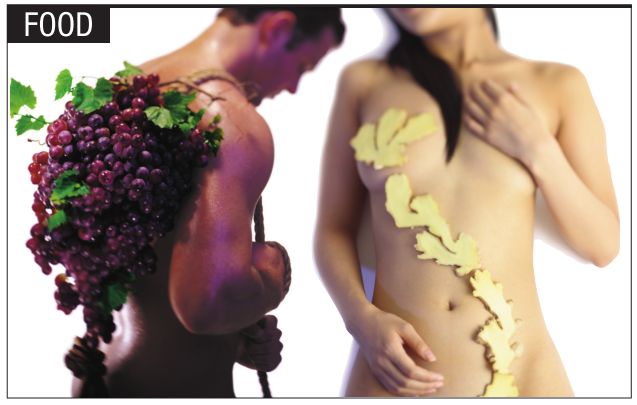
The association of food with love and making love is as old as, well, food and love themselves. From Marc Anthony feeding grapes to Cleopatra, to the Aztec Emperor Montezuma drinking 50 cups of chile-spiked chocolate each day to keep his 200 wives satisfied, to the 18th century Italian, Casanova, who consumed 50-plus oysters daily to both quench his desire for bivalves and fire up his love-making, the sensuous pleasures of loving and eating have always been entwined. After all, as grandmotherly chef and PBS cooking show host Lidia Bastianich says, “What else do you do with your mouth?” Certain foods have long been famed as aphrodisiacs, including those above. Though some scientific evidence substantiates their love-enhancing reputations (oysters are laden with zinc, essential for testosterone production; chocolate contains stimulating caffeine and cannabis-like fatty acids, etc.), some consumables were initially considered aphrodisiacs because they resembled a sexual organ.
Known as the Doctrine of Signatures or Law of Similarities, the theory, dating back to medieval times, says that eating something that looks like a human body part will aid or improve that part (think asparagus or fresh figs). Though science has proven the doctrine false, some foods can provide visual cues/stimulations. And, as Martha Hopkins and Randall Lockridge say in Intercourses, an Aphrodisiac Cookbook, “Explanation or no explanation, anyone who has ever fed a lover grapes knows that aphrodisiacs do exist. Anyone who has served an elaborate candlelit meal, painstakingly prepared with love, knows the potential power of food. We don’t need scientific proof to know that aphrodisiacs exist; we need only experience them for ourselves to know that they are, in fact, a very potent force at our disposal.”
College buddies Hopkins and Lockridge wrote Intercourses on a whim in 1996. “We were 25 and had nothing to lose,” Hopkins told me. The book became an unexpected, runaway success, selling over 225,000 copies.
It’s more than just a cookbook: The gorgeous photographs are sensuous but not seamy. There are recipes utilizing both obscure and well-known aphrodisiacs and massage oils, as well as resources and a usage guide. In 2007, the now-business partners revised Intercourses, retesting recipes, taking some out, and adding 70 more; the resultant book contains 50 percent new material.
But the most unique and enjoyable aspect of Intercourses – what makes it a fun and stimulating read for one-cook couples as well as those who cook together – are the testers’ testimonials. Hopkins’ and Lockridge’s brilliant idea was to give their recipes to couples across America not just to test their recipes, but also to record their romantic/aphrodisiacal experiences with them.
“This is a formula for sensuality as much as it is for dessert,” according to Bostonians Christa and Edwin about chocolate-dipped meringues with espresso cream.
A tomato-basil soup brought this response from John: “This luscious soup offered us everything we could ever want in a tasteful prelude to an amorous evening encounter: the wonderful smell of onions, garlic and basil wafting through our home as they simmered; the smooth, rich texture and warm layers of flavor cascading from lips to tongue to throats, then bellies. Finally the surprising effect of good French bread soaked through with velvety, herb-laden liquid, giving nourishing sustenance to a light, energizing meal.
Afterward: untold delights.”
Foods’ aphrodisiac properties may be more legend than science. But who cares? As NYC couple Karen and Rick report in Intercourses, “It seems…that the anticipation of an aphrodisiac meal is oftentimes aphrodisiac enough. My significant other and I couldn’t stop smiling and casting knowing glances at each other the whole time we were preparing the meal.”
Happy Valentine’s Day!
Contact Julianne Glatz at [email protected].


