FOOD | Julianne Glatz
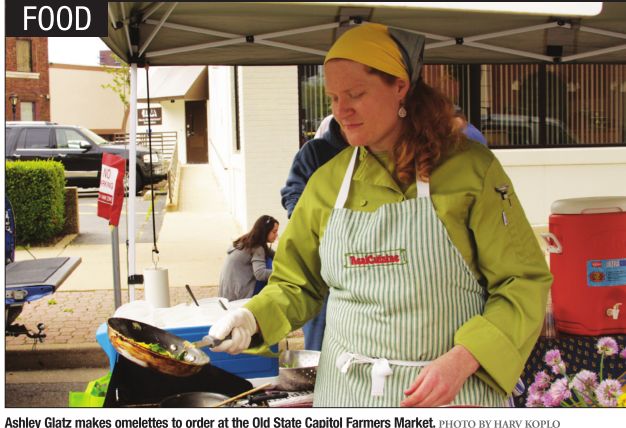
It’s time again to wrap up some of the things I wrote about during 2011. Though I usually do it chronologically, this time around I have to start with the overwhelming reader response to my Oct. 6 column, “It’s alive!” I wrote about my 15-year-old sourdough starter having been inadvertently thrown away by a friend, then discovering that my son had a jar of it in the back of his Boston fridge that had been untouched for at least four years. It seemed almost miraculous that after such a long time it could be brought back to life. I offered readers jars of the revived starter, instructions and recipes as a thank offering. Dozens of people responded, and soon I was building up huge amounts of the starter to be picked up at my daughter Ashley’s omelet stand at the Old State Capitol Farmers Market and emailing recipes and instructions.
It was gratifying to realize how many folks were interested in acquiring the starter. And it was even more gratifying to receive emails from several of them telling me about their successful breadmaking experiences using my sourdough starter.
It wasn’t problem-free,
however. Heavy rains drove my daughter to close early or forgo the
market altogether a couple of times when the starter should have been
available there. But the biggest snafu was when my laptop had a meltdown
– literally. Like the Wicked Witch of the West, it dissolved into
nothingness when I spilled a glass of milk on the keyboard. Fortunately,
even though the computer was kaput, the information it contained was
retrievable.
But I
worried – and still worry – that I might somehow have missed responding
to someone. So if there’s anyone to whom I didn’t reply – either with a
question or to request some starter, please accept my apologies and try
again.
My March 3
column, “Brooklyn fare,” concerned the grocery store and the restaurant
connected to it that’s in the same building in Brooklyn, N.Y., where my
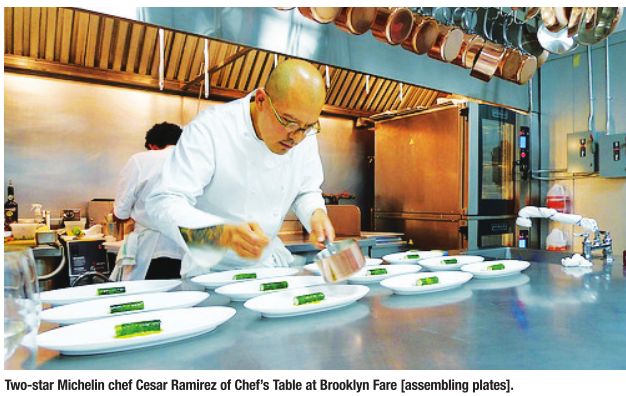
daughter, her husband and son live. The restaurant, The Chef’s Table at
Brooklyn Fare, had garnered two Michelin stars the previous fall – a
first in Brooklyn. The newest Michelin guide, published in the fall of
2011, bumped CTaBF up to three stars, which it says is “The highest
recognition in the culinary world.” Only 97 restaurants in the world
currently have three stars. There are only seven in all of NYC, and only
CTaBF in Brooklyn (which has no two-star establishments and only four
one-star). I was able to score a reservation last February, and had an
outstanding meal. But even though I’ll still exchange waves with the
chef and his staff as I walk past the Chef’s Table picture windows on my
way to the grocery store whenever I’m there, I doubt I’ll be making
reservations again anytime soon: the price for the prix fixe dining
experience has climbed into the stratosphere along with the additional
stars. At $185 per person it’s almost double what I paid last winter.
I’m
an unabashed proponent of local food systems and farmers markets and
write about them frequently. Last spring I attended Illinois Senate
hearings on what’s become known as the Cottage Food Bill.
The bill, which was signed into law by Gov. Quinn on Agriculture Day,
Aug. 16, at the Illinois State Fair, is a big step in the continuing
effort to support local food producers. It revises Illinois’ food safety
laws by allowing homemade, non-potentially hazardous baked items, jams
and jellies, fruit butters, dried herbs and dried tea blends to be sold
at farmers markets as long as they are properly labeled as being
homemade. “Cottage food operations” also must be registered, the
person(s) preparing and selling the items must have a valid Illinois
Food Service Sanitation Manager Certificate, and the annual gross sales
receipts cannot exceed $25,000. The bill went into effect on Jan. 1.
 The
“Fascinating anthropology of Midwestern food” (April 14) concerned the
Greater Midwest Foodways Alliance (a Chicago-based organization that
explores the foods and food customs of the Midwest) and the symposium it
sponsored on Midwest food during the Great Depression. Various speakers
presented a range of topics. Some were funny: what ISU college students
ate – and cooked – during the Depression; and attempts to create
spectacular dishes on a miniscule budget, such as a “crown roast” of
frankfurters, filled with sauerkraut, a picture of which is on the GMFA
website. Others were heart-rending – talks on how the Depression
affected black communities, and how farm economies collapsed – or
heart-warming, such as the establishment of community canning centers by
the Ball Corporation. The last GMFA 2011 event was an exquisitely
elaborate four-course high tea “with Bertha Palmer.”
The
“Fascinating anthropology of Midwestern food” (April 14) concerned the
Greater Midwest Foodways Alliance (a Chicago-based organization that
explores the foods and food customs of the Midwest) and the symposium it
sponsored on Midwest food during the Great Depression. Various speakers
presented a range of topics. Some were funny: what ISU college students
ate – and cooked – during the Depression; and attempts to create
spectacular dishes on a miniscule budget, such as a “crown roast” of
frankfurters, filled with sauerkraut, a picture of which is on the GMFA
website. Others were heart-rending – talks on how the Depression
affected black communities, and how farm economies collapsed – or
heart-warming, such as the establishment of community canning centers by
the Ball Corporation. The last GMFA 2011 event was an exquisitely
elaborate four-course high tea “with Bertha Palmer.”
“Feeding
the famous” (June 2) was about my daughter Ashley’s job with a Chicago
caterer; most of her assignments were being in charge of backstage meals
at some of Chicago’s hottest performing spots for top celebrities. But
Ashley’s goal was to eventually return to Springfield and open her own
catering business. In June she was making omelets at the Old State
Capitol Farmers Market, using the kitchen of a local restaurant to do
her prep while searching for a permanent location to open a full-scale
catering business. It must have been serendipity that she found what
she’d been looking for – and more – in a building at the corner of 15th
and Ash that’s owned by the Humphrey family, who I
wrote about on July 7, “Inside Humphrey’s Market.” The building had
previously housed a bakery and had a fully equipped kitchen. It also has
a spacious dining room, an extra that Ashley hadn’t planned on. But
she’s used it several times for private parties since moving into the
space, and plans are afoot to offer Sunday brunches for the general
public there in the near future.
“Nourishing the nation, one
tray at a time” (Oct. 27) was about a Farm to School Summit that took
place on Nov. 5, sponsored by the Springfield Area Local Food Task
Force. The Farm to School movement is dedicated to increasing the amount
of local foods in school lunches and breakfasts, as well as teaching
schoolchildren about fresh foods and where food comes from. The summit
was well attended by a mix of educators, school administrators, farmers,
parents, and others. But although the event was a great success, it was
clear to everyone that it was part of a process – a springboard to
further action. There was also a surprise for me: Julia Govis, the state
leader of Illinois’ Farm to School Network, told me that my article had
be posted on the USDA’s website!
Having begun with a later-in-the-year column, I’ll end with one of my earliest.
“Becoming
Nana” (Jan. 13), about my grandson Robbie’s adoption and that my
daughter was nursing him went “viral” on the Internet, showing up on
adoption and breastfeeding websites, as well as getting passed from
person to person. Robbie turned one on Thanksgiving Day. He started
walking at 10 months, and is forming his first words. Robbie is the
merriest soul I’ve ever known, even a bit of a flirt, with a twinkle in
his eye; a constant delight.